




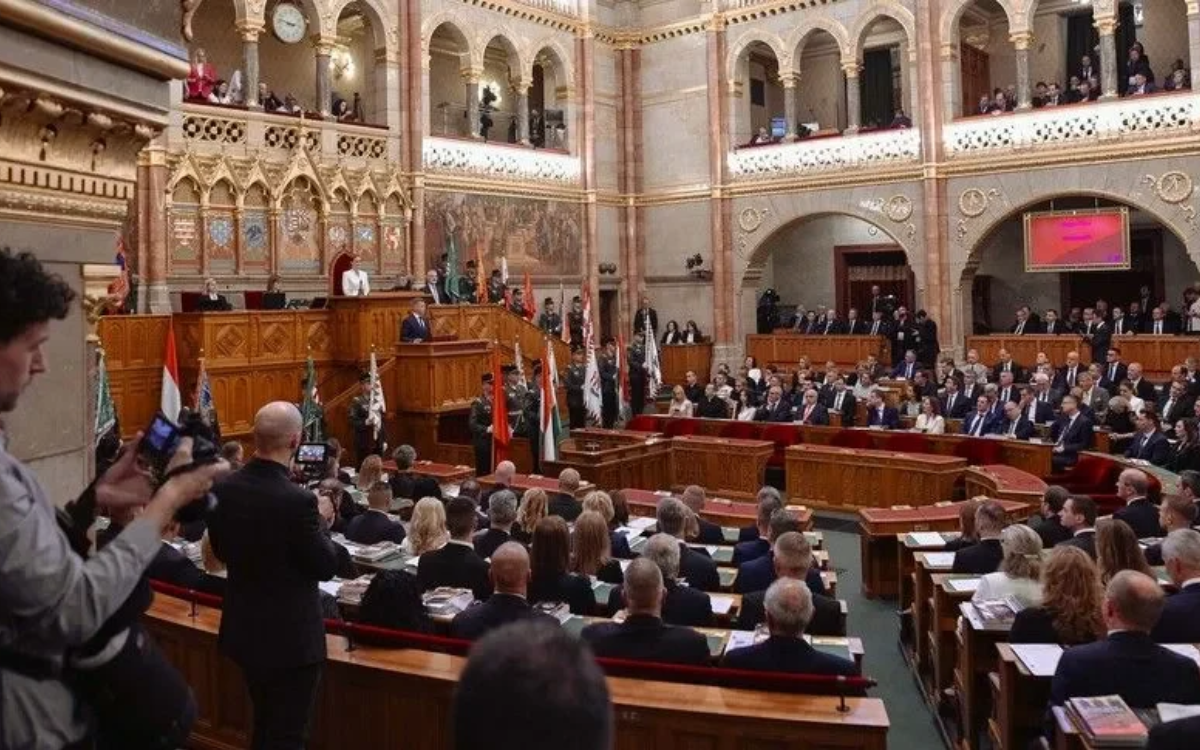
Hungary’s parliament passed a law on Tuesday aimed at preventing conflicts of interest in sports, banning politicians and senior government officials from heading national sports federations and major clubs, as well as serving on their governing boards.
A total of 140 MPs voted in favor of the legislation, 49 opposed it, and there were no abstentions, the Hungarian state news agency MTI reported.
One particularly significant provision is that the ban will remain in force not only while individuals hold political or government positions, but also for a full four years after they leave office.
The ruling Tisza Party and the opposition Our Homeland Movement voted in favor of the law, while MPs from Fidesz and the Christian Democratic People’s Party (KDNP) opposed it.
Who will no longer be allowed to run clubs and federations?
According to Hungarian media reports, the new legislation applies to:
- Government ministers;
- Members of the Hungarian Parliament;
- Members of the European Parliament;
- State secretaries and their deputies;
- Political party leaders;
- Government and ministerial commissioners;
- Presidents of regional assemblies;
- Executives of companies majority-owned by the state.
These individuals will be prohibited from serving as presidents, vice-presidents or members of the governing bodies of national sports federations and sports clubs with more than 500 registered athletes.
The ban also covers senior positions in sports companies, sports schools, foundations dedicated to youth development, and companies established by sports clubs and federations.
In other words, resigning from a political position will not be enough to allow someone to immediately take over the management of a sports club.
They will have to wait four years.
Political connections must not determine sports funding
Hungarian Prime Minister Péter Magyar announced plans to introduce such legislation in September, arguing that Hungarian sports had become an area of political influence in recent years.
According to him, the four-year ban is necessary to prevent sports organizations from becoming safe havens for politicians after they leave government positions.
Attila Csanó-Kiss, the state secretary responsible for sports, explained that the aim of the legislation was to separate sports from day-to-day politics and increase transparency in the financing of sports organizations.
The government’s intention is to ensure that political connections no longer determine professional management, the allocation of public money for sports or the amount of financial assistance received by individual clubs and federations.
Changes expected at Hungary’s biggest clubs
The legislation, which Hungarian media have also dubbed the “Lex Kubatov,” will directly affect the management of several of the country’s largest and most successful sports organizations.
Among them is Ferencváros, headed by Gábor Kubatov, a senior Fidesz official and former MP; MTK, led by European Parliament member Tamás Deutsch; and Honvéd, whose president is Péter Szijjártó, Hungary’s former foreign minister.
Changes are also expected in several national sports federations, including those governing fencing and chess.
Some officials did not even wait for the legislation to be passed. Gábor Schmidt, president of the Hungarian Canoe Federation and a former deputy state secretary, had already resigned after spending ten years at the helm of the organization.
However, the provisions on incompatible political and sports positions do not apply to organizations with a special public-law status, such as the Hungarian Olympic Committee.
Ban also applies to those who misuse public funds
The law also stipulates that individuals who previously headed organizations found to have committed certain serious irregularities in the use of state subsidies cannot hold senior positions in sports.
This applies to cases in which false information was submitted when applying for public funding or money was spent for purposes other than those intended, resulting in the state withdrawing financial assistance or terminating the relevant agreement.
This provision is not limited to politicians.
Ferencváros asks president not to sign the law
The legislation has also met with opposition from part of the Hungarian sporting community.
Ferencváros president Gábor Kubatov, who was elected to a new four-year term at the end of October, has asked Hungarian President András Baka not to sign the law and to refer it to the Constitutional Court for a review of its constitutionality.
Kubatov believes the new regulations undermine freedom of association and restrict the right of members of sports organizations to independently elect their leadership.
Prime Minister Péter Magyar’s government, on the other hand, maintains that freeing sports organizations from political influence is one of the fundamental objectives of the new legislation.
MORE TOPICS:
Source: Sport klub / N1 Foto: Anadolu Ajansi
 Add Serbian Times as your Google source