




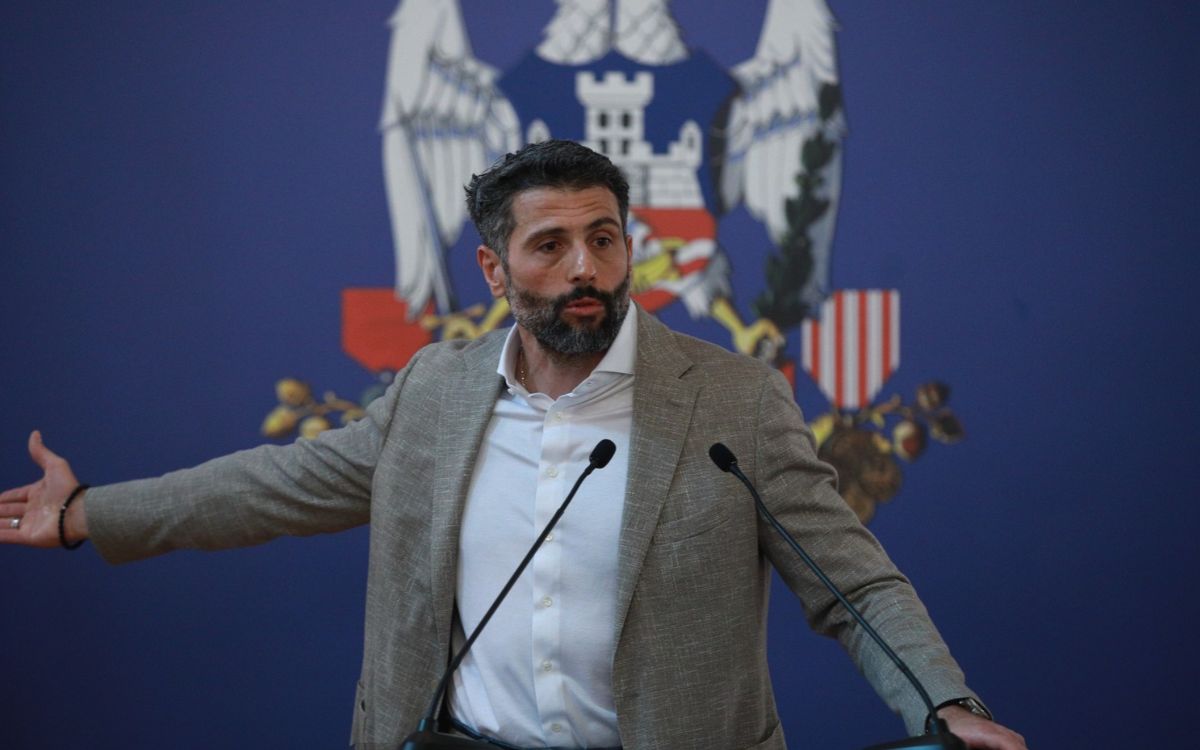
An extraordinary review of the property and income disclosures of Belgrade Mayor Aleksandar Šapić, launched by the Anti-Corruption Agency back in 2018, was completed in January this year with the filing of a criminal complaint with the Higher Public Prosecutor’s Office in Belgrade.
“During the extraordinary review procedure, the Agency obtained information from public authorities and legal entities holding data relevant to the checks. After collecting and analyzing the documentation, the conditions were met for submitting a report/complaint, which the Agency filed with the Higher Public Prosecutor’s Office in Belgrade,” the Agency said in a response, according to BIRN.
The Agency did not specify what irregularities had been identified or which assets and income the complaint concerned.
It said the proceedings before the Prosecutor’s Office were ongoing and that the case had been classified as confidential. Due to the secrecy designation, the Higher Public Prosecutor’s Office also declined to provide details, meaning the current status of the case remains unknown.
Šapić’s property came under public scrutiny in early 2023, when BIRN and the weekly magazine Vreme published an investigation into his villa in Trieste, Italy.
According to the purchase agreement and information from the Italian land registry obtained by BIRN and Vreme, Šapić bought the property in May 2018, while serving as president of the New Belgrade municipality, for 820,000 euros. The building covers almost 400 square meters and includes 13 rooms, a garage, part of a forest and an access road.
However, in the property disclosure he submitted to the Agency in January 2019, the newly acquired real estate was listed as an apartment measuring 150 square meters.
After the article was published, Šapić denied attempting to conceal his assets, claiming that he had reported the property to the Agency and submitted the purchase agreement.
Šapić later said that his secretary had filled out the property and income disclosure form, which described the property as a 150-square-meter apartment rather than a 400-square-meter villa, and that he had simply signed it.
Šapić Sued BIRN Over Two Investigations
In March 2023, Šapić filed two lawsuits against BIRN, seeking a total of 12 million dinars in damages. He claimed that his honor and reputation had been harmed and that the articles about his property had caused him emotional distress.
In his lawsuit, he alleged that false information had been published and maintained that he had duly reported the property purchase to the Anti-Corruption Agency and provided it with the purchase agreement.
He also sued BIRN over its investigation into the disputed legalization of a building in Bežanijska Kosa. Šapić challenged allegations of illegal extensions and irregularities in the legalization process.
BIRN described the lawsuits as SLAPP suits — strategic lawsuits against public participation — which expose journalists and media outlets to legal and financial pressure for reporting on matters of public interest.
Court proceedings in these cases continued into 2026.
No Resolution in a Series of Cases Before the Higher Public Prosecutor’s Office
The Higher Public Prosecutor’s Office, headed by Chief Public Prosecutor Nenad Stefanović, is also handling a number of other high-profile cases covered by the media, including the demolition in Savamala and the clashes in Banjska, Kosovo.
None of these cases has yet reached a conclusion.
The Commission of the Supreme Public Prosecutor’s Office recently published a report on its oversight of the Belgrade Higher Public Prosecutor’s Office, listing numerous irregularities in cases involving the “sound cannon,” searches of the Faculty of Philosophy building and the University of Belgrade Rectorate, pardons granted by former President Aleksandar Vučić, the Vista Rica fund, incidents in which students were hit by cars on Jurija Gagarina Street in New Belgrade and outside the Faculty of Dramatic Arts, as well as proceedings concerning the United States’ extradition requests for Cui Guanghai and John Miller.
Among other things, the Commission proposed launching disciplinary proceedings against Stefanović over his handling of certain cases. It also stated that its “final conclusion” was that Stefanović had established a “parallel prosecutorial system” that he ran in pursuit of “extra-legal interests.”
The Higher Public Prosecutor’s Office in Belgrade rejected the Commission’s findings, describing its report as arbitrary, subjective and lacking a legal basis. In its response, it said that prosecutors who handled the cases had not been given an opportunity to present their side before the report was published. It also argued that the Commission had drawn conclusions about systemic irregularities based on an analysis of just seven cases, even though more than 19,000 cases had been opened at the Belgrade Higher Public Prosecutor’s Office during 2025.
The Prosecutor’s Office also challenged the proposals to hold Stefanović and certain prosecutors criminally and disciplinarily liable, arguing that the Commission had exceeded its authority and interfered with the independence of public prosecutors.
MORE TOPICS:
Source: BIRN, Foto: Milos Tesic / ATAImages
 Add Serbian Times as your Google source