




Located between 27. marta and Cvijćeva streets, in the immediate vicinity of the “Jevremovac” Botanical Garden, Đušina Street is best known for the building of the Faculty of Mining and Geology. And on the building across the street from the faculty, there are two plaques, each of which in its own way provides meager information about who Đuša was, after whom the street was named:
Đuša Vulićević
Vojvoda (Duke) in the First Serbian Uprising
Died in 1805 in Smederevo
Clear at first glance, these plaques hide more than they reveal, because both Đuša’s life, and especially his death, are a subject of speculation and conflicting data.
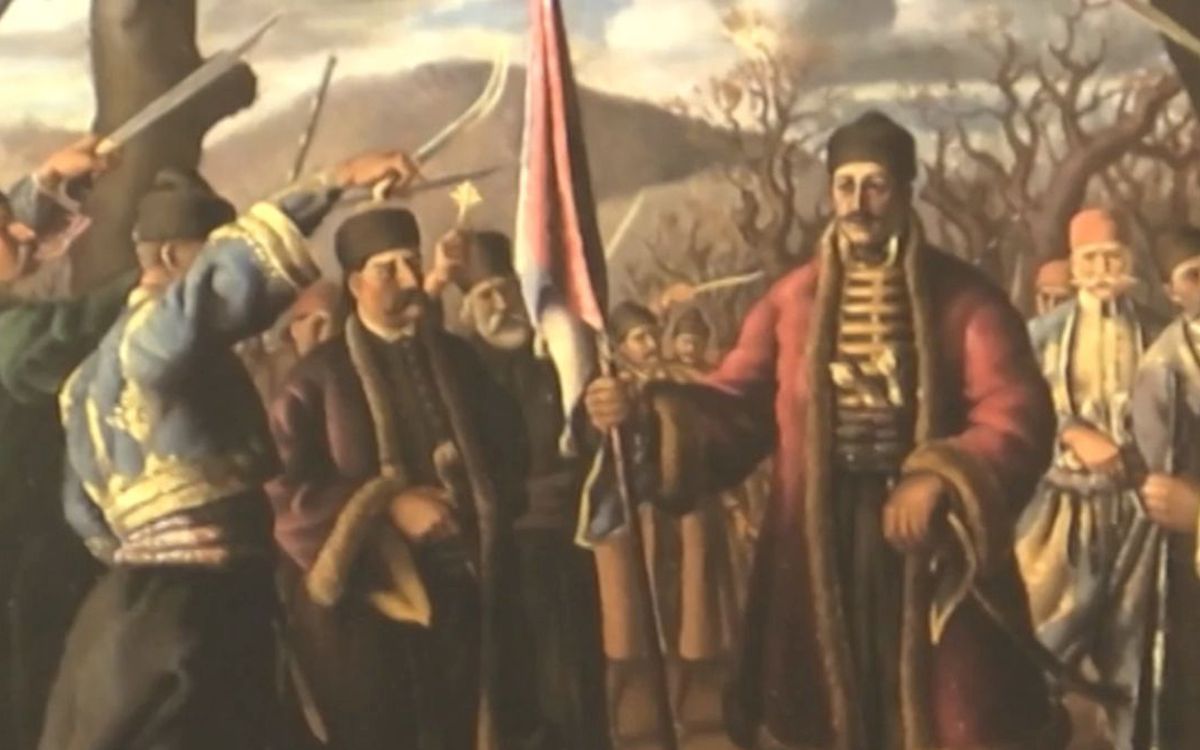
Vojvoda of the Smederevo Nahija Based on meager sources that mention the life and work of Serbian insurgents, it is possible to find out that Đuša Vulićević was born in Azanja near Smederevska Palanka sometime around 1771. At the time of the outbreak of the First Serbian Uprising, he was already known as a successful merchant and a respected host. This was also the reason why, after the Slaughter of the Knezes (Princes), he sided with the dissatisfied national leaders who started the uprising for the liberation of Serbia from Turkish rule. The reason was also the murder of the Serbian buljubaša (captain) Teofan by the Janissaries of Smederevo. The agitated people took up arms, chose Đuša as their leader, and went to battle against the Turks. It is considered that at that time Đuša’s group already had about 200 (according to some sources 400) armed peasants whom he placed at Karađorđe’s disposal.
Seeing that the people could not be calmed down, the Turks withdrew with their families into the Smederevo fortress, but conflicts around the city between Serbs and Turks continued.
Karađorđe came to their aid after the liberation of Požarevac, firing a few cannon volleys from a height above Smederevo as a warning. In an effort to avoid bloodshed, the Turks agreed to negotiations in which they were given the right to continue staying in the fortress, but not to enter into any conflicts with the Serbs. Also, the agreement confirmed that Đuša Vulićević would become the administrator of the Smederevo nahija, who was closely connected with the leader (Vožd) from then on.
He also responded to Karađorđe’s call to help him in the siege of Belgrade, and with his warriors, he set off for Boleč, where he built a fortification and served as support for the right wing of the city’s siege. During the next year and a half, he distinguished himself in various conflicts with the Turks, which only raised his reputation among both the people and Karađorđe. It also seemed that he firmly held power in Smederevo and implemented the decision that there should be two parallel authorities in the city and the nahija – one for the Serbs and the other for the Turks.
Death as the trigger for the liberation of Smederevo A turning point in the relatively peaceful relations between Serbs and Turks in Smederevo occurred after the Battle of Ivankovac, when the insurgents clashed with the imperial army for the first time and won. This victory of the insurgents resonated and brought great anxiety to Smederevo, where the Turks began to fear for their neutral position. Occasional skirmishes and other expressions of distrust began, reaching their breaking point precisely with the murder of Vojvoda Đuša. But, precisely his murder is the point of contention between historians and contemporaries.
Namely, the official version says that the vojvoda was treacherously killed in a conflict with the Turks who set out against the Serbs. The second version does not paint Đuša’s death as particularly heroic. Namely, according to this version, this event was the result of Đuša’s “more than cheerful” mood, which gave him the courage to go towards the fortress with his men, almost unarmed, to clarify some things. On that path, he was intercepted by the Turkish guard, and after a brief skirmish and a warning not to cross the drawn border, he was shot at. On that occasion, two other men from his escort were killed by bullets next to him, and one was wounded.
This murder caused great confusion on both sides, and the Serbs took shelter in the surrounding places on the same day, and the Turks in the fortified city. When, however, they saw that there were no Serbs, the Turks came out from behind the ramparts and took Smederevo for themselves.
The news of Đuša’s murder soon reached Karađorđe, who raised 600 insurgents and set off for Smederevo. After the initial unsuccessful negotiations, and then conflicts, he decided on cunning. Namely, he decided to hide the main body of his army in the vicinity of the city, and convince the Turks that only a few dozen insurgents remained and that the others had fled in fear. It turned out that the plan was successful. Encouraged by the apparent victory over Black Đorđe, the Turks opened the gates and started chasing the Serbs. They had no idea that this was just falling into a trap that would cost them their lives and the city.
With Karađorđe’s lightning-fast action, the Turks were cut down, the city was liberated in mid-November 1805, and the vojvoda was avenged. As Đuša’s successor and the new administrator of the Smederevo nahija, the Vožd appointed Đuša’s brother Vujica.
Đuša’s journey did not end with his death. He was initially buried in the churchyard in Krnjevo, and the following year the body was moved to the churchyard in Pinosava, where he rests today. His bravery and heroic death are also described in the song “Karađorđe took Smederevo.”
MORE TOPICS:
Source: Kurir Photo: Printscreen RTS