




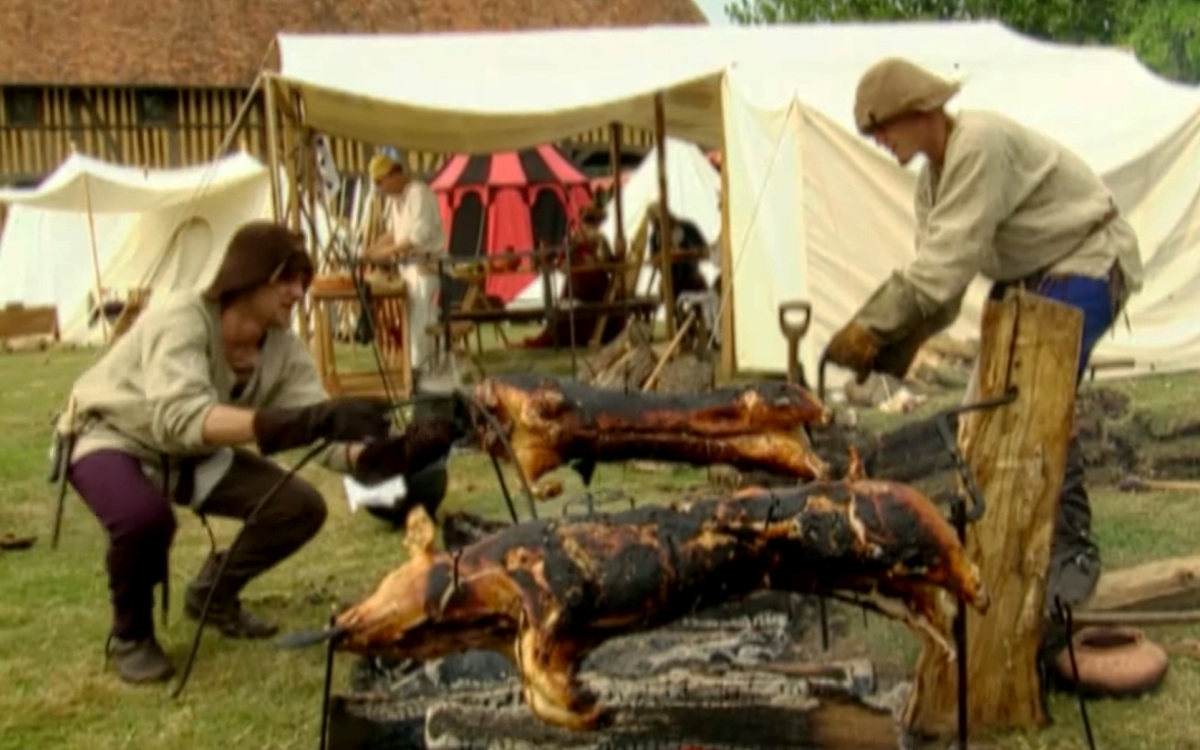
Belgrade, Serbia – What was meant for the rich and what for the poor? How was food eaten in the Middle Ages, and why in that particular way, reveals Tamara Ognjević, a gastro-heritage expert.
What was truly eaten in medieval Serbia? This is a question I’ve heard countless times. Very rarely was the other question posed – How was it eaten, in what company, and in what manner? Even rarer – and why exactly that? People were surprised to hear that medieval man didn’t eat as much game as films depict, and even more so when they learned that the type of food one would consume was determined by their social status. And not for financial, but for health reasons.
This is a brief overview of just some of the findings from the “Living the Past ~ Serbian Medieval Gastronomy” project, for which the Artis Center received high recognition from the International Council of Museums as Project of the Year in 2017.
“Come, comrades and brothers, and beloved children, come with me, that we may rejoice with you at this last feast, and that I may part from the meat table, for such a splendid and abundant meat table will never gather me with you again!” These are the words with which Grand Župan Stefan Nemanja addressed the people gathered at a banquet in Raška in 1195, on the occasion of transferring power to his son Stefan the First-Crowned, as recounted by the monk Theodosius in his famous “Life of Saint Sava.”
Although this unusual farewell to the rich meat table clearly suggests that Nemanja was not only relinquishing power but also preparing to receive monastic tonsure, and monks in the Middle Ages did not consume meat even on fast-breaking days, a better connoisseur of the medieval understanding of food, its symbolism, and ritual meanings will not miss that Nemanja’s farewell to meat was, in fact, a farewell to earthly power.
Namely, according to the stipulations of Galen’s medicine, so popular in the Middle Ages, as well as the strict understanding and implementation of dietary regulations based on natural quality, which primarily implies belonging to a certain social class, a good ruler had to eat a lot of meat to maintain his ruling, knightly, and other qualities that defined him as a superior leader and soldier. And not just any meat, but the highest quality, prepared by roasting or frying, because only the combination of blood and fire ensured ruling and warrior power. Boiled meats, offal, small birds, rabbits, and processed foods were for the farmer and artisan – the ruler and soldiers ate roasts!
The triad – meat, bread, and wine, so highly valued at the ruler’s table, is a kind of synthesis of the ancient Mediterranean concept of bread and wine as maxims of civilized man, and Western consumerism of meat as the greatest source of the male principle, virility, and courage. These two understandings of the special qualities of food met in the Middle Ages at the Balkan crossroads, and supported by the climate, vegetation, and constant movement of people and goods, shaped a particular gastronomic landscape.
Besides lentils, fava beans, wild peas, cabbage, onions, garlic, greens, radishes, turnips, millet, barley, oats, rye, and in later periods, rice and corn, which arrived in our region with the Turkish conquests in the mid-15th and early 16th centuries, the population of Serbian lands in the Middle Ages consumed meat, milk and dairy products, as well as imported foodstuffs that arrived at local markets and fairs.
Sources clearly show that on the tables of rulers and prominent people, high church clergy, and wealthy merchants, one could find seafood and marine fish, figs, almonds, bitter oranges, lemons, olive oil, expensive wines and spices, as well as gold-valued sugar.
Already in the 12th century, the nobility in Raška ate peaches, and the soil of Serbian lands has, since ancient times, been abundant with a wide variety of wild berries, mushrooms, and game.
The findings of certain waste pits unequivocally prove that lamb dominated in mountainous regions, but sources indicate that pork was also a popular animal, and salted and dried meat was a prestigious Serbian export during the Middle Ages.
Serbian medieval food production was dominated by cheese and honey producers. “Vlach” or “Merovlach” cheese made from goat or sheep’s milk, much like sour milk, was a product that foreign merchants gladly accepted instead of money in exchange with the local population. Beekeeping was practically the first profession in domestic food production whose status was confirmed by royal decrees and various regulations.
Especially valuable foodstuffs were spices, sugar, and wine. Mostly imported, in later periods, wine production began mainly on royal and monastic estates.
Entertainment for Men and the Occasional Woman
In the writings of domestic and foreign medieval authors, we rarely encounter descriptions of feasts inside the Serbian royal court or a nobleman’s home, when the ruler himself was a guest at a formal dinner, or in another of the ruler’s personal spaces, such as tents, that essential piece of furniture for medieval dignitaries who often traveled due to their duties.
Even more rarely do we see such scenes in the paintings of the Nemanjić and post-Nemanjić eras, which only allow us to indirectly assume that in certain depictions, such as the Wedding at Cana from Kalenić or the Parable of the Royal Feast from Manasija, the golden splendor of interiors where the lords of Serbian lands in the Middle Ages feasted is revealed.
These two intriguing frescoes from the early 15th century, as well as a number of miniatures in contemporary manuscripts, depict scenes of luxurious dining that, among other things, suggest a clearly established hierarchy of seating at the table, just as they emphasize the lavish clothing of the feast participants, as if a certain dress code was implied on such occasions, to use a modern term.
There is no doubt that order was also maintained at the table of Serbian rulers and dignitaries, just as it was for the common man. From comparative medieval sources, it is well known that feasts were generally attended by men, meaning that women joined them on exceptionally rare occasions, and such exceptions were made only when it came to female rulers. In the case of public, national feasts, men were served first, followed by women, and finally children.
Such patterns were maintained in Serbian society, both in aristocratic and civilian homes, until the first half of the 19th century, and even longer in rural areas.
At large and populous feasts, there was also a kind of hierarchy in terms of table arrangement, and the quantity and quality of food served to members of different social strata. It was customary for the ruler to determine when and in what quantity food would be distributed to the poor after large celebrations or in regular annual cycles related to the customary medieval markets, fairs, and pilgrimages. In Serbian lands during the Middle Ages, the Church was primarily responsible for distributing food to the poor.
In addition to hierarchy and fine clothing, the feast had another special dimension – music, song, and entertainment. Musicians, acrobats, fire-eaters, animal trainers, dancers, and actors were indispensable participants in public spectacles during fairs, markets, and pilgrimages, as well as at wedding and other feasts.
Preachers and chroniclers in monastic robes particularly highlighted the harmful words of skomrahi (medieval term for actors), but there is no doubt that they also had their place at the highest-ranking feasts, where even a particularly joyful ruler, like Stefan the First-Crowned, would pick up a gusle (it is important to note here that in the Middle Ages, the term gusle referred to all string instruments!) and play and sing for his guests.
MORE TOPICS:
BAD NEWS FOR BIDEN: Former president diagnosed with progressive prostate cancer, spread to bones!
MYSTERIOUS MISS V: How a wealthy Canadian woman ended up fighting for Serbia in WWI! (PHOTO)
WONDERFUL ROMAN BRIDGE ON GOLIJA: 30,000 eggs were needed to build this monument! (PHOTO)
Source: Tamara Ognjević za Artis Centar; Foto: Printscreen YouTube / Free Documentary – History
 Add Serbian Times as your Google source