




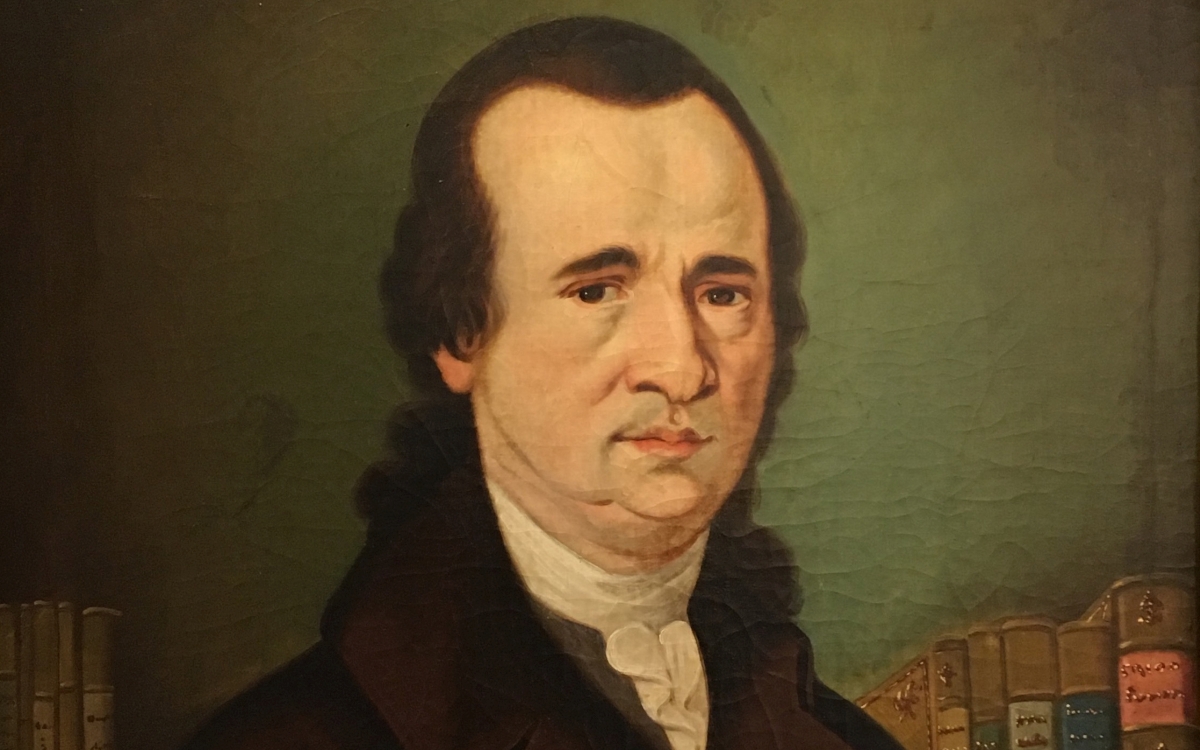
Dositej, that is, Dimitrije Obradović, was born in Banat, presumably in 1739, near Temišvar, in southern Hungary.
As a boy, in addition to working as an apprentice in a shop, he spent all his free time reading the lives of saints and dreamed of dedicating himself. Having lost his parents early, his future depended on his own ideas.
His love for books and the search for knowledge led him to the Hopovo monastery in 1757.
The following year he was tonsured and received the name Dositej. But his real calling was outside the monastery, in the world, where there were large libraries and good schools. He dreamed of a real calling, and after two years he set out on a journey. According to the Chinese approach, we are governed by the social Tao (path). The translation of the word ethics into Chinese is Tao te, which means paths and virtues.

Bukvica and Orfelin
The road led him to Dalmatia, where he was a teacher, then to Boka Kotorska, then from Split to Corfu, and from there to Mount Athos, then to Smyrna. He learned Latin, Italian and Greek, and on his return from his travels, Albanian. He studied theological sciences, biography, moral philosophy, and literature. The first part of the trip lasted ten years and he returned to Dalmatia again.
He got to know the people and started writing at the request of a young girl, the daughter of a Serbian priest. He collected and translated several selected sermons of St. John Chrysostom, arranged them in alphabetical order and presented the book to a beautiful young reader. She was so blessed that she showed her gift, and then others enthusiastically copied the book, and it became popular and spread throughout Dalmatia under the name Dositej’s Primer.
After returning from the East, he turned to the West. He stayed in Vienna for six years, where he learned French and German and taught others French and Serbian. Enriched with knowledge of various languages, Greek and Latin classics, he now expanded his knowledge to contemporary German and French writers. After staying in Modri and Sremski Karlovci, he continued his journey to Italy. Through Greece and Moldova, he continued his journey at the University of Halle, where he attended lectures by Professor Eberhard in 1782. The next two years he stayed in Leipzig, spent the summer semester at the University of Leipzig, published Letters to Haralampius, Life and Adventures, Counsels of Healthy Reason and Instructive Word, works with which our modern literature was created.
The Slaveno-Serbian Magazine, that is, a collection of various compositions and translations, the first magazine among the South Slavs, was published by Orfelin in 1768 in Venice, in the printing house of Dimitrije Teodosije. The first and only issue was modeled on the Russian magazine edited by Gerhard Friedrich Miller in Moscow for the Russian Academy from 1755-1764. A large part of the contributions in the Slaveno-Serbian magazine was taken from that magazine, and Orfelin’s program of enlightenment was written in it.
The magazine emphasizes modernity and for the age of enlightenment it is said that it is an epoch that “feels that a new force is at work in it” and that “the entire eighteenth century poses the problem of spiritual progress”. It is a time of advancement of knowledge based on the belief in man’s universal nature. In addition to understandable language, translation and printing of books in their own language, an appropriate form of knowledge transfer is needed. The written texts in the magazine are hierarchically arranged into religious, civic and practical knowledge. Orfelin assumes his readers to be beings in enlightenment. Awareness of that era and the foundation of enlightenment rests on the amount of knowledge and the requirement that as many people as possible have that knowledge.
The programmatic continuation of the Magazine is Dositej’s work Letters to Haralampius from 1783, in which he says: “Why did God give man reason, judgment and free will, but to be able to judge, recognize and choose what is better?” Whatever you want other people to do to you, do to them too. And what is that, Dositej wonders? To let us live in peace according to our law, not to do us any harm, to forgive us our weaknesses and mistakes. To love and respect us, and to help us in our needs. This is what we owe to all people in the world.
And in the work Counsels of Healthy Reason, Dositej tells us: “I will be paid excessively when someone from my kin says, when green grass grows over me: Here lie his Serbian bones! He loved his kin! Eternal memory to him!” With this, he wanted to show how much he cared that his influence on Serbs was justified by “the harmony of his life and his works”. He presented himself as a thinking man to the judgment of contemporaries and descendants.
For Dositej, God’s firstborn daughter is Truth. “I will only love the truth, I will take care of it, I will desire it with a warm and pure heart,” Dositej conveys to us and adds that he will write as if he were standing before God’s all-seeing eye. The truth is in books, and that is why he tells us: “Books, my brothers, books, not bells and clappers!” He taught us that first we should choose a few well-meaning young men, inclined to science and sharp-witted, and send them to study. When they are well-educated, they will be teachers of our children and write books. While they are studying, schools will be built. First two: one for boys and the other for girls. Dositej says: “All these reflections were caused in me by our proverb: Do not repent of doing good.”
A year after Letters to Haralampius, on the question “What is enlightenment?” Immanuel Kant utters the password of enlightenment. “Enlightenment is man’s exit from the state of his self-inflicted immaturity. Immaturity is the inability to use one’s reason without the guidance of another. That immaturity is self-inflicted when its cause does not lie in a lack of reason, but in a lack of determination and courage to use it without another’s guidance. Sapere aude! Have the courage to use your own reason! – that is the password of enlightenment.”

Counsels of Healthy Reason
Kant thus confirms the modernity of Dositej’s aspiration that man “freely think about everything, judge and speak” (Counsels of Healthy Reason). Michel Foucault even says that there is a superposition of universal, free and public use of the mind. Dositej emphasizes that language is a key factor of national identity. For national affiliation, he emphasized a much broader principle than the unity of faith and church, it is the principle of the unity of language and kin. As he says, “faith and law can be changed, but kin and language never.” Language for him is also a means of enlightenment.
Dositej stayed in London for six months, until June 1785. He lived behind St. Paul’s Cathedral. In this short time, he learned to read, understand, translate and speak a little English. On a book he received as a gift from Sir William Fordaye and Livio Gem, in the dedication it says: “To Dositej Obradović, a Serb, a man skilled in various languages, excellent in the most holy conduct… A small but most sincere pledge of love and friendship, most willingly offered according to merit”. This short visit to England greatly influenced Dositej, who said that they were the most enlightened people in Europe and that they thought most freely. After returning, and a three-year stay in Vienna, he traveled to Germany and in 1788 in Leipzig published Fables and the second part of the book Life and Adventures. Dositej’s third stay in Vienna was from 1789-1802, where he printed The Song of the Deliverance of Serbia and Sobranije.
When reading the works of great and blessed people who worked and lived to develop great good, happiness, joy and gratitude to the people of their time. It’s as if they weren’t sent to this world for anything else. They lived thousands of years before us and did good, and today we feel and cherish them as if they lived in our time and as if they were doing all these good things that they created and showed us. Dositej conveys his impressions to us. He says that wonderful wisdom is when natural reason with love and justice are united in honesty.
Dositej advises us in Sobranije how to learn. The most important thing is to learn the basic and sufficient knowledge of the language in which the best books in the world are written. Then, to examine and recognize one’s natural inclination to which matter and science the heart pulls, because “There is a strange secret in the human soul that in what one is most inclined to, one also succeeds.” It is very important to ask questions. What have you seen, heard, spoken, read, learned and done? This is how the mind opens and the soul is enlightened and directed to all good and praiseworthy knowledge and creation. The greatest achievement is for the reader of a book to perfectly understand what is written, and to be able to grasp it with his spirit, and when he leaves the book, he can talk about it.
MORE TOPICS:
SERBIAN EXPERT TEAM: Data indicates that NATO deliberately committed genocide in Yugoslavia in 1999!
Source: Danas, Foto: Wikimedia Creative Commons