




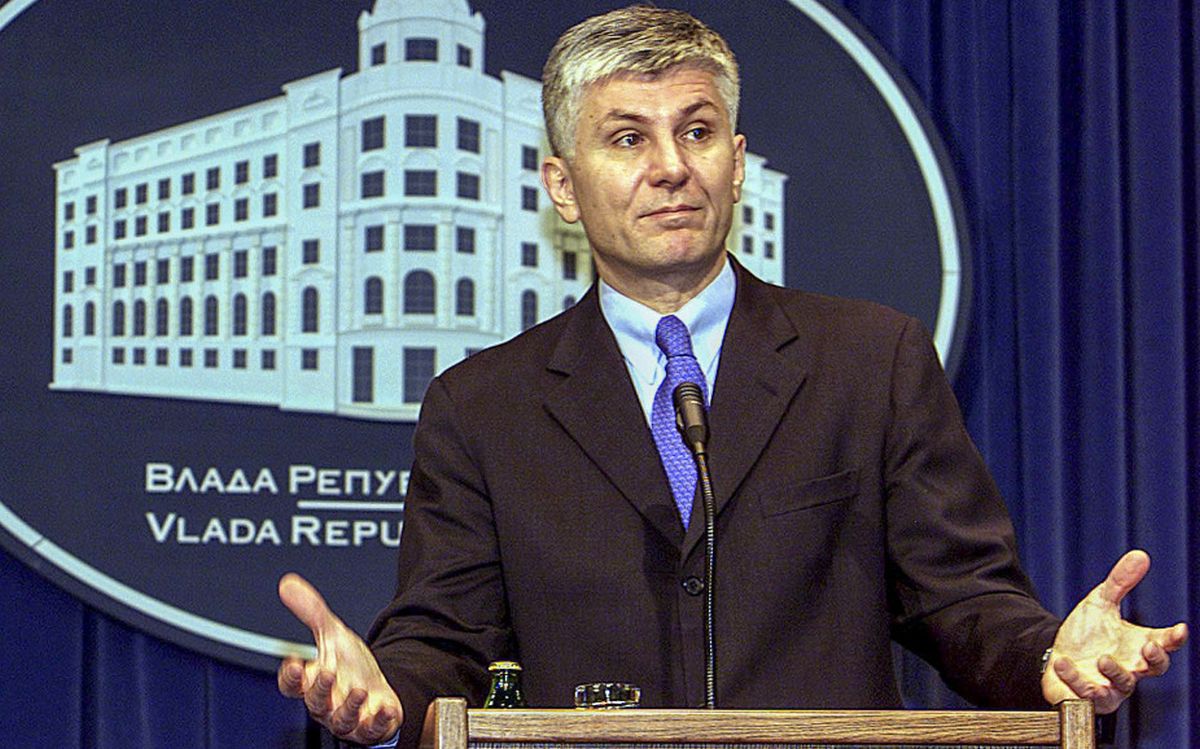
Zoran Đinđić, the Prime Minister of Serbia, was assassinated on March 12, 2003, in an assassination at the entrance to the Government building in Nemanjina Street.
Đinđić, the long-time leader of the Democratic Party, the champion of DOS, the first figure of the changes on October 5, 2000, was 50 years old at the time.
He had been in the position of the first man of the Government of Serbia since January 25, 2001, when he replaced the transitional cabinet of Milomir Minić formed at the end of October 2000.
He entered political life in his student days, when he mostly had radically left-wing ideas.
He was active in the student organization at the Faculty of Philosophy and interested in the legacy of anarchism.
Allegedly, Kroptkin, an anarchist, and then the thinkers of the Frankfurt School were especially close to him at the time.
Zoran Đinđić was born in Bosanski Šamac on August 1, 1952.
His father, a military officer, was there at the request of the service.
He lived in Travnik for about ten years, where he started high school.
He finished the last two grades in Belgrade, at the Ninth Gymnasium.
He then enrolled in philosophy studies at the University of Belgrade.
Those were the years of turbulent student activities, immediately after the events of 1968.
He managed to impose himself on the Student Union of the Faculty of Philosophy. He was already arrested then. He was tried in Ljubljana in November 1974.
The six students who were then prosecuted were saved by pressure from the international public. Allegedly, German Chancellor Willy Brandt stood up for him.
He completed his undergraduate studies at the Faculty of Philosophy in Belgrade in 1974.
He continued his further education in Germany, in Frankfurt, then in Constance, where he received his doctorate in 1979 with the thesis “Problems of Establishing Critical Theory of Society”, and his mentor was Jürgen Habermas, one of the most prominent philosophers of the second half of the 20th century.
He returned to Yugoslavia in 1989, when he and a group of 12 intellectuals participated in the renewal of the Democratic Party. In parallel, he was engaged in business, with varying degrees of success.
At that time, he was no longer carried away by the ideas of the radical left, he became mostly a classic civil liberal.
He managed to fight for the leading position of the Democratic Party in January 1994, instead of Dragoljub Mićunović. He was at the head of the Democratic Party until his death in March 2003.
FIND OUT MORE:
A key figure in the political changes of 2000
He was a prominent champion of the opposition to the regime of the nineties and led several political actions in the fight against the government of Slobodan Milošević.
As one of the leaders of the “Together” coalition, he was elected mayor of Belgrade on January 21, 1997, but was soon removed by the will of coalition partners.
He was a key figure in the political changes of 2000, as the head of the central election headquarters and coordinator of the promotional campaign of the Democratic Opposition of Serbia (DOS) for the federal elections on September 24, 2000.
In September 1999, the American weekly “Time” included Đinđić among the 14 leading European politicians of the third millennium.
He is the winner of the prestigious German “Bambi” award for 2000 in the field of politics, and in 2002 in Prague he received the “Polak” Foundation award for his contribution to the development of democracy in Serbia.
He is the author of several books (“Subjectivity and Violence”, “Autumn of Dialectics”, “Yugoslavia as an Unfinished State”, “Serbia Neither East nor West”) and a series of philosophical and political science essays.
He was also involved in translation, and especially active in political journalism.
He was an advocate of the idea of European integration, convinced that this was the best path for Serbia, despite numerous obstacles, not only in Serbia.
He was killed in an assassination on March 12, 2003. He was shot in the chest, in the courtyard of the Serbian Government building, at 12:25 p.m. His bodyguard Milan Veruović was seriously injured on that occasion.
Soon after, a state of emergency was declared and the “Saber” operation was launched, which had previously been prepared as part of the intended crackdown on organized crime.
Members of the criminal group “Zemun Clan”, whose members and associates were among the organizers and perpetrators of the murder, were then arrested and, after a three-and-a-half-year trial, convicted.
Among the perpetrators were also some members of the then Special Operations Unit, which was then disbanded. According to the verdict, Milorad Ulemek Legija, who was sentenced to 40 years in prison, ordered Zvezdan Jovanović, a member of the JSO, to kill Đinđić.
MORE TOPICS:
JOURNALIST THAT CAUSED THE RTS BLOCKADE: “I did not call students a mob, I apologize to the public”
Source: Euronews, Photo: Tanjug / AP /Darko Vojinović
 Add Serbian Times as your Google source