




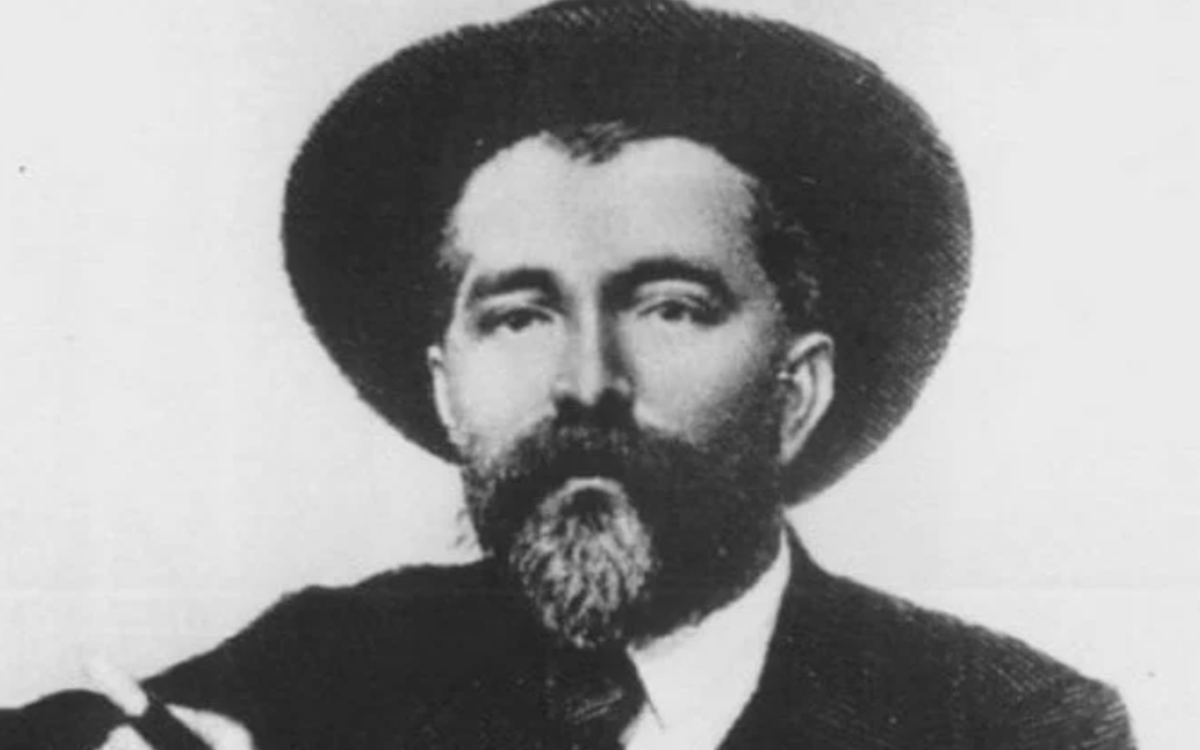
Đura Jakšić was arguably the greatest lyric poet of Serbian Romanticism and one of the most talented Serbian painters of the 19th century.
In addition to poetry, which is the most valuable part of his literary work, he also wrote short stories and heroic poems (Na Liparu, Ponoć, Padajte braćo, Otadžbina, Seoba Srbalja, Stanoje Glavaš).
Jakšić, a poet, storyteller, playwright, and painter, was born in Banat, in Srpska Crnja, into a priestly family. His real name was Georgije. He studied painting in Pest and Vienna, lived for a while in Vojvodina, and at the age of twenty-five moved to Belgrade, where he remained until his death.
He worked as a village teacher in Podgorac, Sumrakovac, Sabanta, Rača near Kragujevac, and Požarevac, and as a drawing teacher in high schools in Kragujevac, Belgrade, and Jagodina.
Despite having a family, his life was marked by bohemianism. The tavern world was his natural environment.
Already suffering from tuberculosis, he participated in the First Serbian-Turkish War as a correspondent, where he witnessed the disgraceful behavior of elite general and prince’s relative, Ranko Alimpić.
Two years later, he published a satirical story about it in a Novi Sad magazine, which led to his trial in Serbia before a military court. He was sentenced to fifteen days in prison.
The truth about this case became known in Serbia only after the Obrenović dynasty lost power.
In 1906, Žarko Ilić, the youngest brother of poet Vojislav Ilić, published:
“In the summer of 1878, in front of the Paris Hotel in Belgrade, several officers were sitting at a table, among them General Ranko Alimpić. At that moment, Đura Jakšić passed by and continued down Batal Mosque Street. On the way, he met a peasant…
The peasant was driving a few oxen. Đura stopped him and asked, ‘Are you heading down to Terazije?’
The peasant replied that he was.
Then Đura took a dinar from his pocket, handed it to the peasant, and said, ‘When you pass by the Paris tavern, drive the oxen closer to those gentlemen sitting there, strike one of the oxen with your stick, and say: “Why are you hesitating like Ranko Alimpić on the Drina?”’
The peasant did as he was told. When he uttered those words, all the officers looked at each other. One of them immediately got up from the table and slowly followed the peasant to the nearest gendarmerie post…
At the police station, they questioned the peasant about whether he had said those words on his own or if someone had told him to. The peasant admitted that a gentleman he met along the way had told him to say it and had given him a dinar for it…
FIND OUT MORE IN ENGLISH:
They immediately suspected Đura Jakšić.
Đura Jakšić lived on Skadarska Street. One evening, as he was returning home from a lively gathering, he was ambushed in the nearly deserted street by two night guards disguised in civilian clothes. They seized him, knocked him down, and beat and trampled him so badly that the poor man barely made it home… From that moment on, Đura’s health began to deteriorate.”
Đura Jakšić passed away on November 17, 1878.
Four writers carried his coffin out of his poverty-stricken room in Skadarska Street: Jovan Jovanović Zmaj, Jovan Dragašević, Milan Kujundžić, and Milorad Popović Šapčanin.
“There were high-ranking statesmen, large and small officials, professors and scholars, soldiers, students, merchants, craftsmen, and poor workers…”
According to newspaper reports, out of the 25,000 residents of Belgrade at the time, nearly half came to pay their final respects to the great poet.
His sentence was never served. A court official wrote on the verdict document: “Since Đura Jakšić has died, this case is considered closed, and the records are to be archived.”
His killer, General Ranko Alimpić, has a street named after him in Šabac today.
MORE TOPICS:
Source: Luftika, Foto: Wikipedia
 Add Serbian Times as your Google source