



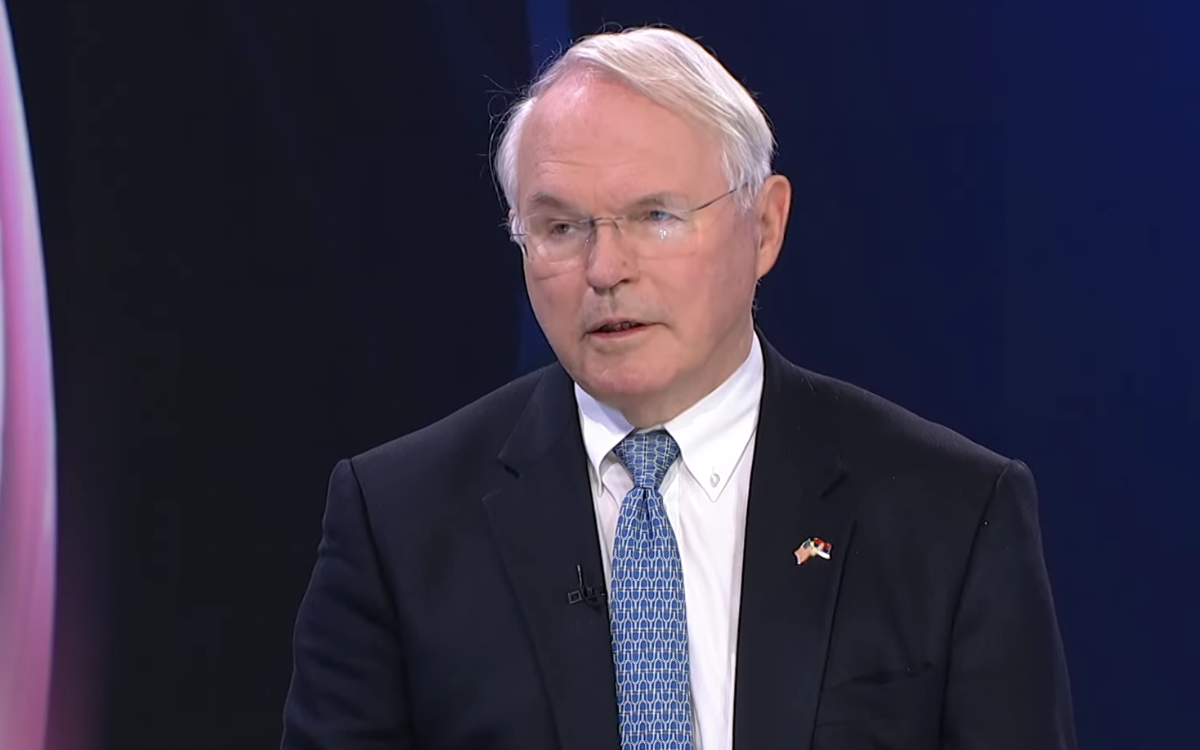
The U.S. ambassador is concluding his mandate in Serbia ahead of the White House transition. In a farewell interview with RTS, Christopher Hill discusses why he admires Nikola Jokić and Serbian basketball, his views on the future of Serbian and American democracy, bilateral relations, whether he was closer to the authorities or the opposition, and his thoughts on Belgrade as a potential meeting place for Trump and Putin.
Christopher Hill arrived in Belgrade as a young diplomat and, over a nearly 50-year career, played a key role in the Dayton and Rambouillet negotiations. He assumed the ambassadorship in Serbia after retiring from active diplomacy, bringing his extensive experience in the region.
During his career, Hill served as ambassador to North Macedonia, Poland, and South Korea, where he was also actively involved in negotiations with North Korea.
He came to Serbia in March 2022, just before early parliamentary elections, and departs on the eve of Donald Trump’s inauguration. It is logical to begin the conversation by asking how the change in the White House will affect Belgrade-Washington relations.
Each time there is an administration change in Washington, local analysts conclude that U.S. policy toward this region, particularly Serbia, will remain unchanged. Is this still the case?
It’s hard to say. It’s certainly a standard talking point for any diplomat that nothing will change. But we’ll have to see.
I think the incoming Trump administration, some of its staff, has experience working with Serbia, so I wouldn’t rule out changes.
The question for Serbia and the United States is to try to improve this relationship and continue in the right direction. I believe that will happen.
What about inertia in diplomacy, particularly at the State Department?
There is always inertia. In everything, there is inertia, and certainly in the State Department. But I think there is an understanding that we need to move forward with Serbia.
Some changes have occurred. Serbia is now more in a position to negotiate cooperatively on many issues. We’ll see how this develops, but I am optimistic about the future of U.S.-Serbia relations.
What will happen to the strategic dialogue? Will it disappear just like the DFC office did when Biden took office? That office was announced with much fanfare in Belgrade in September 2020.
First, I’d like to emphasize that the DFC brought significant funding for small businesses during the Biden administration, so I wouldn’t say it disappeared entirely. However, regarding strategic dialogue, it makes sense and has logic behind it. I expect it to continue.
We have much to discuss with Serbia, not just in bilateral relations—there are always bilateral matters—but also issues in Europe, particularly European security and the economy.
The U.S. is quite a significant factor in the Serbian economy, particularly in the tech sector. There’s increasing movement between the two countries, not just basketball players but many others. With additional flights between the two nations, I think we’ll see even more progress. I believe the next administration will embrace this dialogue.
So, you’re optimistic about it?
Yes, I’m quite optimistic. Dialogue is always about what’s said and agreed upon to move forward. Serbia’s economy continues to grow, as does interest in integrating it with the U.S., so I believe we’ll see significant progress.
A hot topic in U.S.-Serbia relations right now is sanctions on Russian companies, including NIS. Did the U.S. adequately consider the consequences of sanctions on NIS for Serbian citizens?
I assure you this was carefully studied and executed. The answer is absolutely YES. From the perspective of Serbia’s economy and consumers, I can confidently say this won’t impact Serbia’s economy, nor will it affect the availability or price of gasoline in Serbia. So I think we’ll be fine in that regard.
But I’m not saying this won’t matter for NIS, as that’s been our stance for some time. We’ve been observing this issue since the large refinery was sold to Russia. It was very generous on Serbia’s part, but we now see Russia benefiting far more than Serbia’s economy.
We’re displeased with what Russia has done with this, especially its role in the aggression against Ukraine. This is something the Serbian government and people should reflect on, as losing sovereignty in the energy sector doesn’t make sense. I believe we’ll see changes here.
American colleagues advised Serbia to diversify its energy sector, but losing Russia as an option means less diversification.
You know, at some point, I imagine Russia—when they find their way out of this forest or wherever Putin has led them—will become a player in Europe’s energy space again. Not now, during this terrible war, but sometime in the future. And it’s a question for Serbia, as it is for many countries, to have energy options.
A few years ago, Russia was Serbia’s sole option for natural gas. I believe Serbia will have more choices now, with additional opportunities. As you know, we signed a U.S.-Serbia agreement on a strategic approach to energy, and I believe much will come from this. Energy will also be part of the strategic dialogue we discussed earlier.
Many have quoted you saying there would be no sanctions on NIS. Can you explain this?
Sanctions are about using NIS, a majority Russian-owned facility, as part of the European energy space. The point is that we won’t encourage or participate in energy purchases from Russian-owned facilities.
The ownership structure must change, and that’s certainly the nature of the discussions. Serbia needs fuel, and we fully understand and support that. But I must say, having been here a while and knowing what happened in the 1990s, that must never happen again.
Do you think Belgrade or Serbia could be a good place for a meeting between U.S. President Donald Trump and Russian President Vladimir Putin, given the pro-Russian and pro-Trump sentiment among Serbian citizens?
I can’t really comment on the location of any potential summits, which aren’t planned or discussed yet. What I can say is that we want this war to end. Everyone wants it to end.
Efforts must be made to achieve that. As for the meeting location, that’s not for me to decide. It’s not something that can be answered now.
But someone might ask for your advice as someone who has been an ambassador here. What would you say if asked whether Belgrade is a suitable location?
Someone might ask for my advice, but I’m not sure I’d share it on RTS. I’d wait for someone to ask directly. What I can say is that significant effort is needed to see if this war can be resolved because it’s a deeply damaging conflict.
What Russia has done—not only to Ukraine but to Europe’s energy supplies and global food security—this war must end.
Let’s talk about another conflict that ended but remains unresolved. Have the U.S. failed to ensure a dignified life for Serbs in Kosovo?
This has been a real challenge. Kosovo needed to do certain things, including protecting various communities, including the Serbian population. Personally, I find the progress on Kosovo very disappointing.
I hope for more effort in dialogue, particularly the European-led Brussels dialogue. Many of us are disappointed by the lack of progress, and in my view, much of the blame lies with the Kosovo government.
Many in Serbia are disappointed with the lack of U.S. action. What’s your response to that?
I understand the concern and frustration. I’d like to see a more supportive approach from the EU. They’re facing significant challenges, and it’s up to us to back them and push for progress. I can tell you I’m not satisfied with what’s been achieved.
But are you optimistic?
I’m always optimistic. If you’re a pessimist, you never accomplish anything. I’m optimistic that the Community of Serb Municipalities, agreed upon 12 years ago, will have to be established.
Yes, I’m optimistic about that, but everyone needs to come together to resolve this because the current situation is unsatisfactory.
“I am very pleased, for example, with the dialogue in the Parliament,” the ambassador began, reflecting on Serbia’s progress. “The effort to bring different sides together has shown some progress, although, of course, we all wish to see more.”
He emphasized that as a foreign diplomat, it is crucial not to tell people what to do. “These are truly difficult decisions that Serbian parties must make, parties that often disagree among themselves,” he said.
Acknowledging the challenges of the times, he added, “We live in difficult times, where people are more inclined to raise their voices than to carefully listen to the other side. I think everyone has a responsibility to try to move forward, and we certainly encourage progress.”
Challenges and Strategic Decisions
When asked how he explains current developments in Serbia to his superiors at the State Department, the ambassador noted the importance of perspective. “You can look at things tactically or strategically. Strategically, I see a country that has largely made its choice to head West. Although there are diverse opinions here, as in any country, I believe there is a definite tendency toward the West. Tactically, this is a difficult process, and everyone has their own views.”
He reiterated his role as a diplomat: “My job is not to interfere or tell people what to do but to encourage and support the process.”
A Diplomatic Encounter at a Basketball Game
The ambassador recounted an unexpected situation at a basketball game between Crvena Zvezda and Fenerbahçe. “Some people, I assume just a few, were not happy about me enjoying the game. But Serbian basketball is excellent. I’ve been a lifelong fan of the Boston Celtics and will continue to be. Watching high-level basketball here has been a true pleasure.”
He jokingly lamented Crvena Zvezda’s loss in the match. “Maybe some fans were less focused on basketball than they should have been,” he quipped.
On Being a Friend of the Serbian People
When asked if he considers himself a friend of the Serbian people, he replied warmly, “I love sports, history, and discussing important issues. My wife and I have thoroughly enjoyed our nearly three years here in Serbia, attending cultural events and games. I feel very comfortable here.”
On Lithium Mining and Criticism of Support for the Government
Responding to a question about Serbia’s lithium potential, he remarked, “I’ve said a million times, and I’ll say it again: it’s up to Serbia to decide. Personally, I think it’s an opportunity for Serbia. Everyone carries a piece of lithium in their pocket—it’s in your phone. The question is who will produce it. Those who do are in a better position, and Serbia has that opportunity.”
Addressing criticism of his perceived support for the government, he clarified, “My job is not to support the government but to advance U.S. interests. A positive relationship with Serbia’s government is crucial for that. At the same time, I’ve met with a broad range of people, including opposition representatives, particularly in recent weeks.”
Plans and Reflections
When asked about his personal plans, he expressed a desire to remain active. “I’d like to write another book, focusing on the future of American diplomacy. Retirement and golf? Not for me. I want to contribute to making my country better.”
Reflecting on his time in Serbia, he emphasized listening and understanding. “This is a very different country from the one I saw in the 1990s. I’ve tried to listen more than speak and show respect for differing opinions.”
As a keepsake, he mentioned considering a rug or other mementos, but what stands out most are “the memories of wonderful people and the time we’ve spent together.”
Advice to the Serbian People
The ambassador concluded with advice that applies globally: “Talk less, listen more, and respect those with whom you disagree. Especially in Serbia, there needs to be a calming of the situation and an understanding that we’re all in the same boat.”
Final Reflections
Asked about his legacy, he said, “I’ve done my best to follow U.S. policy and support Serbia in areas it wanted our help. While I didn’t succeed everywhere, I’ve worked hard to engage with as many people as possible.”
He ended with a hopeful note: “I hope you remember me well, as I will remember my time here fondly.”
READ MORE:
SERBIAN GENERAL HONORED IN CANADA: A Mountain Named After Our Hero of World War I! (PHOTO)
Source: RTS, Photo: Printscreen Youtube