





Modern times have brought us a lot of stress, uncertainties, and problems we have never faced before. Real life has mixed with the virtual one that overwhelms us from the media and social networks, and we often cannot distinguish between dreams and reality.
Maja Rueger is a medical doctor, licensed psychotherapist, and life coach from Niš who has been dealing with the aforementioned problems for over a decade through her work with her clients and patients.
With her help, we tried to find some answers to questions that many of us are struggling with…
What are the biggest psychological and emotional problems people face lately?
-I would say that, among other things, it also depends on what you mean by “lately.” We had a pandemic, we are increasingly in the virtual world and on social networks, life is getting faster, so it brings new challenges. Essentially, most people face problems related to relationships and work-related problems. All these problems are now much more complicated and it is much more difficult to establish a causal relationship between them. People experience this as more intense stress.
For example, in the past, family members had more time to spend together, to work on intimacy. Now, due to the conditions dictated by the business environment, they are forced to work more, with longer working hours, which means less time for relaxation and more stress. This, in turn, spills over into the family, into the partnership… And a vicious circle begins: the professional context has less and less certainty, the conditions are more dynamic, they require faster adaptation. It requires people to be more agile and flexible, to constantly improve, and that takes time, brings stress, and reflects on private life.
To summarize, I would say that people most often turn to psychotherapy or coaching because of stress and tension related to work, relationships, and parenting, as this requires the improvement of psychological skills in order to adequately respond to these challenges.
To what extent are alienation and lack of direct communication the causes of the conditions people fall into?
-I assume this question also applies to people who live and work abroad. They certainly feel more lonely when they are not surrounded by their loved ones and cannot count on support as they would among their own. Everyone also struggles with the cultural stress that many face when they find themselves in conditions that are culturally and socially different from those where they grew up. That is why, for us psychotherapists, important topics on which we work are the development of emotional, social, and cultural intelligence.
However, I always emphasize to such clients the other side that they often do not see: That they are much more independent, that they should give themselves additional credit for coping in new circumstances, to reframe it and recognize the opportunity and advantage over others who have not faced such challenges. Of course, we must not lose sight of the fact that each of us is different and in terms of which competencies we possess to regulate our emotions and how great our capacities are for managing different types of stress.
Many people have difficulty establishing or maintaining an emotional relationship… why?
-If we were to look for all the potential reasons, I’m afraid it would never end. Basically, it’s that people, simply put, haven’t built basic emotional skills or, even simpler, don’t know how to love and have wrong ideas about what love is. I work with clients to understand what mature love is. Many think that love is when they can’t live without someone. If you can’t live without someone, there is a need for control, obsessiveness, and jealousy, which they declare as strong love… Many think that it is only necessary to find the “right person”.
Love is a complex emotion, but also a skill. Mature love requires a multitude of psychological abilities to be able to last. One thing is to find a partner and fall in love, and another is to stay in a good relationship that does not involve any manipulation. Clients often find it strange when we talk about the fact that the ability to love is learned, and from the earliest days of life. If you have not mastered the psychological abilities that make you capable of mature love, even if you find the ‘right person’, it would probably be short-lived and end in some disappointment.
Can we divide these problems into male and female ones, and how much do both sexes have in common and different in that sense?
-I am against sexism, but neuroscience tells us that the female brain and the male brain are very different. Although we all know that estrogens are female sex hormones, they have just as much impact on the brain as they do on our sex glands – the ovaries. Estrogens make a woman different in every way, especially if we look at periods of life when the female body is flooded with hormones (puberty, pregnancy) and then when their levels decrease (perimenopause and menopause).
It is difficult to consider “female emotional problems” in isolation without understanding the bodily basis, especially in the endocrinological sense (what hormones do). The same is true for men: Their brains are also influenced by hormones, primarily testosterone.
If we look at the bigger picture, from experience, I can say that ‘male’ and ‘female’ problems are increasingly overlapping. Jealousy, the need for proof and dominance, career orientation, and the desire for professional achievement are equally present in both sexes. On the other hand, members of both sexes have a need for attachment and intimacy, for family, and this (mostly) represents a greater challenge for women to reconcile. That’s where the problem arises, and it often happens that what brought a couple together at the beginning of a relationship (ambition, common hobbies, hedonism) becomes a point of separation because it often excludes each other. Especially if there is no family to provide support and help. All this can be overcome, which is often the subject of work in partner sessions.
In short, the nature of the problems we face is similar, but the ways of expressing and overcoming them differ.
To what extent are these relationships initially problematic due to unrealistic expectations, because the virtual space in which people meet in the absence of direct communication, which is mostly social networks, does not present a real picture?
-Unrealistic expectations can create a problem on several levels: if we have them in relation to ourselves, in relation to our partner, and in relation to the environment. For example, one person in a romantic couple expects of herself to be perfect and for the other side to constantly show her that, to praise her virtues, not notice her flaws, and in addition, for the surrounding conditions to be perfect and for us to live happily ever after. This will ruin the relationship and probably cause great dissatisfaction, anxiety, depression…
As for social networks and cyberspace, I would assess it as a double-edged sword: it both helps and hinders. We can have an unrealistic picture of a partner even when we are live with him, if we are, for example, prone to idealization, and the partner, in addition, knows how to seduce and behaves in the way we would like.
Social networks and applications have helped many people to make contact, but communication through social networks has its specificities. It provides us with anonymity and the ability to present ourselves as we want, and the other side creates an image of how they want to see us. In addition, we do not see the emotional reaction of the person we are ‘talking’ to, so we can be ruder, we feel less responsible for the emotions caused, or how the other person experienced it. Communication through social networks is often unsynchronized in time (we are not able to respond immediately, for example), so this leads to different interpretations on the other side (“I write and he doesn’t answer, so he doesn’t care”). I would say that social networks can be a ‘good servant, but a bad master’, depending on how we use them.
Do you have the impression that the Balkans and Serbia are ruled by the trend of material values and that this also dictates emotional relationships?
-I cannot single out the Balkans in that sense, nor can I generalize. It’s all a matter of individual characteristics and preferences in combination with social circumstances. Money can be a motivational tool and trigger behavior that we may find unacceptable, and on the other hand, a very powerful tool for instrumentalization: we use it as a tool to get what we want. Money and material goods are means by which people achieve different goals: social status, a sense of security, satisfy their narcissistic needs to look the way they want, to be admired by others… An environment with a strong focus on material values often shapes expectations and of interpersonal, especially partner relationships, even among those who have different priorities.
Is “gold digging” more of a psychological or social problem?
-First, I must say that the term is not familiar to me from the professional literature (laughs). But I believe that someone becomes a “gold digger”, which I think is represented in both sexes, due to psychological factors in conjunction with social factors.
For example, this looks like this: Girls see that their friends who wear branded clothes and look like popular TV stars do better with men. The environment, where the media also participate, sends a message that this is desirable, social networks are flooded with photos from parties in exotic places. Girls whose financial resources are smaller are frustrated that they cannot have that. It is more difficult to be rewarded for their work, investing in their development and waiting patiently, and it is also uncertain. Then they choose to get it the easier way: They find a sponsor. He gets a ‘trophy’ – a young and beautiful girl in whom he invests his money to add a little more to his sense of value, and the girl gets everything she wants, without effort and waiting. That is why I believe that “gold digging”, as you called it, is part of a personal deficit of the ability to tolerate frustration, to invest work and time in one’s own development, and also the influence of the social environment that sends a message that you are not worthy if you are not in the “elite” society and do not have fun…
Our girls care more about their physical appearance than is the case in other countries. On the other hand, they care less about intellectual qualities… What can this lead to?
-I’m building on the previous answer… Beliefs acquired in childhood that the most important thing for a woman is to be beautiful, often create various problems in adulthood. Beliefs are strengthened by the fact that girls are directed from childhood to be sweet, gentle, like princesses, and they realize that this opens many doors. Focusing on those “bikini qualities” that society itself (in)directly promotes through the media and culture, is sometimes not accompanied by the development of intellectual abilities. That’s why they try intensively to maintain those qualities in order to stay where they want (and with whom they want) for as long as possible.
What can this lead to?
-To constant dissatisfaction with oneself, anger at the world that is not kind to them, to non-acceptance of oneself, inauthenticity, fear of ‘middle age’ that are not seen as years of maturity and achievement but as years of loss of youthful beauty and attractiveness…
We also witness that girls at a young age often opt for aesthetic and surgical interventions… How good/bad is that?
-I notice that this is becoming more widespread, regardless of age. I look at billboards, I constantly receive advertising messages offering aesthetic interventions at affordable prices. Prices also play a role. These aesthetic interventions, from Botox and filler injections to surgical interventions, temporarily reduce the feeling of insecurity for those girls, but this usually lasts a short time and requires repetition. I don’t condemn it, they can do whatever they want with their bodies, but where is the line and will they know how to set it? The phrase that the cosmetics industry lives on female vanity and insecurity is trite.
That’s how it’s seen from my perspective as a psychotherapist.
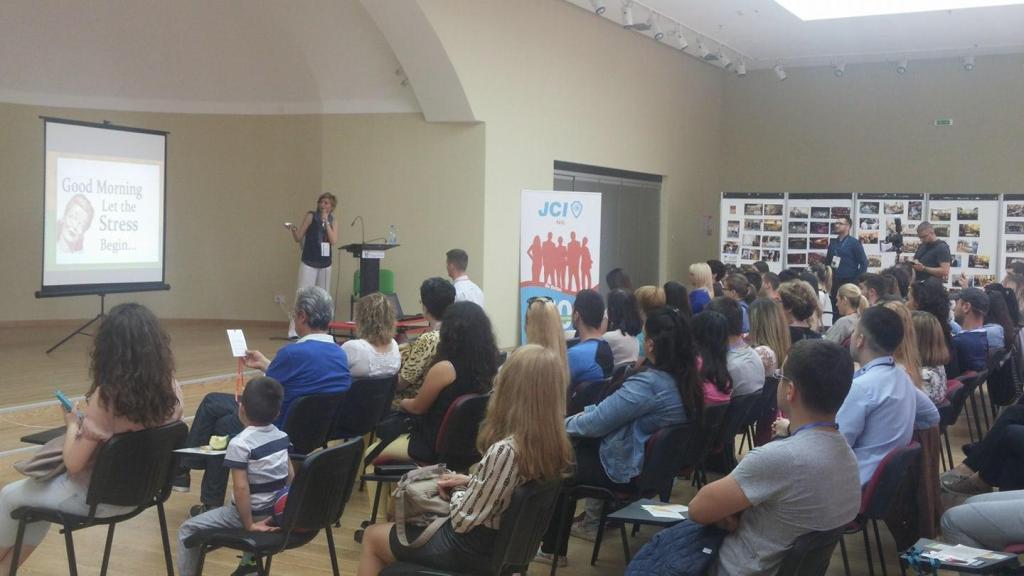
STRESS AS THE GREATEST CHALLENGE: Maja Rueger at one of the lectures
From a medical point of view, I am stricter: the market contains both suspicious preparations and suspicious ‘experts’ for these interventions. Beauty trends change quickly, and some things cannot be corrected. For example, to mention that our grandmothers wore earrings on their earlobes, then girls started wearing earrings on their nose, navel, genitals, tongue. Now I see the latest trend is “Conch removal” where part of the earlobe is removed and then various ornaments are attached there. I would like to consider the ethical principles of doctors who perform interventions that are according to suspicious aesthetic standards (excessively large lips, breasts…).
Tattoos were once considered more of a masculine thing and were associated with certain personality traits. Then, tattoos became widespread among women as well. All of these are phallic symbols, highlighting a certain kind of power, freedom, or rebellion.
I always try to make my clients understand the long-term consequences of injecting and implanting foreign materials into their bodies and whether it is worth the feeling that it brings them on the other side (greater self-confidence, power). I emphasize the importance of them inquiring well and getting acquainted with the procedure, materials, checking the doctor’s references, etc.
How much does gender, so-called woke culture, influence the Balkans?
-I joke in lectures and ask which “-isms” are most prevalent: racism, sexism, ageism, ableism… I just wrote about women who fear aging and changes in their bodies. The reason is precisely that ageism. A large number of my clients are women over 35 – the beginning of middle age and the period called perimenopause. An interesting new coinage is: menopause. It includes discrimination both in terms of gender and age, and implicitly in terms of the loss of female attributes. I have in mind a few jokes that resigned female members of the female sex in their fifties told me they heard from their colleagues.
Imagine how it is with the acceptance of the LGBTQ+ population in traditional and conservative environments where these types of discrimination exist.
As a parent, do you think a 10 or 12-year-old child is capable and mature enough to decide about their sexuality?
-I don’t deal with these issues in my practice, but I know how the psychosexual development of a child goes. If I can be completely honest, I don’t think sexuality is decided. If a ‘decision’ needs to be made, then it sounds like an imposition to me. Rights come with responsibilities and awareness of the consequences. It is difficult for a child at that age to anticipate the long-term consequences of their decision.
We are faced recently not with two, but with many more genders, or rather sexual orientations… How much do children decide about their sexuality under the influence of the media and social networks, in order to be IN and in line with trends?
-In the past, gender and gender identity usually coincided and things were much simpler. There were boys who were called “sissy” and girls who were “tomboy”. I don’t know the exact statistics on what you asked, but I believe there is a great influence. Especially in teenagers, there is a need, on the one hand, to belong to a group and to be as ‘similar’ as possible, but also to be different, special. To be the same, but also special. These needs are strong, sometimes tearing. Then I can imagine how the dissemination of content about these rights can confuse. I emphasize, I am not an expert in this field, so perhaps my comparison will be banal, but I don’t know many people who were what they wanted to be as children when they were adults. I was sure I would be an astronaut, and now I can only sometimes be ‘lost in space’ from all the obligations I have.
How to preserve marriage in the modern era, when you work more and more, have less and less time for your partner, and you are overwhelmed from all sides by “offers” from social networks, where everyone is attractive and seemingly accessible?
-It is challenging to maintain intimacy and erotic vitality in a relationship when partners do not have enough time for each other. You have to sacrifice a little spontaneity and plan well for such time, and above all, create a good work-life balance. It is also challenging to maintain exclusivity in a relationship. I often encounter stories in conversations with clients that they ‘caught’ their partners in correspondence on social networks. Sometimes there is nothing more than the correspondence itself, but I am always interested in what those people get from chatting. The answer is usually in some cheap gratifications that give partners a sense of value, break the monotony, give them the opportunity to present themselves in a different light and dream… Such situations often end in disappointment, but there are exceptions.
Everything is fast and instant today, and marriage should be a community “until death do us part”. How does eternity fit into all that speed?
-Hm… If both partners try hard and work on themselves and their relationship, or if their marriage is more like an alliance that satisfies common and personal interests and that keeps them together.
How to preserve a long-distance relationship today… I’m asking because of rich personal experience, as your husband lives and works in Ukraine, in the midst of a war…
-A long-distance relationship is full of challenges. No matter how emotionally mature you are, these are conditions in which all your psychological abilities are tested. How to maintain a stable perception of your partner who is far away, when physical contact and joint activities are absent – it is not only a challenge but also stress, effort. To make this work, a lot of ‘psychological work’ is needed – I mean questioning your thoughts and feelings, common goals, remembering good shared moments, refraining from violent reactions, coping with the difficult frustrations that separation brings. Each of the partners copes with personal stresses, successes and failures, and then there is the impossibility of sharing this with a loved one, and then the holidays come… “The constant struggle” with oneself and one’s thoughts and feelings… But every encounter and shared moment is precious, says Maja Rueger at the end of the interview, adding that a large part of her clients are women in perimenopause (middle age) and that on December 24 she will hold an online workshop “Middle age – my time for reset and growth”.
The link for more information and registration is HERE.
All those who would like to talk and consult with psychotherapist Maja Rueger can call her at +381 (0)65 35 19 563 (Viber and WhatsApp for calls outside Serbia) or write to her at email: maja.inspireyourself@gmail.com.
You can find more information about her work, the workshops she organizes, and the therapies she uses on her website: www.life-leaf.com
Interviewer: Antonije Kovačević Photo: Handout