




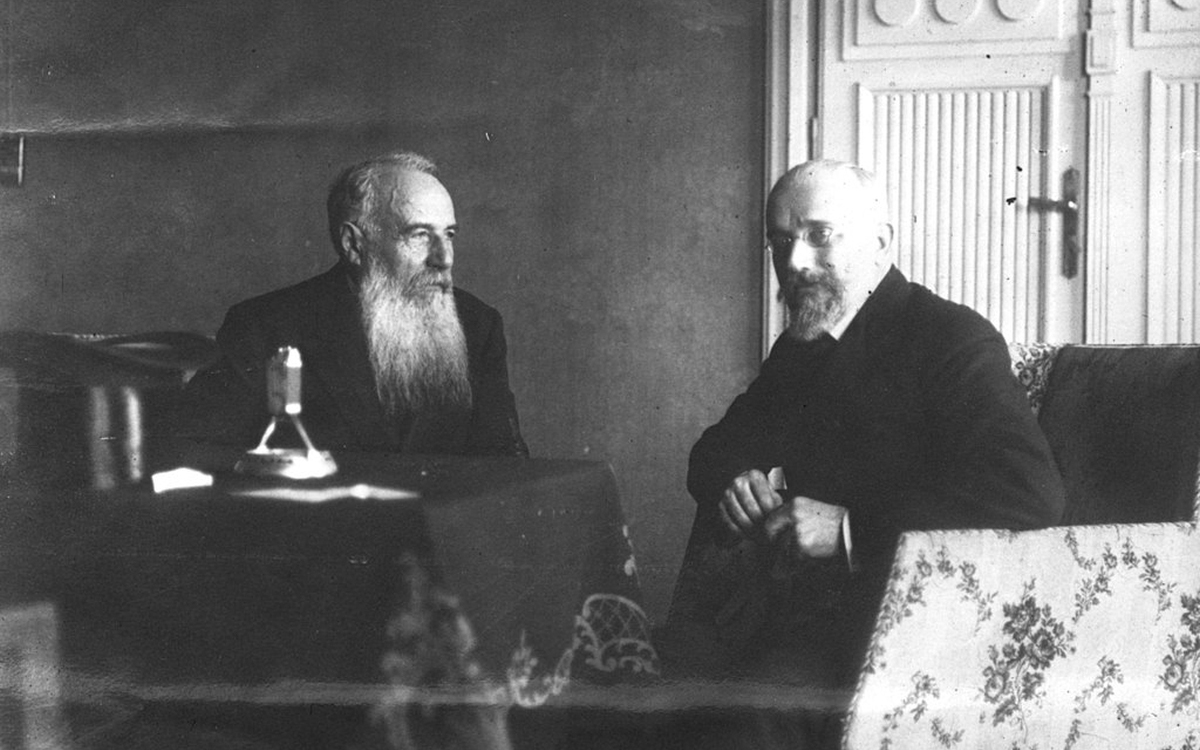
Nikola Pašić was one of the most significant politicians in the history of Serbia and Yugoslavia, the creator of the Vidovdan Constitution of 1921, the first constitution of the Kingdom of Serbs, Croats, and Slovenes. He served as the Prime Minister of both the Kingdom of Serbia and the Kingdom of Serbs, Croats, and Slovenes, and was the founder and leader of the People’s Radical Party.
According to some sources, Nikola Pašić was born on December 6, 1845, in Zaječar, according to others on Saint Nicholas’ Day, i.e., December 19th, and according to still other sources, this politician was born on December 31st.
He began his education relatively late, at the age of eleven. He was educated at a time when, due to political circumstances in the Principality of Serbia, the Zaječar Gymnasium was frequently relocated, and so Pašić also stayed in Negotin and Kragujevac for his studies. Although he started school late, which he finished at the age of 21, the data shows that he was an excellent student.
As an excellent student, in 1868, the Serbian government sent him to study at the Polytechnic School in Zurich. Later, at this school, he received a degree in civil engineering but also acquired a high level of expertise in geodesy.

After a year of practical work, Pašić returned to his country and finally began his political career.
As a student, he became acquainted with the ideas of the United Serbian Youth – a movement founded in August 1866 in Novi Sad, which aimed to cultivate awareness of the past, establish a fraternal community, and advance the Serbs.
In Zurich, he joined the circle of Serbian socialists led by Svetozar Marković – a literary critic and political activist – also from Zaječar.
The life path of one of the greatest Serbian politicians was varied, and his political career was full of twists and turns.

Nikola Pašić began his political career as a socialist in the movement of Svetozar Marković, only to later, in 1881, found the People’s Radical Party.
During the reign of the Obrenović dynasty, Pašić was a “troublemaker” and, due to his leading role in the Timočka Rebellion of 1883, was even sentenced to death.
The rebellion was raised by representatives of the People’s Radical Party against the government of King Milan Obrenović, but the royal army quickly suppressed it, and Pašić fled to neighboring Bulgaria and spent several years in exile.
He spent 11 years in political disgrace and returned to the political scene in 1903 after the May Coup – a state coup in which King Alexander Obrenović and his wife, Queen Draga, were killed.

It can be said that he went through several ideological phases: in his youth, he was a socialist and revolutionary, in his mature years a fighter for parliamentary democracy, while in his later years he became a conservative.
Pašić is known for the fact that after the Balkan Wars of 1912 and 1913, which he initiated, the territory of Serbia doubled.
Nikola Pašić had a direct connection with the leader of the Black Hand, Dragutin Dimitrijević Apis, who worked for the Serbian intelligence service.
This was the reason why Pašić was suspected of complicity in the assassination of the Austro-Hungarian heir to the throne, Franz Ferdinand, by Gavrilo Princip, a representative of the Black Hand.

As Prime Minister in 1914, he was aware that the Austro-Hungarian ultimatum was written to be rejected and that Serbia, already exhausted by the Balkan Wars, was facing difficult years of a new, even more difficult conflict.
Pašić was the one who established an authentic and modern model of Serbian civil politics, which could set its own national, economic, and cultural development goals, in accordance with the tradition formed at the end of the 19th century.
He also helped cultural and scientific creators who reached the world’s top. He devised the policy of “the Balkans to the Balkan peoples” and enabled Serbia to become a strong military power.
Today, this man is attributed to the term Greater Serbianism, as well as the idea of a “Greater Serbia,” although Pašić never used that term or advocated such an idea, even at times when it was offered to him by his allies.

Pašić fought for a Yugoslav state, primarily through internal forces, with the ultimate goal of uniting all Serbs, who were dispersed and mixed with other peoples throughout almost the entire Yugoslav territory, in one state.
History shows that he was a wise, pragmatic, and persistent politician who was respected by like-minded people and political opponents, even by enemies. He uncompromisingly advocated for the democratic parliamentary system of the Serbian state and the so-called patriarchal democracy.
Within the museum in Zaječar, the Nikola Pašić Endowment was founded in 1992, and the museum is located in a street named after him.
He received more than one decoration, including the high Russian Order of the White Eagle with diamonds, the Russian Order of Saint Alexander Nevsky, the Romanian Order of Carol, the Turkish Order of Osmanli, and the Order of the Karađorđe’s Star.
MORE TOPICS:
Source: Danas, Photo: Wikimedia Creative Commons