




The First Serbian Uprising was launched against the oppression of the Ottoman officers called Dahijas in 1804, but by 1805, it had evolved into a national revolution for liberation from centuries of Ottoman rule and the re-establishment of Serbian statehood. Although suppressed in 1813, it paved the way for further struggle, the Second Serbian Uprising in 1815, and ultimately Serbia’s freedom.
The Turks brutally suppressed and crushed the rebels’ resistance. Simultaneously, they attacked from the south, east, and west. The Ottoman Empire employed many soldiers to quell the uprising—its entire striking force: three armies totaling a quarter of a million soldiers—130,000 from Bosnia, 60,000 from Niš, and 60,000 from Vidin.
The soldiers from Bosnia first reached the outskirts of Belgrade, in the small village of Sela, near present-day Obrenovac. On October 5, 1813, the Turkish “punitive expedition” entered the village…

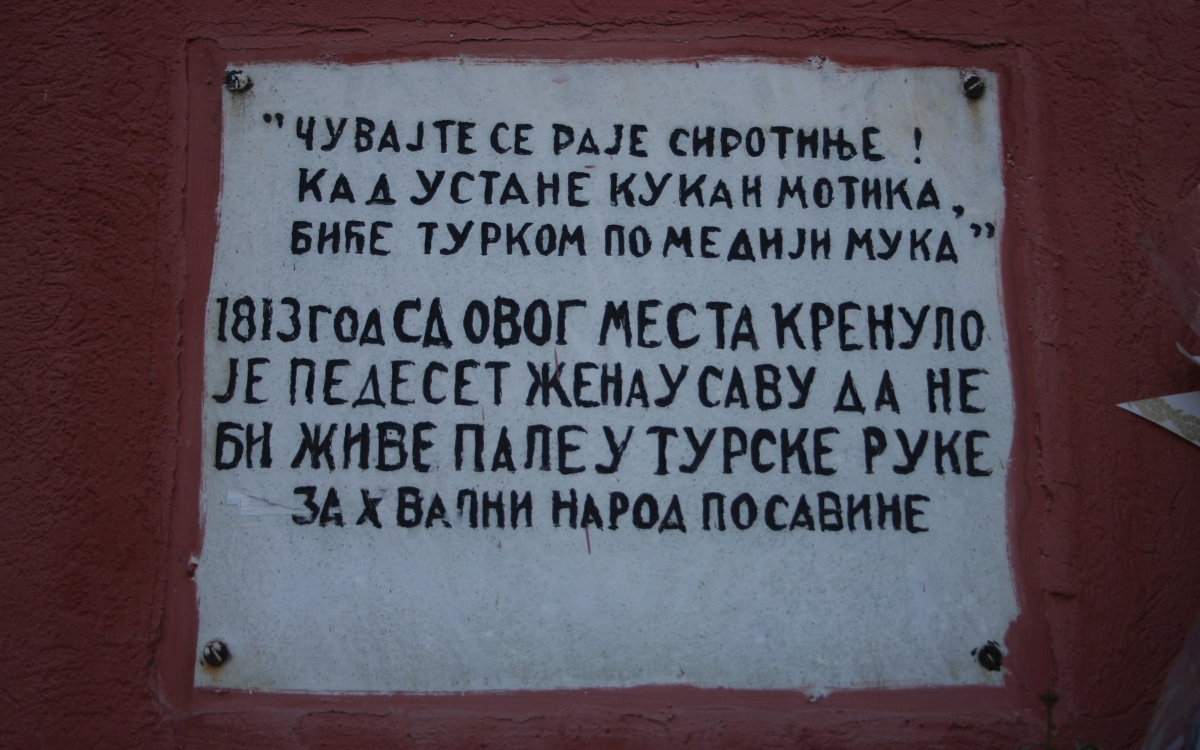
Fleeing the invasion, fifty women and girls from the village, unwilling to be dishonored by the Turks, jumped into the Sava River. Legend has it that they held hands and stepped into death together. Before the Turks could do anything, they had all drowned, preserving their honor and dignity.
In the village, which is now home to fewer than 1800 inhabitants, a memorial still stands to commemorate this act.
“Beware of the poor rabble! When the pitchfork and the hoe rise, the Turk will suffer in the Media,” it reads.
The rebels’ resistance was finally crushed on October 7, 1813, when the Turks entered Belgrade and reestablished the administrative apparatus and organization as it existed before the outbreak of the uprising. Karađorđe and many other leaders fled to Austria.
FIND OUT MORE:
GREAT SUCCESS FOR SERBIAN FEMALE DIRECTORS: Sanja and Emilija Win Awards at Vancouver Film Festival!
HONORING A GREAT SCIENTIST: Prestigious US University holds conference in honor of Mihajlo Pupin!
Izvor: Istorijski Zabavnik
Foto: Wikimedia Creative Commons
 Add Serbian Times as your Google source