




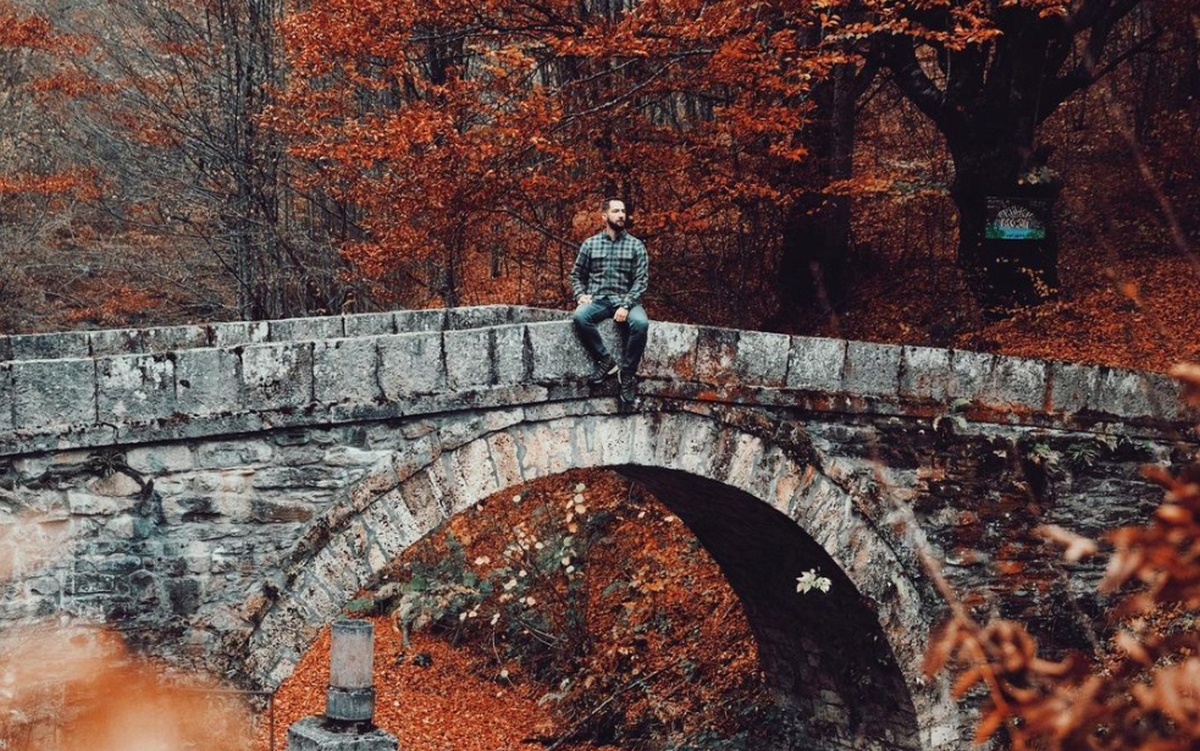
At an altitude of 1,350 meters, on the slopes of Mount Golija, the Golijska Moravica River originates. Then, through the Ivanjica valley, between the Čemerno and Mučanj mountains, it flows and passes through Ivanjica. At the end of its course, it forms the West Morava River, together with the Đetinja River.
During the time of Turkish rule in these areas, the road that passed near today’s Ivanjica was extremely important.
Caravans used to pass through there on their way to Istanbul, and today one of the landmarks of the Ivanjica region and that part of Serbia is hidden there.
The Golija village of Kumanica is located near Ivanjica and today is a place often visited by adventurers and nature lovers. In the area of this village lies one of the two bridges with well-preserved openings. The Golijska Moravica River flows under one, and the Uvac River under the other.
It is assumed that the bridge is called Roman because there may have indeed been a bridge there earlier, which was built even during Roman rule in those areas. However, after the research carried out, it was concluded that the bridge was built much later.
Due to the combination of materials, it is believed that it was built successively. And since the construction style largely resembles the bridges in the imperial city of Prizren, there are indications that the Roman Bridge was built during the 15th century.
The Kraljevo Institute for the Protection of Monuments carried out the restoration of the Roman Bridge in the 1980s.
Today it is a pedestrian bridge.
Although quite well preserved, the Roman Bridge in the area of the village of Kumanica near Ivanjica is not used for tourism, so it is usually known to those who are fond of discovering unusual destinations.
Truth be told, the bridge does not stand out at first glance because it blends perfectly into the nature that surrounds it.
In folk tradition, a legend about the construction of the bridge can also be heard, which, like any other legend, has not been proven. According to it, eggs were used as a binding material for the construction of the Roman Bridge. More precisely, egg whites. And as many as 30,000 of them.
What is known for certain is that the Roman Bridge is among the oldest structures in the municipality of Ivanjica.
TEODORA SPEAKS OUT: Serbian woman from Vienna reveals how the winning Eurovision song was created!
Source: Luftika; Photo: Printscreen Instagram @urosvisekruna