



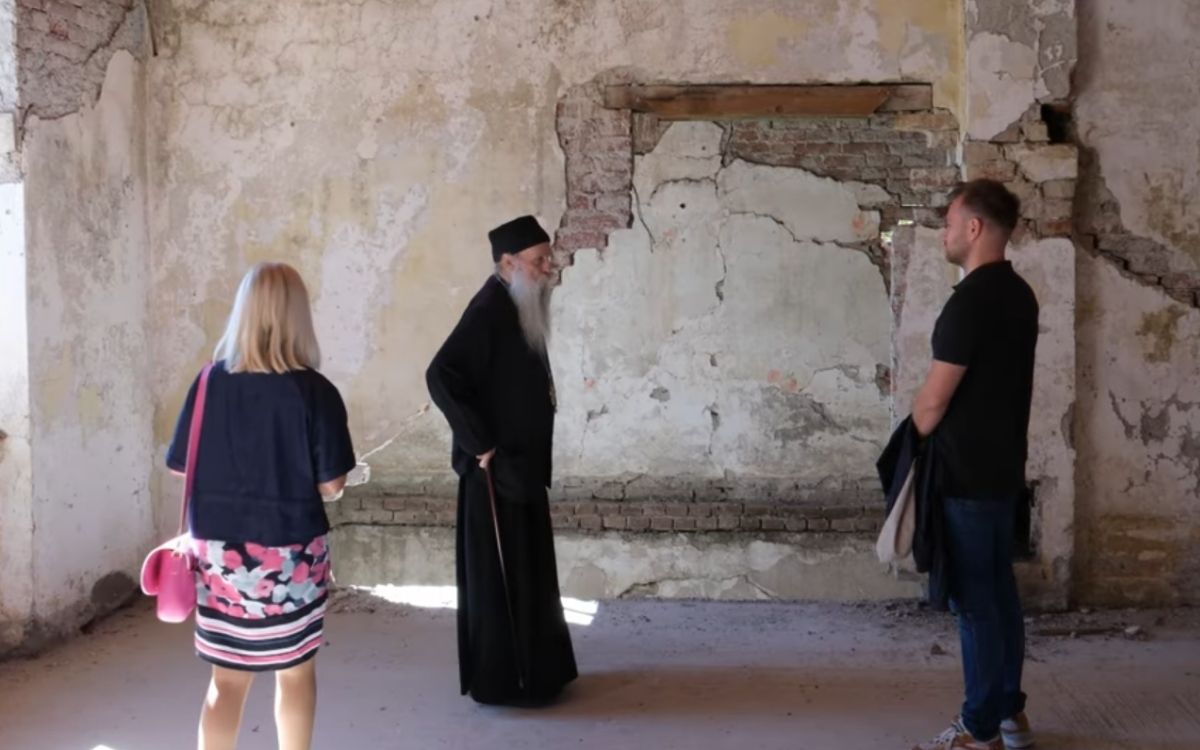
His Grace Bishop Jovan of Pakrac-Slavonia emphasized that the restoration of the Cathedral Church, the Eparchy Library, and the Bishop’s Court in Pakrac means a lot for the fullness of the Serbian Orthodox Church and Orthodoxy, as it testifies to the continuity of the Serbian people’s existence in that area.
Bishop Jovan noted that the Pakrac Library, housed in the Bishop’s Court, as well as Pakrac as an eparchy, which has existed since the time of the restored Patriarchate of Peć in the 16th century, have one of the most valuable roles for the Serbian people.
-And that is that they are witnesses to the continuity of a church, spiritual, intellectual, and national presence. That is the most valuable role, connecting us vertically, through time, as well as horizontally, across borders – said Bishop Jovan.
The Cathedral Church of the Holy Trinity was consecrated at the beginning of September, and the liturgy was served by His Holiness Serbian Patriarch Porfirije, with the presence of bishops from all over the world, which indicates the significance of this holy place.
-There was an envoy of the Patriarch of Jerusalem, an envoy of the Archbishop of Athens, bishops from the Czech and Slovak churches, and this indicates that our church has a much greater significance than local. And for the Serbian people who remained in Pakrac, its significance is immeasurable – emphasized Bishop Jovan for Srna.
The Bishop stated that this was also demonstrated by the people who gathered around the church that day, dancing, singing, socializing, and feasting, as is the custom.
Bishop Jovan notes that there are 50 destroyed churches in the Eparchy of Pakrac-Slavonia, some of which were destroyed in World War II, and some in the last one, in the early nineties of the last century.
-We had to start the restoration with the most important one, which is the Cathedral Church of the Holy Trinity. But the restoration is just beginning – said Bishop Jovan.
The Bishop of Pakrac-Slavonia said that the plan is to restore the church dedicated to the Holy Emperor Constantine and Empress Helena, which is located in the part of Jasenovac called Uštica and was destroyed during the Second World War.
-The construction of a new church, designed by Peđa Ristić, one of the greatest Orthodox architects of the 20th century, only began in 1991. The foundations of that church were consecrated by the late Serbian Patriarch Pavle, and this was the first time he consecrated the foundations of a church as Patriarch. The church was built to a height of three to four meters before the war began – recounts Bishop Jovan.
Bishop Jovan highlighted that the restoration of the Church of the Holy Prophet Elijah in Mlaka, Jasenovac, represents great joy.
-Now we are beginning the fresco painting and furnishing of that church, and I invite everyone to participate. When the Cathedral of Christ the Saviour in Moscow was built, marking the victory in the Patriotic War against Napoleon, there was a limit to how much each person could donate so that all the Russian people could raise that church. In the same way, we want all our people to decorate, paint, and furnish the church in Jasenovac. We talk a lot about Jasenovac, let those words be accompanied by even small deeds – said Bishop Jovan.
EPARCHY LIBRARY DEVASTATED, BUT ALSO RESTORED, OVER TWO AND A HALF CENTURIES
Despite the great suffering it experienced and survived during the wars, the Eparchy Library in Pakrac has existed for 250 years.
-In World War II, the Independent State of Croatia (NDH) abundantly helped itself to its books. There is no record of everything that is missing, because an inventory of everything it had was not made before that war. If we went through the private libraries of Serbian leaders from Croatia, a large part of the books from our library would surely be found, because we find them in such and similar places – said Bishop Jovan.
A good part of the library’s treasure was returned in 1985, thanks to the efforts of the late Metropolitan Jovan (Pavlović) of Zagreb and Ljubljana, who was from Slavonia.
-But it was returned to inappropriate conditions, because the Bishop’s Court was in a very bad state before the war due to the state’s neglect, which, on the other hand, had confiscated property from the Church, so the Church did not have the means to restore it – said Bishop Jovan.
The Bishop points out that the attitude of Croatia towards cultural heritage is best shown by the fact that in the 60s of the last century, Dejan Medaković came on behalf of the Serbian Academy of Sciences and Arts to help with the restoration of the Pakra Monastery, but socialist Croatia did not allow it.
In the early nineties of the last century, the Bishop recounts, an unfavorable period for books and the Library in Pakrac set in again.
-The books, from the room in the northern wing where they were kept, were taken out and thrown into the Court’s yard and a large number of them were stolen. Four manuscripts disappeared, as well as the “Octoechos of the First Tone” by Đurađ Crnojević, which is the first book printed in the Serbian language, which means that someone knew very well what they were stealing – emphasized Bishop Jovan.
According to Bishop Jovan, portraits of bishops from the Bishop’s Court and the iconostasis from the Cathedral Church also disappeared.
In 1995, only ruins remained of the Library and the Church, just four walls.
The Cathedral Church was roofed in 2007, and the Bishop’s Court in 2010, while the major restoration only began in 2013/2014.
-The restoration of the church is complete, and it was the wars of the nineties, who did not allow the books to be destroyed, as the Croatian army had planned. He prevented that plan from being implemented, collected them, and took them to the National and University Library in Zagreb.
-In 2007, those books were returned to the Metropolitanate of Zagreb-Ljubljana with a complete inventory and, indeed, they took care of those books. Ten years later, in 2017, the collection was handed over to us by the then Metropolitan, and now Patriarch Porfirije, and we placed it in a depot, which we made from the old priest’s house. Today, this is the place where we keep manuscripts and books that require a certain temperature and humidity to be preserved, as well as icons from churches that are not in good condition and which are under state protection. A vault is also located in the depot, where important and valuable copies are stored – stated Bishop Jovan.
MORE TOPICS:
BOJOVIĆ HAD A VALID WORK PERMIT: Turnaround in the case of the arrested policeman in Chicago!
Source: RTRS; Photo: Printscreen YouTube