



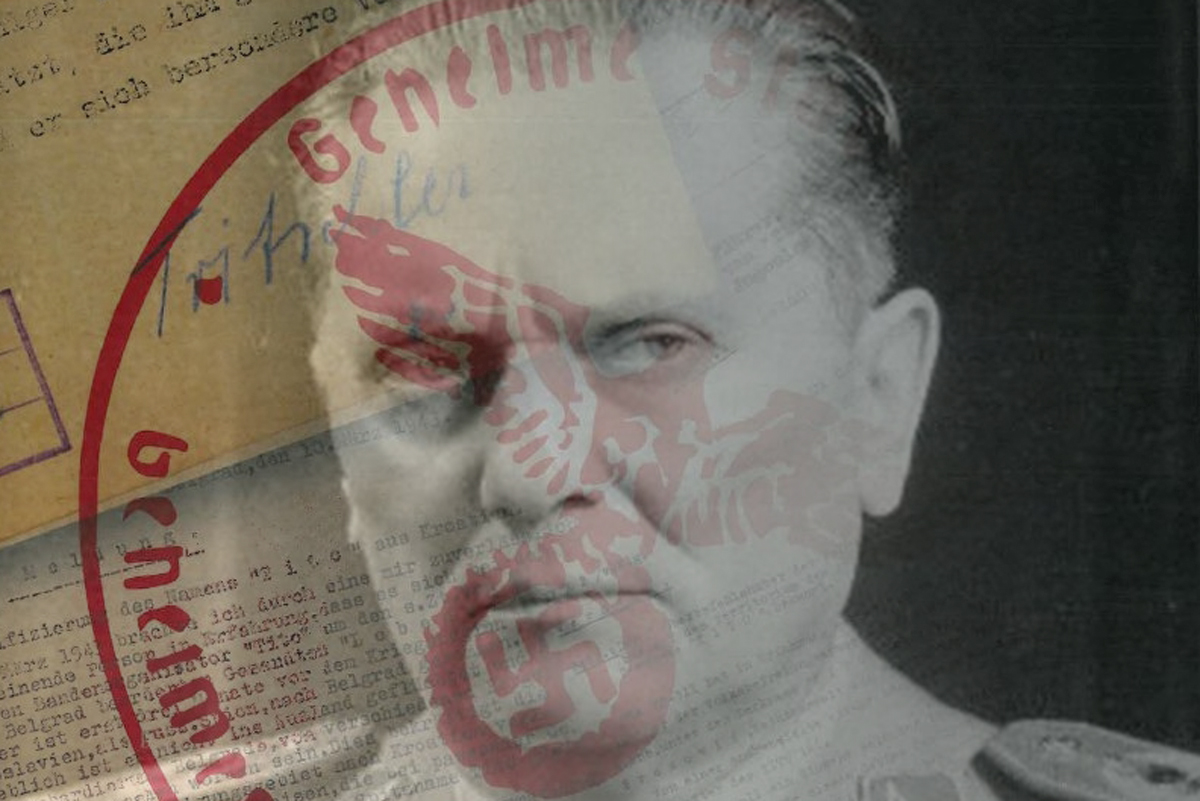
Tihomir Tom(ić), Kamilo Horvatin, Ivan Brozović, Filip Filipović, Niderle, Lebedev, Josip Tomanek, Jozef Vaclaj, Toša Tišmar – these are just some of the identities that Gestapo members attributed to the person known as Tito.
Doubts about the “real” identity of Josip Broz Tito remain relevant even today, almost four decades after his death. In addition to numerous books published in the former Yugoslavia and studies conducted by foreign intelligence services, one of the most notorious secret police forces in history—the German Gestapo—was also puzzled by the mystery surrounding the lifelong president of the SFRY.
In secret, previously unpublished documents reviewed by Newsweek, it is evident that SS officers from 1941 to 1943 had significant difficulties in determining not only what Tito actually looked like but also who he was, where he really came from, and what his true agenda was.

CLOSE TO THE “GERMAN CAUSE”
One of the earliest secret reports discussing Tito’s identity was compiled in September 1942, based on the interrogation of German officers captured after a Partisan attack on a Nazi metal factory in Livno and later released in a prisoner exchange. During their captivity, the German officers had a unique opportunity to talk with Tito, and one of them provided the following testimony:
“It can be said about Tito that after the ban on the Communist Party in Yugoslavia, he was its unofficial leader. It should be noted that he held a high position in the Spanish Civil War and commanded a unit larger than a brigade. After the war ended, he went to Russia, and in the fall of that year (1939, author’s note), accompanied by an English and a Yugoslav General Staff officer, he arrived on the Dalmatian coast via submarine. From them, he received a radio transmitter through which he maintained communication abroad to exchange intelligence.”
Despite the assumption that Tito was deliberately transferred to Yugoslavia by an English submarine (as clarified in a 1943 document), the double or even multiple political games that marked his postwar era had already begun during the war.
The captured German officers were shocked by Tito’s stance that, due to the “horrific bloodshed on the Eastern Front, a truce between the Germans and the Russians must be negotiated, as there was a danger that England and America would once again emerge as the victors.” Tito believed that the victory of capitalist regimes dominating the Anglo-American world would mean disaster, or rather enslavement, for the working class. His statement leads to two possible implications. The first is that Tito’s remarks were intended to weaken the Germans’ fighting morale—convincing them of the futility of their struggle against the Soviets, thereby swaying them in his favor. On the other hand, there is a possibility that Tito was much closer to the “German cause” than previously thought. Supporting this theory is a statement in the report noting that Tito “knew the Germans very well from before” and that he was “surprised they were capable of the crimes they had committed in Belgrade at that time.”
The German officer to whom Tito said this dismissed his remarks, stating that these were “English lies, as they were in World War I,” evidently playing along with Tito’s game.
Additionally, during a lengthy conversation, Tito provided the Germans with a detailed description of the Austro-Hungarian military organization in World War I, demonstrating “very extensive professional knowledge and flawless command of the German language,” leading to the assumption that Tito had been an Austrian officer.
These statements and details about the “bandit leader,” as he was frequently called, led the Germans to question who Tito really was and to invest significant resources in finding an answer—extending their search far beyond Yugoslavia to Paris, Prague, and Soviet Russia.

WELL-MAINTAINED HANDS OF A LOCKSMITH
In a document submitted in October 1942, German intelligence services began examining Tito’s origins for the first time, suspecting—primarily due to his accent—that he was Slovenian or Czech, a theory later confirmed in an interrogation by a certain Dr. Levi Kurt.
Paradoxically, as the number of people providing testimonies about Tito increased, so did the number of contradictions. “We have no clear information about his profession. Sometimes he was described as an intellectual, and at other times he was considered a metallurgical worker from the Ljubljana region. In any case, he is highly intelligent. We are not certain whether he participated in the Spanish War. We cannot determine that based on the materials available to us,” stated a report from October 13, 1942.
While Nazi services across Europe searched archives for Tito’s true identity, intelligence officers in occupied Yugoslavia focused on the only tangible aspect of the elusive Marshal—his physical appearance, which remained unknown to the Germans until the end of 1942.
Only in the interrogation report of Belgrade’s Communist Party Central Committee member Svetozar Marković from January 1943 did the Germans insist on a detailed description of Tito. In addition to physical traits such as “broad shoulders, dark thick hair combed back, a strikingly chiseled and clean-shaven face,” Marković noted that Tito dressed exceptionally elegantly and that he had “very well-maintained hands, despite his supposed occupation as a locksmith.”
Comments on this document reveal that Marković’s testimony piqued the Germans’ curiosity, especially after Gestapo received testimony that same month from officer Mitterhamer, who suggested that Tito “could very well be the same person as Croatian Kamilo Horvatin,” who, before traveling to the USSR in 1925, worked as a journalist in several communist publications in Zagreb. As evidence, Mitterhamer provided a photograph of Tito, based on which a separate report concluded that Tito and Horvatin were identical individuals.
How the German secret services—renowned for their precision and thoroughness—managed to confuse Josip Broz with the well-known Croatian communist and editor of the workers’-peasants’ newspaper Borba, who in 1937 and 1938 accused Tito from Moscow of “giving a completely false picture of the state of the party,” remains unclear.

HE WAS A SERB AFTER ALL
The Gestapo did not dwell long on this mistaken assumption and, within two weeks, pursued further speculation. A document from the German embassy in Zagreb first mentioned the name Ivan Brozović as a potential identity for Tito. “Tito’s real name, based on found photographs and verified sources, is Ivan Brozović. He is a metallurgical worker and was imprisoned until 1934 for communist activities. After his release, he traveled to the USSR for business and, during the Spanish Civil War, went to Spain via France. After that, he took over the Central Committee of the Communist Party of Yugoslavia (CK KPJ), where he remains in charge, and his chief of staff is Arso Jovanović.”
Although further reports from Ustaše services claimed that Ivan Brozović (referred to as Brosović in Ustaše documents) allegedly replaced a certain Gorkić as secretary of the CK KPJ in France—organizing the transfer of Yugoslav communists to Spain—the Gestapo quickly determined that Ivan Brozović was not Tito, but rather his associate and a lawyer from Herzegovina.

Due to their failure to locate Brozović, the Germans turned to information from the Ljotić movement. From these circles, an unnamed German officer presented a controversial version of Tito’s origins, different from all previous ones, which was noted with caution in the documents.
MORE TOPICS:
Source: Novak Lukovac (Text was first published in a Serbian Newsweek, br. 79, jun 2017.)
Photo: Wikimedia Creative Commons / Privatna arhiva