




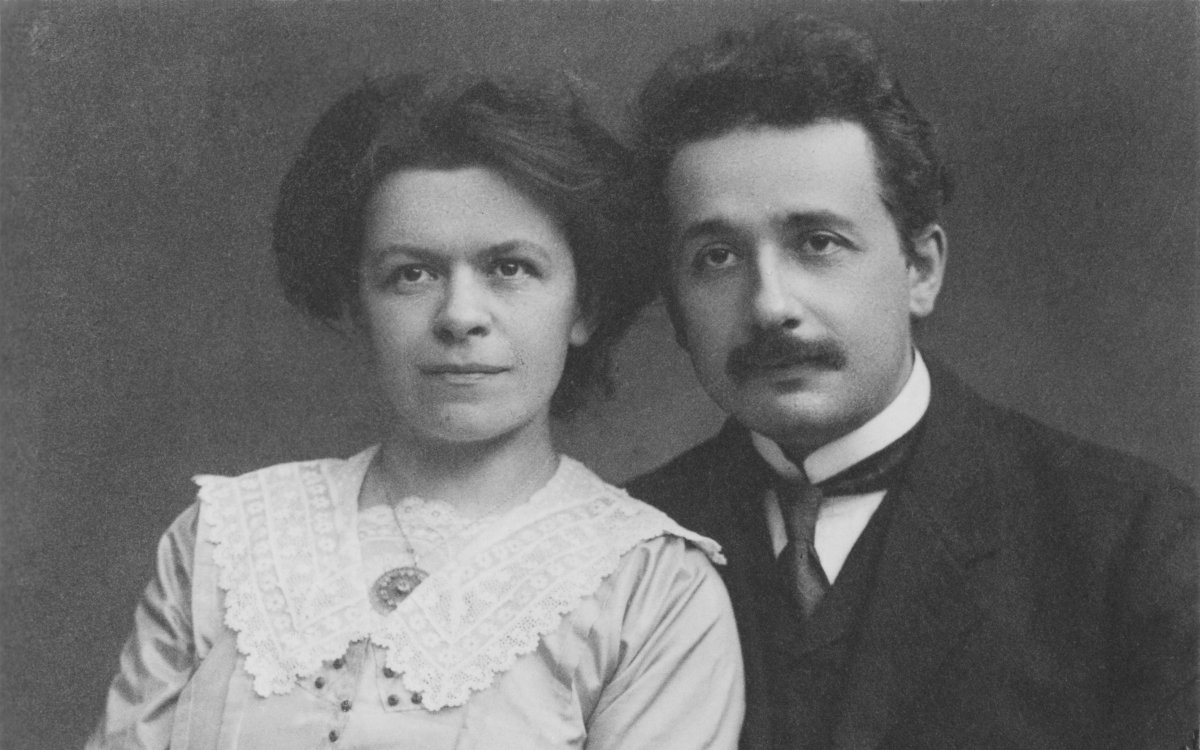
The Ministry of Culture has purchased letters exchanged between Mileva Marić and Albert Einstein as a married couple.
The purchase of the letters was made in preparation for the 150th anniversary of the birth of the Serbian physicist and mathematician, and the documentary material consists of a series of 43 signed letters from Einstein to Mileva, along with ten signed by her and sent to Einstein.
These letters, as well as other traces, indicate that Mileva had an influence on the early phase of Einstein’s scientific work, but that does not mean we can consider her the “mother of the theory of relativity,” explains physicist and science journalist Slobodan Bubnjević for Euronews Serbia.
“There are two things that should always be emphasized in this regard. First, such a fundamentally different and revolutionary theory, such as the special theory of relativity that Einstein presented in 1905, is certainly not the product of just one mind. A great deal of knowledge and work that preceded it, both immediately before Einstein’s own work and, of course, with the contribution of Mileva Marić, was already incorporated into it,” explains Bubnjević.
Our interlocutor, as the second thing that should not be lost sight of, mentions the position of women in science in the early twentieth century, when they were not allowed to shine even close to the level that was allowed to men.
“With her outstanding successes during her studies, she showed great talent and great ability, but it could not be expected that someone from her position would get the opportunity to make that kind of contribution. It certainly is not true that she did everything, and Einstein only contributed a little, because after the divorce, Einstein developed the general theory of relativity and came to some other findings, but it is actually very difficult to dispute that she made her contribution and that is how we should think about it,” the physicist believes.
A part of the intellectual elite in physics
Mileva Marić was born on December 19, 1875, in Titel in Bačka. Since this was the command post of part of the Military Frontier of the Habsburg Monarchy, in addition to her native language, she learned Hungarian and German, which she perfected through schooling, and she also studied French.
She was a withdrawn and excellent student and changed several schools, and she finished the last year of high school in Zurich, Switzerland.
In the summer of 1896, she enrolled in the summer semester of the Faculty of Medicine at the University of Zurich, but in October she decided to switch to studying mathematics and physics at the Swiss Federal Polytechnic. She was only the fifth woman to be admitted to this educational institution and, at that time, she was the only woman in the group.
In the same group were Marcel Grossmann, Louis Kollros, Jakob Erath, and Albert Einstein, as the youngest (he was only 17 years old at the time).
In the spring of 1897, sympathy and a student romance developed between Albert and Mileva, which culminated in marriage in 1903.
While Einstein devoted his time to physics, his wife raised their children and gave up her studies.
“At the time when this was happening, there was no other alternative to such a resolution of the situation. Only the influence that Marie Curie had on science in the twenties, thirties, and forties will actually lead to women taking more significant positions in science, and it is realistic to expect that what happened to Mileva Marić happened to other women who entered science,” explains Bubnjević.
It is difficult to determine the extent of Mileva’s contribution
However, the grades she received and the very possibility of actually listening separately from Einstein for one year show that she really did belong to the intellectual elite in physics at that time, our interlocutor believes. Despite this, even for Einstein, it was unattainable at that time to expect any position at the university, let alone for a woman.
“In that sense, this is a position that those who study the position of women in science today use abundantly, and they return to it very often,” says the physicist.
One of the arguments often used by those who believe that Mileva made a much greater contribution to the special theory of relativity than history acknowledges is that Einstein paid the money from the Nobel Prize, which he won after their marriage ended, to her and their children.
However, this is not the right conclusion, according to Bubnjević.
“Given that he received the award at a time when he had already left for Berlin and actually left the family, and she remained in Zurich with the children, it was his desire to take care of them, among other things. It was a gentlemanly gesture. Her scientific help is proven through letters. It is very difficult to say to what extent Mileva’s contribution was, but in the end, he had a conversation partner and accomplice in that great undertaking at home while he was developing the special theory of relativity, the fact that she says in one of her letters: ‘We have now written a work that will make my husband famous’,” points out the science journalist.
One of the reasons why it is impossible to determine her contribution is that there are no works that she signed separately, our interlocutor explains.
A tragic end
Mileva and Einstein’s marriage fell into crisis after the birth of their second child, Albert. (Their first, out-of-wedlock daughter, Lieserl, disappeared without a trace after the age of two).
Einstein began corresponding with his cousin Elsa, with whom he had been in love as a boy, and the affair would last for years, even after they had another son, Eduard.
In the spring of 1914, Albert was granted permanent membership in the prestigious Prussian Academy of Sciences, so they moved together to Berlin, but at the beginning of summer, the day before the outbreak of the First World War, Mileva packed her things and returned to Zurich with her children, as it became clear that Einstein would not give up Elsa.
They divorced in 1918, two years after Albert filed for divorce. Mileva took it hard, explains historian Nebojša Damnjanović for Euronews Serbia.
“Mileva comes from a good family, but as often happens, she was also endowed with a certain nervous instability. Her sister was also in a psychiatric hospital, and one of her children as well. This is not at all coincidental or exceptional, because with great gifts, people often carry extraordinary burdens,” explains Damnjanović.
Mileva was in debt due to the treatment of Eduard’s illness, and after one of his violent attacks, she lost consciousness.
She died on August 4, 1948, at the Zurich “Eos” clinic, where she had been admitted a month earlier due to a stroke. She was buried in the Nordheim cemetery in Zurich, but her grave was only found in 2004 thanks to Petar Stojanović, the founder of the Nikola Tesla Memorial Center in St. Gallen.
“Her fate was tragic, but we Serbs can be touched that a woman from our nation was the wife of Albert Einstein and that during a very fruitful time for him,” concludes Damnjanović.
Memorial house in Ruma and personal fund in the Serbian Archive
Next year marks the 150th anniversary of the birth of Mileva Marić Einstein, and by then, the construction of a memorial house dedicated to the physicist and mathematician should be completed, and that in Železnička Street in Ruma, where she once lived with her parents.
The completion of the works is planned for June 2025, and the president of the Municipality of Ruma, Dušan Ljubišić, told Euronews Serbia that the project was initiated at the initiative of the citizens.
“The house was owned by a private individual who donated the location and the then house to the local self-government. We secured funds with the help of the Ministry of Culture, which significantly finances this entire project, and I assume that when the house is completed and opened to visitors, it will be the pride of all Ruma citizens,” Ljubišić emphasized.
MORE TOPICS:
JAĆIMOVIĆ UNWAVERING: I will drive students to the protests even if they seize my buses again!
DUE TO FORCED LABOR IN THE ZRENJANIN FACTORY: America ordered the retention of goods from Linglong!
Source: Euronews, Photo: Wikimedia Creative Commons