




The British BBC has published an extensive report on the controversial plan by Donald Trump’s son-in-law, Jared Kushner’s company, to build a multi-purpose complex, branded as “Trump Tower Belgrade,” on the site of the bombed General Staff building in central Belgrade.
One of the first sights greeting visitors in the center of Serbia’s capital, Belgrade, is government buildings in a serious state of decay, the BBC notes, recalling that NATO planes bombed them back in 1999 – and they have remained almost unchanged to this day.
The message such a sight sends to visitors could be: “Welcome to Serbia – our recent history has been turbulent and complicated, and we still haven’t fully processed it.”
Like a smile with a row of broken teeth, the Ministry of Defense buildings still stand. But it is clear that they suffered a severe blow when NATO intervened to stop Serbia’s military campaign in Kosovo at the time.
As a member of the Western military alliance, the United States was directly involved in that bombing.
In light of that history, it was a shock for many Serbs last year when the government signed an agreement with Affinity Global to redevelop that space and build a $500 million luxury hotel and apartment complex.
Not only because the firm is American, but also because its founder is Jared Kushner, best known as Donald Trump’s son-in-law. And because the planned complex is to be called “Trump Tower Belgrade.”
Although a major obstacle has now emerged that calls the entire project into question, the Serbian government’s decision to conclude this agreement is actually not surprising.
Because, before he became US president in 2016, Donald Trump himself expressed interest in building a hotel on that very spot.
Such a move also fits a pattern of behavior by the authorities – as the opposition claims – of allowing foreign investors to profit from public property.
The main example cited is the Belgrade Waterfront project – a residential and commercial complex built by a UAE investor on land that previously belonged to Serbian railways.
Where rusty wagons and abandoned tracks once stood, there is now a modern shopping mall, luxury restaurants, and an unusual, curved 42-story Belgrade Tower. However, not everyone likes it.
But that was a neglected industrial zone – not a landmark in the heart of the city. The Ministry of Defense complex is a completely different matter – not only because it serves as a memorial to the victims of the 1999 bombing.
It is also a strong visual reminder of why the vast majority of Serbian citizens still feel aversion to NATO, and why they sympathize with Russia.
In that context, giving an American investor the right to use the location for 99 years, allegedly without any upfront compensation, is a bold move.
Vučić sees a chance to build better relations with the US
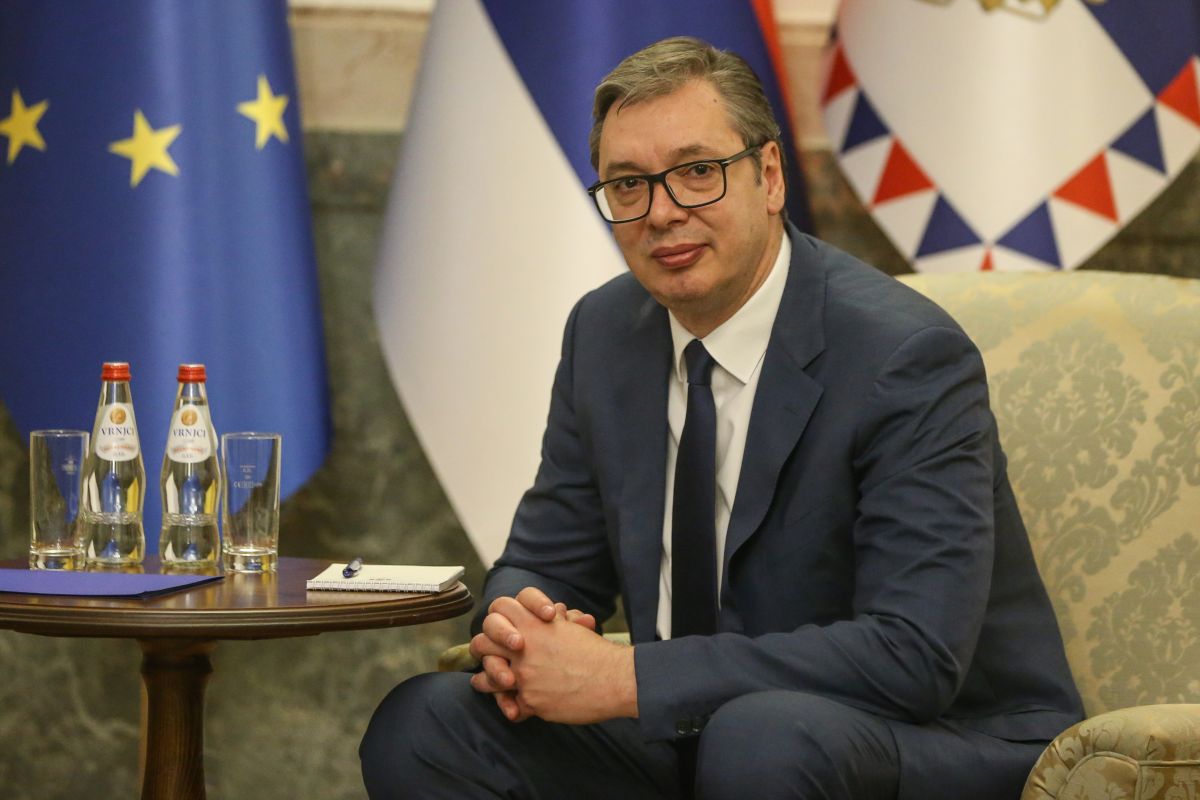
But Serbian President Aleksandar Vučić feels no need to justify himself. “It is important that we overcome the burden from 1999. We are ready to build better relations with the United States – I think that is extremely important for this country,” he told the BBC.
Such a stance meets with a certain understanding from the international business community in Belgrade.
The inflow of direct foreign investments has more than tripled in the last decade. However, GDP per capita is still low compared to EU members – only a third of the Union average.
To keep these numbers moving upwards, attracting new investors is key. And while the financial details of the project are not publicly available, the New York Times reported that the Serbian government will receive 22 percent of future profits.
“For a small and specific market – the former Yugoslavia, outside the EU – any publicity is good publicity. If big international players come, it attracts attention. You get both recognition and opportunity,” says James Thornley, former partner at KPMG Serbia, now a partner at KP Advisory in Belgrade.
Thornley has lived in Serbia for 25 years and is aware of the sensitivity of the topic. But he believes that people’s opinions will change once they see the benefits of the project.
“That space is an eyesore and needs to be resolved. Nothing has happened for 26 years – let’s fix it,” he says.
“If this were happening even in Romania or Bulgaria – there would be a tender”
However, not all international investors are so enthusiastic.
Andrew Pearson, former director of CBRE for Southeast Europe, now runs iO Partners, a company focused exclusively on that region.
He acknowledges that the dilapidated state of the Ministry complex is “bad for the city’s image” and that the project is probably “good news because it shows that the country can attract large investments.”
But he has serious objections to the way the deal was concluded with Affinity Global. Pearson claims that there was no public tender, which would have allowed other firms to compete.
“For state property, you need to be able to prove that you are getting market value, and that is usually achieved through a public tender. If this were happening in the UK, Germany, Hungary, or even Romania or Bulgaria – there would be a tender. It would go to the open market. Investors who are already present or want to enter would have a chance to buy that land,” says Pearson.
As early as 2023, Vučić said that he had an “extraordinary conversation” with Jared Kushner about “the potential for large and long-term investments.”
Since then, Donald Trump Jr. has visited Belgrade multiple times, as it was announced that a part of the complex would be a Trump International Hotel. The role of the Trumps, it is stated, is limited exclusively to the hotel part.
Questions about a possible conflict of interest, given that Donald Trump has returned to the White House, were dismissed by his spokeswoman who claims that the president does not profit from this deal.
Pearson, however, wonders how companies that have already invested significant funds in Serbia feel: “If I were an investor who had already invested tens or hundreds of millions, I would be disappointed that I didn’t get an opportunity.”
Neither Affinity Global nor the Serbian government responded to the BBC’s questions about how the deal was made, or whether there was a public tender at all.
Historically and architecturally significant location
And then the question arose – should a commercial complex even be allowed to rise on that site? The building, even now in ruins, remains significant both architecturally and historically.
It was originally built to welcome visitors to the capital of Tito’s Yugoslavia. Architect Nikola Dobrović designed two buildings on either side of Nemanjina Street, which together form a symbolic gate.
The shape of the buildings also resembles the Sutjeska canyon – the site of a decisive partisan victory over the Nazis in 1943. And since 2005, the complex has enjoyed protection as a cultural asset of Serbia.
“A serious city does not build a modern future by destroying its historical centers and cultural monuments. If Serbia wants to progress, it must first respect its own laws and cultural heritage. According to the law, it is not possible to revoke protection for this site,” says Estela Radonjić Živkov, former deputy director of the Republic Institute for the Protection of Cultural Monuments.
A twist worthy of a Hollywood thriller
But just when it seemed that the fate of the place was sealed, the Prosecutor’s Office for Organized Crime delivers a twist worthy of a Hollywood thriller.
On May 14, an official who gave the green light for the revocation of the Ministry’s protection was arrested – Goran Vasić, acting director of the Institute.
The prosecution announced that Vasić admitted to falsifying an expert opinion that served as the basis for revoking the cultural property status. He was charged with abuse of official position and falsification of documents.
Opponents of the project see this affair as proof that Kushner had preferential treatment – which the authorities deny.
Where this now leaves Affinity Global and the planned Trump hotel – it is not yet entirely clear.
Multiple attempts to interview company representatives were unsuccessful, but in a statement, they said that Goran Vasić “has no connection with our company,” and that they will “assess the situation and decide on further steps.”
Vučić, on the other hand, denies that there is any problem: at a summit of European leaders in Tirana, he stated that “there was no falsification.”
For now, it seems that the ruined remains of the Ministry of Defense will remain unchanged for some time yet. And thanks to the Trump connection – there will be even more talk about them among those who come to Belgrade for the first time.
MORE TOPICS:
RECTOR ĐOKIĆ IN BRUSSELS: Meeting with EU Commissioner on higher education crisis in Serbia!
Source: N1, Photo: ATA Images