




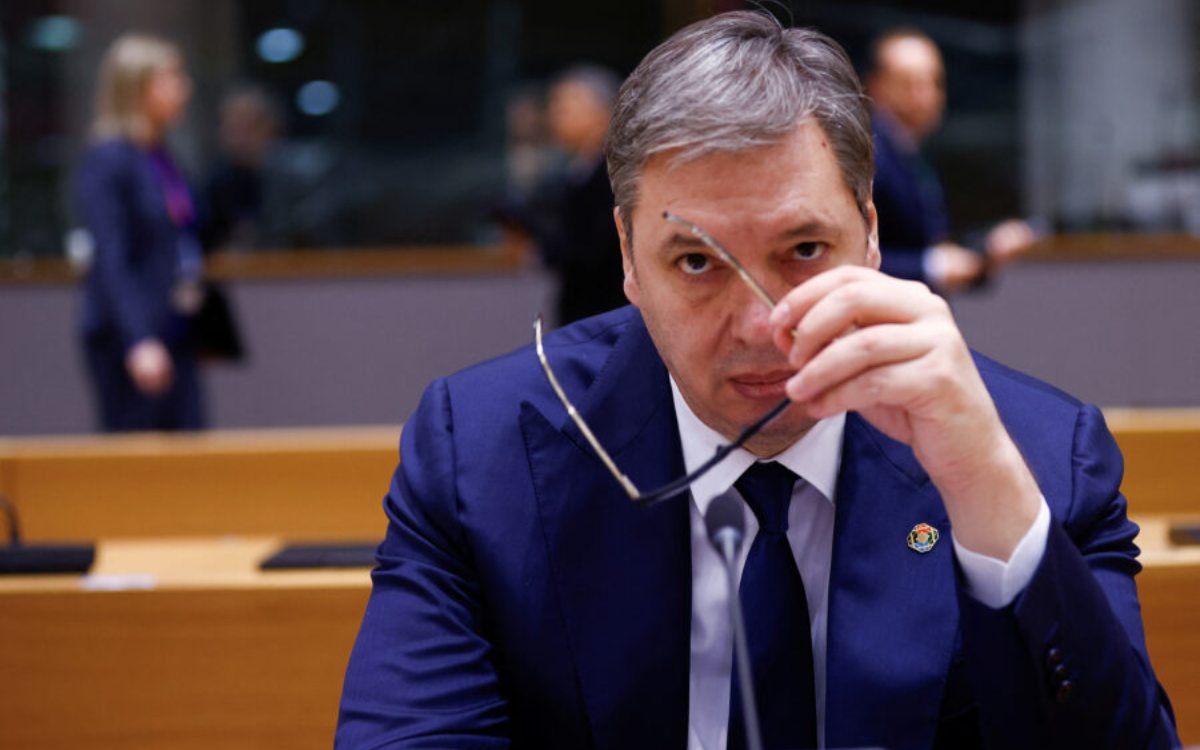
Serbian President Aleksandar Vučić has called for a consultative referendum on his removal from office.
He made the proposal citing data from a survey conducted by the research mission Crta, according to which 61% of Serbian citizens support student protests, and 52% of them would vote for the dismissal of the President of the Republic in a referendum. Although they may have the opportunity to answer the referendum question, the voters’ decision will not be decisive.
A consultative referendum is “not legally binding”, so the legislative and executive authorities are not obliged to act in accordance with the referendum decision, as stated in the Law on Referendum and People’s Initiative. It differs from a binding referendum, which is also adopted by a majority of voters who cast ballots and which “produces legal effects from the day the total results of the referendum are announced,” the law adds.
Members of the ruling coalition will submit 100 signatures on Wednesday to hold a consultative referendum on confidence in the president, announced the Speaker of the National Assembly, Ana Brnabić. In the first reactions to this proposal, representatives of opposition parties say that “this is an attempt to divert attention from the protests” and that they do not want to participate in this “performance”.
Who calls for a consultative referendum and why?
The National Assembly calls for it “on an issue of broader significance within its jurisdiction in order to obtain the opinion of citizens on a decision to be made on that issue,” according to the Law on Referendum. In addition to the referendum question and the proposed answers, it must be clearly stated that it is a consultative referendum.
The Assembly is then obliged to “expressly state whether it accepts or rejects the opinion of the citizens obtained when making a decision,” it adds.
The highest legislative body in Serbia is obliged to hold a consultative referendum even in cases where it adopts an act contrary to the decision previously made in a referendum.
However, in the case of changing the law or adopting new laws contrary to the opinion of citizens expressed in consultative referendums, the National Assembly is not obliged to do so.
Can the president be removed by referendum?
No, according to existing laws. The mandate of the President of the Republic ceases when his term expires, by resignation, or by removal, as stated in the Constitution.
The decision to remove the President of the Republic of Serbia is made in the National Assembly if it is considered that he has violated the Constitution, and to initiate a vote on removal, the support of at least one-third of the deputies is required, as stated in the Law on the President of the Republic.
Then, the Constitutional Court decides within 45 days whether a violation of the Constitution has occurred. If it is determined that there has been a violation, the procedure continues in the assembly, where two-thirds of the votes are required to remove the president. If the Constitutional Court decides that there has been no violation of the Constitution, the removal procedure is terminated when the decision is published in the Official Gazette.
What have Serbs voted on in referendums?
Since the introduction of a multi-party system in Serbia more than three decades ago, Serbs have voted in referendums seven times. Referendums in 1990, 2006, and 2022 were organized due to constitutional changes.
Almost 90% of voters in July 1990 supported the adoption of the Constitution of the Republic of Serbia, constitutional amendments were supported by about 53% of those who voted in October 2006, and the “Mitrovdan” Constitution was adopted, and in 2022, 60% of voters supported constitutional amendments, with a turnout of just over 30%. In 1992, there were as many as three unsuccessful referendums on constitutional amendments and state symbols, and in one of them it was proposed that “March on Drina” become the national anthem.
In April 1998, a vote was taken “on the participation of foreign representatives in resolving the problem in Kosovo and Metohija”, and almost 95% of voters voted against it.
READ MORE:
INTERVIEW, HUSA: How Džej (Jay) prevented bloodshed on Belgrade’s streets in the 1990s (VIDEO)
Source: BBC News, Photo: REUTERS / Johanna Geron