




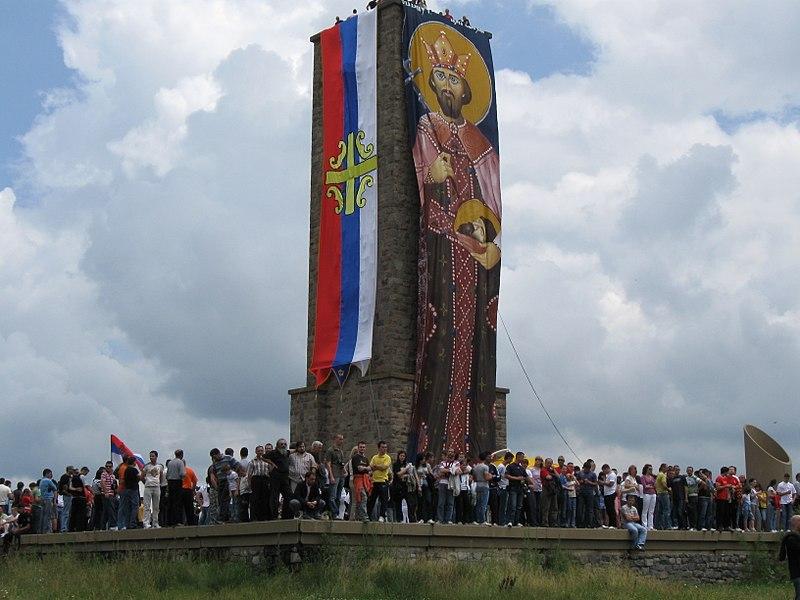
Vidovdan plays an important role in both religious and historical contexts. Find out what happened on this day and in the days before or after it in the text that follows.
In the collective consciousness of the Serbian people, Vidovdan is not just a religious holiday – the day when believers celebrate Saint Vitus’s Day. Vidovdan in Serbia has a layered meaning. It speaks of history and tradition, of important decisions and events, sacrifices and wars, and all of this speaks of the continuity of a nation’s existence and the building of its identity.
It all began with the Battle of Kosovo.
Battle of Kosovo (1389)
It should be known that this, the most significant battle for Serbs, was the First Battle of Kosovo, as others occurred in that locality and its immediate vicinity afterwards. It took place on June 15th (according to the old calendar) near Priština between Christians and Ottomans.
Serbian forces were led by Prince Lazar Hrebeljanović, and among them were forces of his relatives and allies, while the Turkish army was led by Sultan Murad I with his sons Jakub and Bayezid.
Secret Convention of Serbia and Austria-Hungary (1881)
On Vidovdan in 1881, an agreement was also signed by which Serbia committed not to conclude any political or economic agreements with other countries without the prior approval of Austria-Hungary. In exchange for complete subjugation to Vienna, the Serbian state and the Obrenović dynasty, as a kingdom, received internationally recognized independence.
Battle of Bregalnica (1913)
Although it did not happen on that exact date but a few days later, this event is tied to Vidovdan because the Vidovdan celebration was still ongoing. Just a few days later, on June 30, 1913, the Bulgarians launched an attack on Bregalnica, which was the prelude to the Second Balkan War.
Sarajevo Assassination (1914)
The Sarajevo or Vidovdan Assassination occurred on June 28, 1914, in Sarajevo (Bosnia and Herzegovina), when Gavrilo Princip from a group of six assassins (five Serbs and one Bosnian Muslim), members of the Young Bosnia organization coordinated by Danilo Ilić, killed Austro-Hungarian Archduke Franz Ferdinand and his wife Sophie, Duchess of Hohenberg.
The political motives for the assassination were the desire for the separation of the Austro-Hungarian province of Bosnia and Herzegovina and its unification into a Greater Serbia or Yugoslavia. Serbian army officers were behind the organization of the assassination. The assassination directly led to the First World War when Austria-Hungary issued an ultimatum to Serbia, which it partially rejected. Austria-Hungary then declared war on Serbia, which triggered a series of war declarations between other European powers.
Treaty of Versailles (1919)
The Treaty of Versailles, which ended the First World War, was signed on June 28, 1919, the same day the Sarajevo assassination occurred, which was the cause of its beginning.
Vidovdan Constitution (1921)
The continuation of the story about the continuity of existence
Source: Vesti online Photo: ©commons.wikimedia/Radosav Stojanović/public domain