



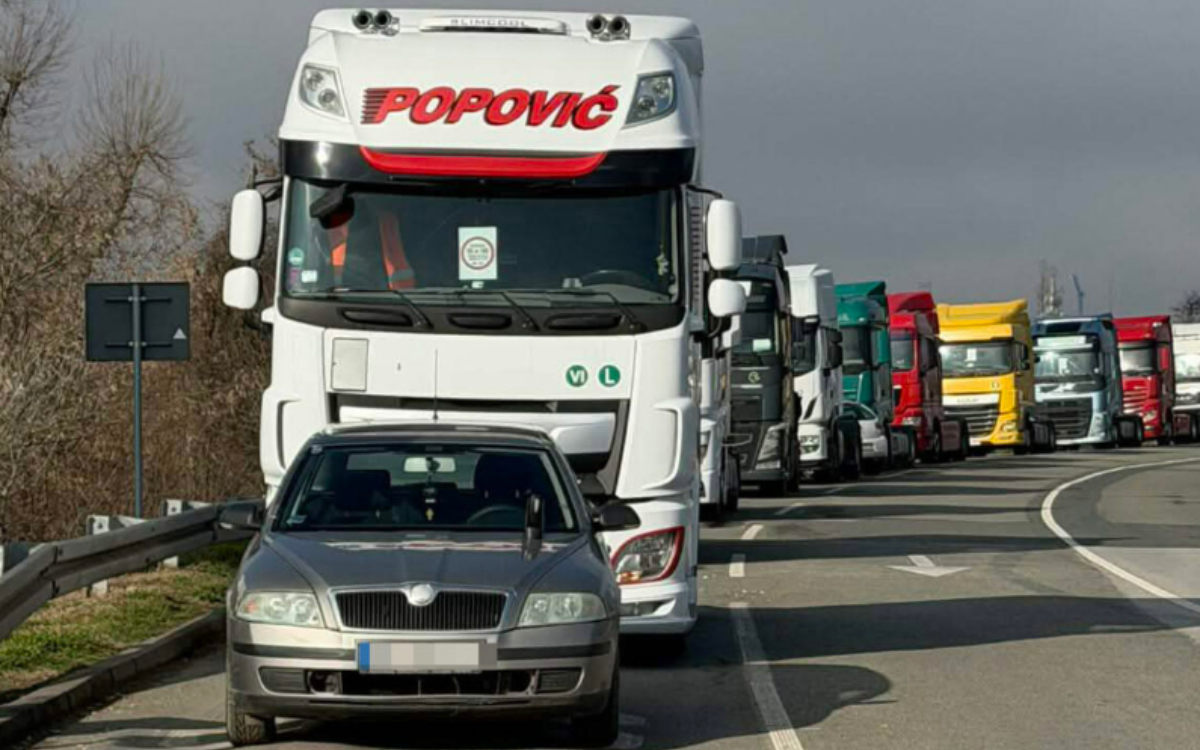
Truck drivers from Serbia, Bosnia and Herzegovina, Montenegro, and North Macedonia began blocking freight terminals at several Balkan border crossings on January 26 at 12 p.m., in protest against the introduction of a new EU system at border checkpoints. Among them are Borislav Popović and Neđo Mandić, positioned at the Batrovci and Bačka Palanka crossings. In an interview with Nova, they explain how the blockade is unfolding, how many truckers are involved, how long it will last, and why the new EU system is unacceptable for them.
Experienced Drivers Leading the Protest
Borislav Popović from Bačka Palanka has been driving trucks for decades. He is currently at the Bačka Palanka border crossing and is a member of the so-called Truckers’ Crisis Staff organizing the blockade.
“To our eyes, the blockade has succeeded so far. The new EU system being implemented is bad for us and our work, which is why we took action,” Popović told Nova.rs.
“All border crossings used by freight trucks are literally closed. Today is the second day. I wish I could say it’s the last, but it’s not. The blockade will probably continue. There have been some positive reactions from the European Commission, which is good for us, but we’ll see how it develops,” he added.
He emphasizes that none of them are certain whether the proposed solutions from the European Commission will benefit truckers, which is why they remain at the borders until everything is received in writing.
Limited Passage Allowed
Popović says only a very small amount of goods are being allowed through.
“Only imported medicines, live animals, possibly explosives, dialysis equipment, and any goods that can be justified as urgent can pass. Our Crisis Staff of four decides on these matters,” he explains.
Some truckers live close to the border, while others are up to 300 kilometers away, forcing them to sleep in their trucks. Despite the difficulties, they are determined not to abandon the blockade.
Organized Shifts
“We have six-to-eight-hour shifts, with properly marked marshals wearing vests and badges so colleagues know their shifts in advance. If food or water is needed, anyone who can helps.”
At the Bačka Palanka crossing, 14 trucks are currently participating.
“Our goal was not to mass trucks. We didn’t want to bring hundreds of trucks and endanger residents or increase police workload. We went with the minimum number necessary to break the supply chain, not to show force or create unnecessary chaos. The police coordinate with our marshals if problems arise, but so far, there has been no need. We also printed flyers in multiple languages for foreign drivers stuck in the protest lanes to keep them informed.”
According to Popović, the European Commission recognized truck drivers as a special group in a written statement, which they view as significant progress.
“They said they are monitoring the situation and supposedly working on a kind of visa package for special groups like drivers and athletes. We hope this goes in the right direction, because professional athletes face similar issues as we do,” he said.
Why Truckers Oppose the New EU System
Popović explained that the new EU system at border crossings is problematic for truckers.
“Previously, the Schengen border was the border of Germany. It took us two days of driving to enter that zone. You enter Germany, load and unload in a day, and in two days you’re out of Schengen again. Now, with the expanded borders, we’re already in the EU and Schengen as soon as we start our route. We spend much more time in Schengen than before. If they expanded the territory, they should have proportionally increased the number of days for us.”
Determined Despite Heavy Losses
The truckers are determined, even though the blockade carries heavy and incalculable costs.
“This costs us a lot, of course, but we have no other choice. We won’t send our drivers to be treated like clay pigeons and arrested — not even if it takes a month or two at the borders. There’s no choice. No one will cross to be arrested anymore. Recently, driver arrests have become frequent, which is unacceptable. Migrants receive housing, social benefits, healthcare, and assistance in cities, while our drivers, who transport their goods, are arrested. It’s absurd,” Popović told Nova.rs.
Neđo Mandić added that drivers should be left alone to do their jobs.
“Until a new acceptable rule is introduced, let drivers work. We will continue our actions, but if we get guarantees that drivers can safely do their jobs, we will stop the protests. This affects all Western Balkan drivers, not just Serbian ones,” he said.
Where the Blockades Are
According to the Serbian police on January 26, border crossings blocked include routes to Croatia, Romania, Bulgaria, Montenegro, Bosnia and Herzegovina, and North Macedonia: Batrovci, Šid, Bogojevo, Bačka Palanka, Neštin, Bezdan, Horgoš, Kelebija, Vrška Čuka, Gradina, Strezimirovci, Srpska Crnja, Vatin, Kaluđerovo, and Preševo.
“We have 17 border crossings and four administrative crossings to Kosovo. All of us — transporters from Serbia, Montenegro, BiH, and North Macedonia — started the blockade at the same time with the same demands,” Mandić said.
Economic Damage
Due to the border blockade and the inability to export goods, Balkan countries are suffering direct losses estimated at €100 million, said Marko Čadež, president of the Serbian Chamber of Commerce (PKS), to Radio Television of Serbia.
“Direct losses for Serbia amount to €55 million,” he added. Companies that fail to export on time face penalties ranging from €10,000 to €50,000 per day, Čadež noted.
MORE TOPICS:
Source: Nova.rs, Foto: Privatna arhiva