




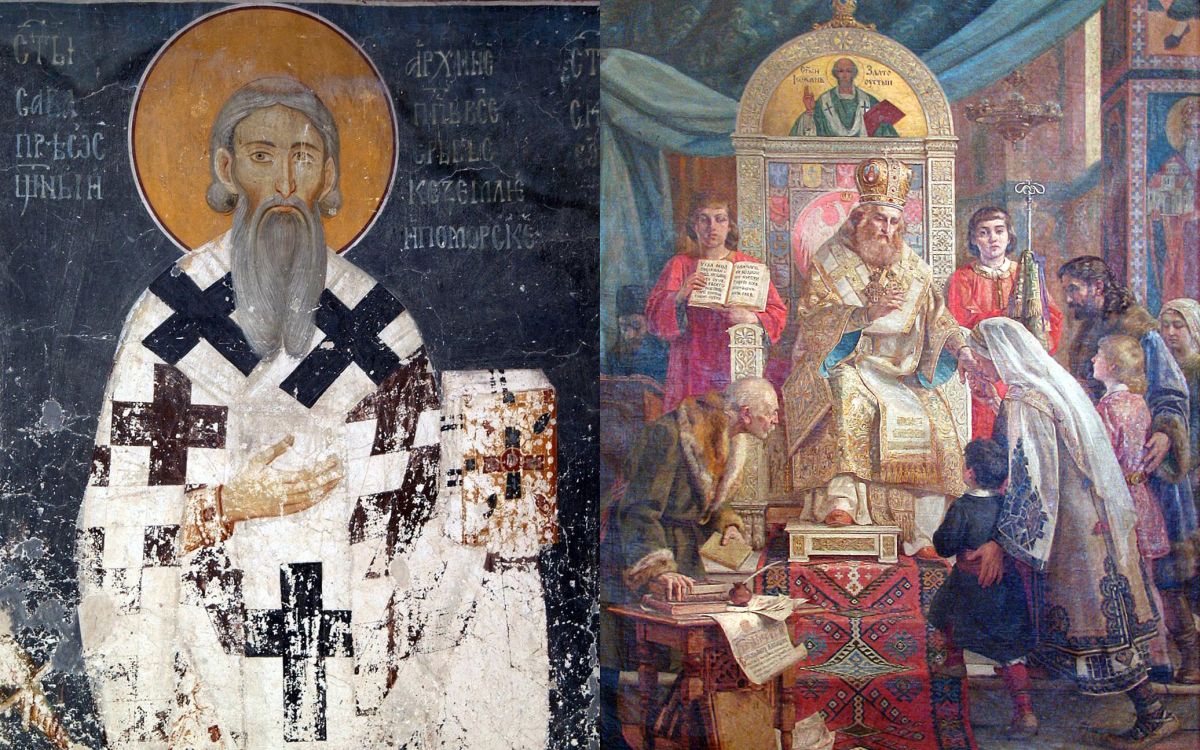
The Serbian Orthodox Church and believers today mark St. Sava, in honor of the first Serbian archbishop, educator, and creator of legislation.
St. Sava is one of the key figures in Serbian history, the founder of the Serbian Church and an educator. He is considered the founder of Serbian medieval literature, which is why he is also the patron saint of educational institutions.
Rastko, in monastic life Sava, was born around 1175, as the youngest child, the third son, of Ana and Stefan Nemanja, the founder of the Nemanjić dynasty.
His biographers Domentijan and Teodosije state that, as the youngest, he was in a certain sense a favorite child, and that from an early age he showed premature maturity, an inclination toward spiritual themes, books, and learning.
Rastko Nemanjić’s departure to Mount Athos
He was seventeen years old when, under the impression of a conversation with a Russian monk who was visiting the court of Stefan Nemanja, he set off for Mount Athos.
There he soon took monastic vows at the Monastery of St. Panteleimon.
From the Monastery of St. Panteleimon, Sava moved to Vatopedi, where he stayed for several years. According to testimonies preserved for later generations, as a monk he was the embodiment of ascetic devotion.
It is believed that he played a decisive role in Stefan Nemanja taking monastic vows in 1196, and Stefan assuming the throne.
During his stay in Constantinople at the end of 1197, he managed to obtain permission from Emperor Alexios to restore the deserted monastery. Thus, sometime at the beginning of 1198, the construction, that is, the restoration of Hilandar began, which would become the center of the Serbs in the monastic community of Mount Athos.
In Serbia, a coup took place in 1202, when Vukan overthrew his brother and seized power. A year later, Stefan overthrew Vukan.
St. Sava reconciles the feuding brothers
St. Sava reconciled the feuding brothers over their father’s grave.
In Nicaea in 1219, he secured autocephaly for the Serbian Church and the Serbian archbishopric from Byzantine Emperor Theodore I Laskaris and Ecumenical Patriarch Manuel I Charitopoulos.
He left behind several written works. The most significant are “The Life of St. Simeon,” the “Karyes Typikon,” the “Hilandar Typikon,” the “Studenica Typikon,” as well as the “Nomocanon.”
He died in Tarnovo on January 25, 1236, on his return from a pilgrimage to Jerusalem, after a diplomatic mission for the Bulgarian archbishopric. According to records from that time, news of Rastko Nemanjić’s death reached Serbia on January 27, so on that day liturgies are served in the Serbian Orthodox Church.
King Vladislav transferred his relics to Mileševa in 1237.
St. Sava’s cult was strong among the people, which is why during the Banat Uprising in 1594, Grand Vizier Sinan Pasha ordered that the relics of St. Sava be taken from the Mileševa Monastery and burned in Belgrade, on Vračar.
The first written record of the school celebration of St. Sava’s Day dates from 1734, when it was marked in Sremski Karlovci. It was established as a school patron saint day in 1840, at the proposal of Atanasije Nikolić, rector of the Lyceum in Kragujevac.
After a half-century ban, it has again been celebrated as a school patron saint day since 1990.
On the occasion of St. Sava’s Day, Serbian Patriarch Porfirije called on everyone “to become better themselves, because in that way others will also become better,” and said that this is achieved through repentance. In the Temple of St. Sava, the Patriarch reiterated the importance of reconciliation.
The central religious service will be held at the Temple of St. Sava on Vračar, and the ceremonial academy in Skopje.
Beliefs and customs
In many regions, this holiday is celebrated very solemnly, and a seven-day fast was observed before it.
Many craftsmen in Serbia considered St. Sava their patron and took his day as their guild patron saint day. In addition, shepherds also considered him their protector, so many customs related to today’s holiday are connected with wolves and livestock.
There are many folk beliefs related to St. Sava’s Day, including the belief that if it thunders on St. Sava’s Day, important events will occur.
Another belief says that before this day livestock must not be driven into the forest, otherwise they will all fall victim to wolves.
In addition, today nothing should be done with sharp tools or blades so that the wolves’ jaws remain closed. Belief also dictates that women should not dye anything red today so that wolves would not slaughter the livestock.
Many toponyms bear the name of St. Sava, such as Savina, Savinica, Savina voda, Savina greda, Savina stopa, Savin izvor, Savin potok, Savina strana, Savin kuk, Savino počivalo.
MORE TOPICS:
Source: RTS, Foto: Wikimedia Creative Commons