




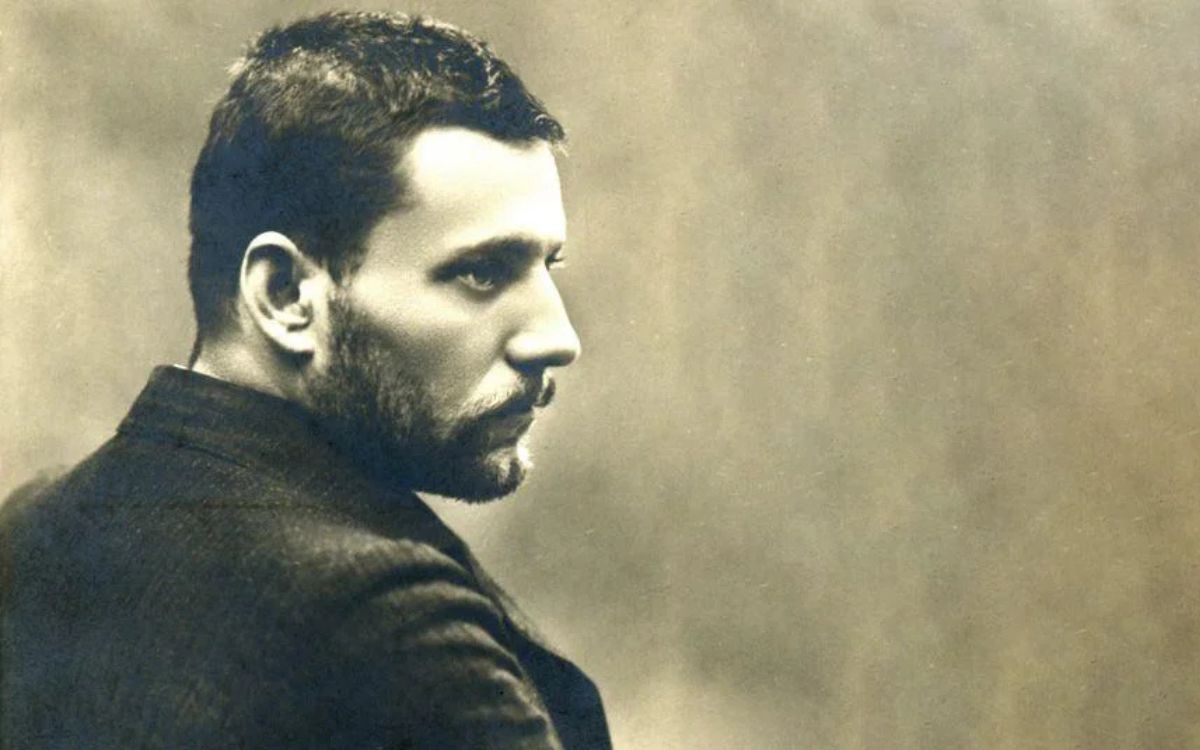
No one in Serbian literature has confessed love and woman with such fierceness and intensity as this writer
Borisav Stanković is a turning-point writer of Serbian artistic prose with whom modern Serbian literature begins. In his short stories, dramas and novels, he presented an image of his hometown Vranje at the turning point between the Turkish era and the modern age. His themes are socially determined, while in the manner of depiction an inner, psychological perspective prevails.
Borisav Stanković was born in Vranje on March 31, 1876, where he also attended primary school. He attended high school in Niš, and studied law in Belgrade. He wrote collections of short stories: “From the Old Gospel” (1879), “Old Days” (1902), “God’s People” (1902); dramas: “Koštana” (1902), “Jovča” (1927), “Tašana” (1928); novels: “Impure Blood” (1910), “Master Mladen” (1927), “The Roosters” (unfinished novel). He died in Belgrade on October 22, 1927.
When it is said that Stanković was the first in Serbian literature to speak about the soul, this primarily refers to the perspective in his works that turns from the external world toward the individual and his complex inner world. His poetic realism implies a deep immersion into the psychology of the literary character. His characters were not satisfied with reality, social principles, circumstances and expectations, so they retreated into themselves, into their memories, their fantasies, only to encounter there again what they had been escaping from. As professor Dušan Marinković says: “that elusive individual, that unrepeatable self.” Stanković’s heroes discover themselves by fully, unreservedly living through their passions, which society restricts or completely forbids. Because feelings and experiences cannot be prescribed, they are free and interwoven with lyrical sensuality, and in that freedom with tragic sublimity. That is why Stanković became the first writer who truly looked into the human body, into its physiological and psychological dimension.
Borisav Stanković was the first to turn to the crisis of identity, which is the central place of modern literature. As professor Danica Andrejević observes: “Man’s dividedness, duality, the split within the being, enabled the presence of unconscious and erotic metamorphoses of the characters. He incorporated modernism into the old-fashioned content of his characters.” What is modern is that “Impure Blood” is the first Serbian novel in which we have a major erotic female protagonist. No one in our literature has confessed love and woman with such fierceness and intensity as this writer. He is also modern in his sense of alienation, the vulnerability of being, a merciless existence, where the being cannot realize its essence. Stanković is a narrator of feelings, love, longing, anxiety, fear, pain, suffering. He presents the theme of love and the theme of the erotic as divided themes, which intertwine and diverge. Thus the awakening of happiness, illusion, rapture and youth merge and flow into the theme of misfortune, destruction and self-destruction. A human being, regardless of gender, is shown as an extremely complex and contradictory being.
Stanković’s language, even more than a century after publication, does not leave readers indifferent. The intensity and strength of his words are still strongly felt, which places him among the first great, independent, creative voices of Serbian culture as a whole. His work has remained open to various forms of literary, artistic, philosophical, psychological, sociological interpretations and analyses, and it is certain that the future will bring us some other interpretations as well.
In 2021, exactly ninety years had passed since the opera “Koštana”, directed by Petar Konjević, had its premiere at the Zagreb National Theatre, and in the year ahead, exactly 120 years since the publication of “Koštana” will be marked, today one of the most frequently performed and most watched works in Serbian theatre. Petar Konjović, a Serbian composer of classical music and director of the opera in Zagreb (in 1926), began work on “Koštana” during the Great War. He was driven by enthusiasm for Stanković’s play and inspired by meetings with the prima donna Maja Strozzi in Zagreb, for whom the title role of the opera in the making was intended. The opera “Koštana” had three premieres in 1931 on the main Yugoslav stages, in Zagreb, Belgrade and Ljubljana. This was the first version of the opera in five acts, composed between 1916 and 1928. It can be said that “Koštana” had more success across the Sava than in Belgrade, writes Nadežda Mosusova, because in Zagreb and Ljubljana they were not burdened by Stanković’s drama. The second version came modified and in six acts, between 1935 and 1939. Thus, the first Koštana at the Croatian National Theatre was Vera Misita, in Belgrade Blanka Kezer, in Ljubljana Zlata Đunđenac. It is also worth noting that the opera “Koštana”, wherever it was performed, was loved by all its singers, appreciated by conductors and gladly staged by directors.
MORE TOPICS:
LEST WE FORGET: The March pogrom in Kosovo was deadly for many Serbs, while thousands got expelled!
Source: p-portal.net:Foto: Wikipedia