




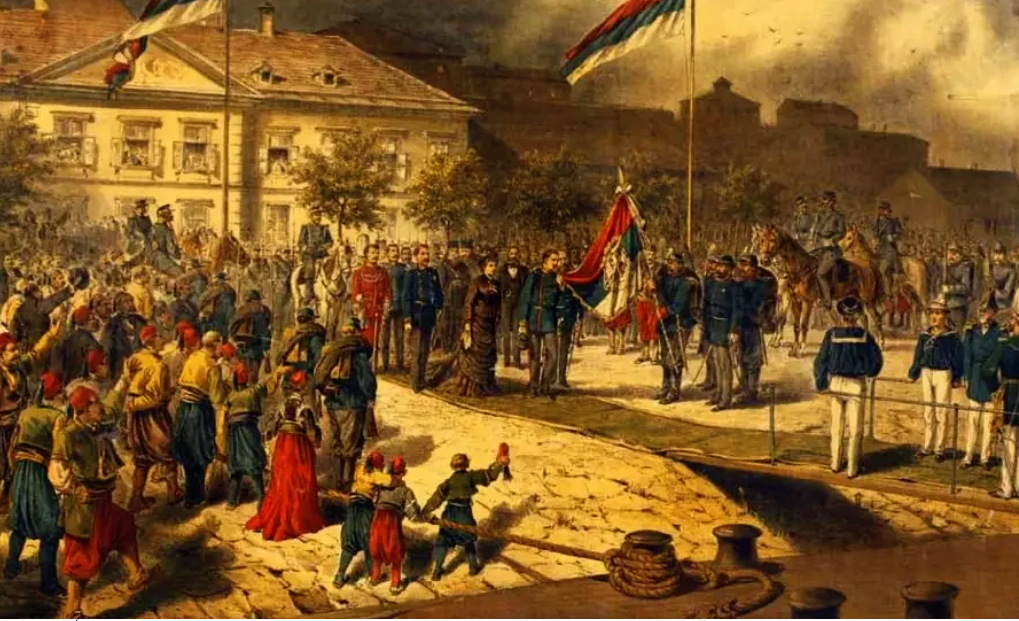
The Second Serbo-Turkish War of 1877–1878 was a war waged by the Principality of Serbia against Ottoman Turkey with the aim of liberating the southern regions and ensuring Serbia’s full independence. The war lasted from December 13, 1877, to February 5, 1878.
Conditions in Serbia on the eve of the war
After the failure in the First Serbo-Turkish War, there was great dissatisfaction in Serbia due to the impoverishment of the population, which was intensified by a barren year, impositions to cover state costs, and the suppression of political freedoms. Nevertheless, the start of the Russo-Turkish War in the spring of 1877 was viewed with sympathy, and cautious connections began with Russia, which advised restraint. When the Russians were stopped by the Turks near Plevna in Bulgaria, Russia requested Serbia’s entry into the war, but Serbia was completely unprepared for it. Russia provided significant financial aid to Serbia, so by the end of September, Serbia deployed 25–30 thousand soldiers to its southeastern borders, and the army was reinforced with weapons and equipment.
Colonel Sava Grujić, Minister of War, reorganized the Serbian army by forming five corps:
Šumadija Corps, with 15,500 fighters and 146 officers;
Morava Corps, with 18,450 fighters and 118 officers;
Timok Corps, with 22,150 soldiers and 124 officers;
Javor Corps with 13,100 soldiers and 66 officers, and
Drina Corps with 12,350 fighters and 54 officers.
At the beginning of the war, a special Timok-Zaječar Army was also formed with 8,800 fighters. Serbia entered the war with Turkey with 89,000 soldiers and 232 cannons, while Turkey had 85,000 regular soldiers and several thousand Bashi-Bazouks and Arnaouts. The Prime Minister during the period 1876–1878 was Stevča Mihailović, and the Minister of Foreign Affairs was Jovan Ristić.
Topola rebellion
One battalion of the Kragujevac Brigade of the Second Šumadija Division rebelled on December 7, 1877, and refused to go to the front. The soldiers from Kragujevac went to Topola, hoping that other battalions would join them, that Petar Karađorđević would lead them to overthrow the Prince, or then King Milan, and subsequently abandon the war.
This was an attempt by the Karađorđević supporters to carry out a coup in Serbia. The rebellion was suppressed without bloodshed on December 11; the rebels were captured and harshly punished. Some of the organizers of the rebellion were punished and executed by firing squad in Aranđelovac only on May 31, 1878.
Occasion and goal of this war
The immediate occasion for these wars was the uprising of Serbs in 1875 against Turkish rule in Bosnia and Herzegovina, which ignited the spark of resistance and the struggle for freedom throughout the region. These wars were not only military conflicts but also a continuation of the centuries-long liberation struggle of the Serbian people against Ottoman domination.
The goal of this war was the same as the goal of the First Serbo-Turkish War: the liberation of the Serbian people from Turkish rule and territorial expansion towards the South. The war plan of the Serbian army was based on the fact that Serbia, at the request of the great powers, could not have pretensions towards Bosnia, as well as Russia’s request to assist their army in advancing towards the south of Bulgaria.
Based on these facts, the war plan foresaw that three out of five Serbian corps (Šumadija under the command of General Belimarković, Morava under the command of Colonel Lešjanin, and Timok under the command of Colonel Horvatović) with a total of about 46,000 men and 128 cannons would launch an attack to the south and southeast, encircle Niš, capture Babina Glava, Bela Palanka, and Pirot, and continue advancing towards Sofia to cooperate with the Russian Danube Army.
The Drina Corps, under the command of General Alimpić, was to be in defense towards Bosnia, and the Javor Corps, under the command of Colonel Nikolić, was to switch from defense to attack towards Novi Pazar and Sjenica at a favorable moment. The Timok-Zaječar Army, under the command of Colonel Zdravković, was to attack and conquer Kula and Vidin.
The Turkish war plan provided for persistent defense in all directions, for which many points in the valleys of the Nišava, South Morava, Raška, and Ibar rivers were well fortified, with Niš, Novi Pazar, and Pirot being the strongest fortifications.
Declaration of war on Turkey
War was declared on Turkey on December 13, and the operations of the Serbian army began on December 15 with the advance of three Serbian divisions (Ibarska, Morava, and Danube) to the south for the purpose of encircling Niš.
This operation was carried out successfully and accurately, and Niš was completely encircled in just five days of military action.
To prevent aid from Kosovo from reaching the besieged in Niš, Colonel Milojko Lešjanin ordered the Ibarska Division to capture Kuršumlija and the strategic points Samokovo and Prepolac, which cut the Priština–Prokuplje–Niš road.
Executing this order, Colonel Binički’s units conquered Kuršumlija after two days of fighting on December 25, but only managed to get close to Samokovo and Prepolac and remained there. Under the action of Serbian vanguards and under the pressure of the insurgents, whose number increased to 6,000 people, the Turks left Leskovac at that time and retreated south, closing the Grdelica gorge. The Supreme Command of the Serbian Army, led by Prince Milan, had been located in Aleksinac since December 18.
Liberation of Niš, Pirot, Vranje, and Bela Palanka
During the operations around Niš, the Timok and Šumadija Corps acted towards the southeast, achieving significant success. The Knjaževac Army captured the strategic positions of Babina Glava and Sveti Nikola, Bela Palanka was liberated, preventing Turkish aid from Bosnia, Albania, and Kosovo towards Sofia.
After the liberation of Pirot, Serbian forces were directed towards Niš. Three days of fierce fighting ensued, and the city surrendered on January 10. The Serbian army then liberated Kula, Breznik, Trn, Radomir, stopping near Slivnica when the Russians occupied Sofia.
The attack on Niš was conducted with four divisions and 15,000 soldiers. General Belimarković managed the battles, and the Turks agreed to negotiations for surrender. Niš surrendered on January 10, and Serbian troops solemnly entered on January 12.
After the liberation of Niš, the plan was to direct the attack towards Kosovo. The Morava and Timok Corps faced difficulties, and the news of the armistice from Edirne on February 5 ended the fighting. The Šumadija Corps liberated Vranje on January 30, and then headed towards Priština. However, the news of the armistice also arrived there.
Serbia suffered significant losses in this war. About 3,000 fighters were killed, and over 2,500 were wounded.
Armistice and the struggle for Serbian diplomacy
At the session of the Serbian government held on January 15, 1878, it was concluded that upon the conclusion of peace, recognition of Serbian independence and the territory of Old Serbia (Kosovo Vilayet, Niš, Prizren, Skopje, and Novi Pazar Sanjaks) with the addition of Vidin should be requested from Turkey. Aspirations towards Bosnia and Herzegovina were abandoned due to the energetic opposition of Austria-Hungary.
Serbia’s territorial demands were rejected both by Turkey and by allied Russia, which had promised Niš, Pirot, Leskovac, and Vranje to Bulgaria. Through the exceptional efforts of Prince Milan, Minister Ristić, and Colonel Lešjanin, Serbia managed to secure Niš and Leskovac under the San Stefano Treaty (March 3, 1878), but not the other liberated regions. Further efforts by Serbian diplomacy ensured that the Pirot and Vranje districts, as well as Mali Zvornik, were awarded to Serbia at the Berlin Congress (June 12, 1878). Serbia finally became an independent state.
MORE TOPICS:
Source, Photo: Kompas