




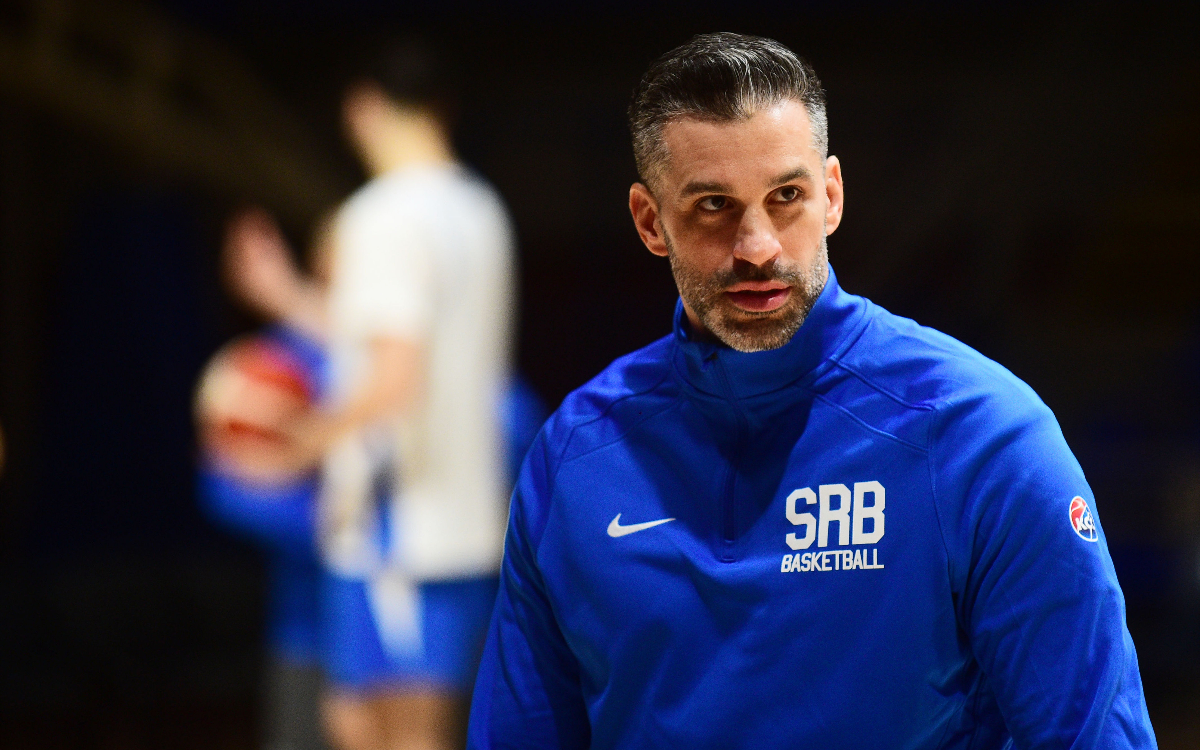
The Serbian national basketball team has opened a new era, one that will be led from the bench by Dušan Alimpijević. In November, the head coach gathered the Eagles ahead of the start of the World Cup qualifiers, and after the first training session he set aside time to talk about various topics for Sportal.
Behind Alimpijević is an incredible year. With Beşiktaş he dominates the domestic league, a legend is being built around his name at the club, and in the meantime he also received the call to sit on the bench of his country’s national team—at just 39 years of age—and, of course, he could not refuse it.
What was the feeling like entering the arena for the first time as head coach?
- Different from all other feelings. Playing for the national team, being the coach of the national team, that is truly something that cannot be compared to any other feeling. It has nothing to do with the feeling you have at a club; these are two completely different loves, two completely different emotions. Standing under your own flag, listening to your national anthem, really carries a different weight and is a totally different feeling. The greatest possible.
Everything that is happening to you in your career, including this—becoming head coach at 39—does it ever feel like a dream? Starting from Red Star, everything you’re doing in Turkey, and now culminating in this.
- Thank God for this. We can say it’s going along a beautiful path, one that every coach in their career can dream of or wish for something like this. It really feels like the boyhood dream of someone who starts doing this job. I assume that in some ultimate idea this is the highest possible goal, to be at the head of the Serbian national team in your own country. So, for me it certainly represents both the greatest challenge and the greatest pride of my career.
You mention challenge and pride, but is there also pressure? Considering the results, considering that you inherited the legend Svetislav Pešić on the bench…
- Pressure always has to exist; it’s what drives us in this sport. Truly, if we were some flat, indifferent line, there is no worse feeling than that. There has to be emotional charge, of course the most positive possible, which is then directed onto the court, so that we give our maximum as a team, all of us here together—the coaching staff, myself, and the players, of course. It’s not something that paralyzes; it’s something that drives.
What surprised you in the national team and how close are we to that generational change that is already being talked about?
- It’s a natural sequence of events, not only in our national team, but in all national teams and in all sports. It’s something that is expected at some point. I believe that we, as the country of Serbia, still have by far the most prominent coaching school, which is still responsible for creating, or rather developing, players in this region perhaps much better than in any other part of Europe. I had the opportunity to see this now when we were monitoring players who play for all those clubs we covered. Serbia still leads in those data because, for example, let’s just mention one fact—we covered around 70 Serbian players in the United States who are in college or high school. The factory here in Serbia is really still working very well.
So, for the future of Serbian basketball there is no need to worry, and your problem won’t be who to call up to the national team, but who not to call up.
- That’s right. That’s for sure, now we just need to create those true aces, like we had in the past.
When we touched on younger players and the future of our basketball, we don’t have to single out names, but Nikola Topić, Nikola Đurišić, Bogoljub Marković are already emerging. You’ve had the opportunity to meet and start working with some of them, and you invited some to the first national team gathering, like Marković. How satisfied are you with these young players you’ve seen so far?
- You mentioned only a few; it’s a much longer list. That is the future of our basketball; those are people, those are generations that now need to be followed very carefully. It would truly be irresponsible for me at this moment to make any predictions, apart from what we all already know—that these are talented players who should certainly represent the future of basketball. For something to be called a “true national team player,” many factors are important, and in the future we need to follow whether it’s going in the right direction.
At the conference when you were officially presented as Serbia’s head coach, you said you would not talk about the names of players who would make up the team in the upcoming period, not because you wanted to be mysterious, but because at that moment you had not yet had time to talk to them. Can we ask you now—have you managed to talk to the Eagles, above all with Bogdan Bogdanović and Nikola Jokić, and can we expect to continue seeing them in the national team jersey?
- Bogdan Bogdanović, Nikola Jokić—that does not make up the entire national team; there are many names. I can tell you that I have spoken with everyone. I had a very positive feeling from those conversations; our communication was at the highest possible level, and I am very satisfied with everything I heard.
We can’t avoid mentioning the start of the season you’re having with your team in Turkey. First, I would ask what it was like to move from Bursa to Beşiktaş at all, since we’re talking about a different level, starting with the fact that it’s a club with a base of 20 million fans.
- Bursa is also a club with a large number of fans, who are also very fanatical. We had a kind of connection, and then my move to Beşiktaş was harder for them, because it was never fully explained in the way it should have been—why it happened… What I must say is that the connection that was created with Beşiktaş fans, as you mentioned, 20 million fans—that’s a serious base, which for us in this region is perhaps unimaginable for a single club to have. I must say that the connection with Beşiktaş fans happened very quickly, because after one very bad season, with those new changes and our arrival, we immediately and very quickly reached the top in all three competitions and played semifinals everywhere right away, in the first year. That, in the most positive sense, crazy energy that was created around the basketball club was quite big in the first year; in the second year it was unprecedented; and in this third year, I can’t even explain the energy around the basketball club. For example, we have a sold-out arena against Manisa on Saturday at one o’clock. That’s something that two, three, or four years ago was unimaginable. Not because people don’t appreciate that opponent for some reason, but because it’s not such an attractive opponent for fans, plus the timing is inconvenient. We had a sold-out arena in the last game, which helped us a great deal to win the game during that energy drain.
You mentioned Beşiktaş fans, but you also had an exceptional relationship with Bursa fans. The arena chanted your name, you received ovations, you gained their exceptional affection and respect. Before you, among Serbian coaches, Željko Obradović experienced that in Turkey. We see that coach Marko Barać is now also achieving success there with Bahçeşehir. What is the secret of your success in Turkey, and generally—what is the secret of Serbian coaches there?
- I wouldn’t compare myself to Željko at all, because we know that Željko is unique in that regard and we know what he has done, primarily on the EuroLeague stage, in European basketball. That is something that really should not be put in the same sentence with other coaches.
- Personally, I think it’s very simple when it comes to Turkish fans at least—they are very emotional and passionate lovers of sport, regardless of whether it’s women’s volleyball, football, or basketball. They are truly people who follow and support their club with incredible passion and energy, and when they see that someone is doing the job with dedication, that they are fully committed, giving themselves and full of energy for that club, they enter into such a level of support that you haven’t seen anywhere else. That street is two-way, but it can also very easily go in the other direction. So, if the results are not good, you can feel that very easily, and it’s not naive at all. I had the good fortune, thank God, to have good results in the past five years, so the connection was much easier for me.
Who is your coaching role model?
- We do not make idols other than God, but there are certain basketball coaching models that should be followed. Basketball is changing significantly; in the last three to five years it has changed more than it changed in the previous 15 years. I like to follow the entire EuroLeague, but of course there are very good coaches in the EuroCup and everywhere in domestic European leagues. However, what is perhaps most important is that we should not expand this story beyond our Serbian coaches. So, all those you know or have already mentioned—we should not go beyond that. What we have that is ours, we should preserve and not give to anyone.
On one occasion, you told me that you gained immeasurable knowledge in just seven days with Željko Obradović, watching his training sessions. What is so special about him?
- I said that those seven days I spent in that period were better than I don’t know how many clinics. That period spent at training is one thing, but outside of training, when you sit down to dinner with him or are in his office, that’s a completely different dimension—you can learn many more things, above all about relationships with players. So, those seven days were very instructive for me.
MORE TOPICS:
Source: Sportal.rs, Foto: Dusan Milenkovic / ATAImages