




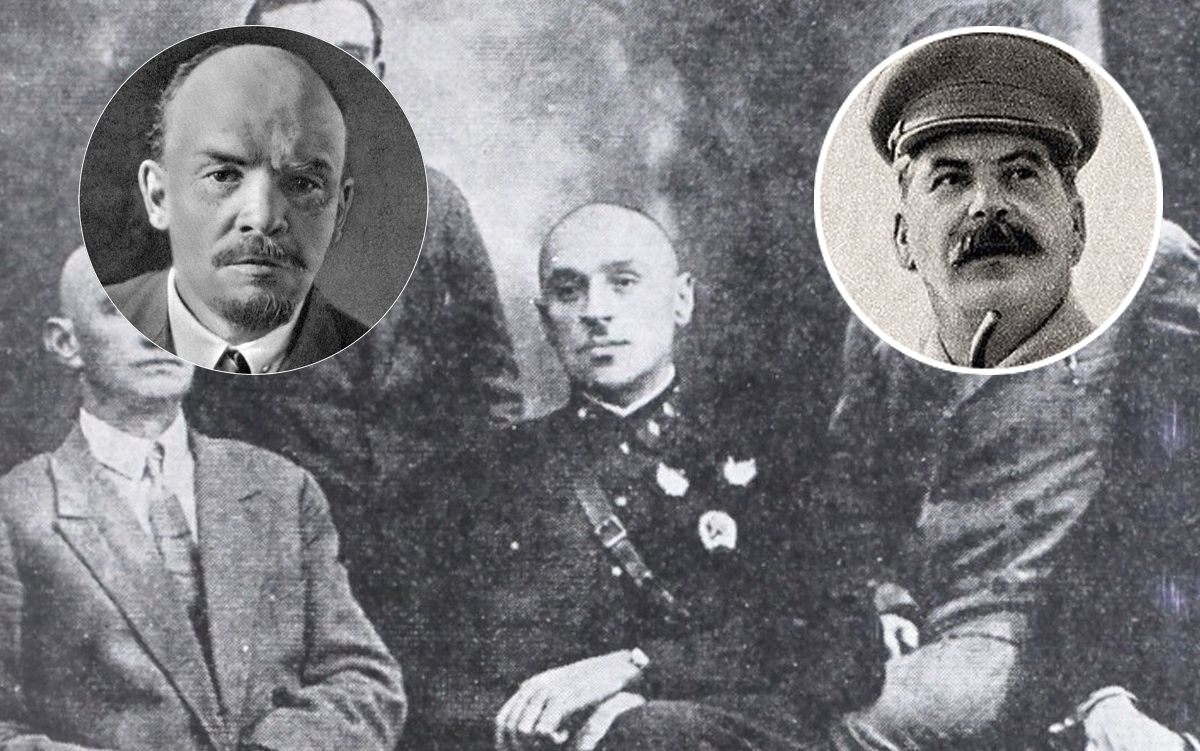
The history of the Soviet Union, a 20th-century global superpower, remembers numerous heroes, fighters, and officers who astounded the world with their bravery and achievements. During the period when the USSR was just forming and rising, a significant contribution was made by a Serb, Danilo Srdić (1896-1937), the first and only Serb to become a general of the Red Army. This is his story.
The biography of this notable, yet relatively unknown Serb, is just one of many examples of Serbian historical figures who started “from scratch” and reached the “peaks” of their time.
Danilo Srdić was born in 1896 in Vrhovine, into a Serbian family from Lika. Details of his early education are unknown, but it is known that in the years before the Balkan Wars, he was studying in Belgrade. The liberation of the southern Serbian regions and the war against the Turks led this young man from Lika to choose military service and go to Russia with the intention of enrolling in a Military School there. He finally succeeded in 1914 and was enrolled in a cavalry school in the Belarusian city of Grodno.
He graduated from the school with the rank of senior non-commissioned officer and began his military career in the very place of his schooling. He was recruited into the local cavalry regiment.
Upon the outbreak of World War I, on official assignment, he went to Odessa, which at that time served as a recruitment and agitation center for gathering Serbs and other South Slavic peoples into the ranks of the Allied army (Austro-Hungarian soldiers of Slavic origin were massively sent to the Russian front, from where they often deserted and joined Russian troops). The First Serbian Volunteer Division was also formed in Odessa, to whose organization and staffing Srdić contributed. He himself was a member of it.
As a member of the Serbian Volunteer Division on the Eastern Front in Ukraine, he earned the Order of St. George for his wartime merits.
With the outbreak of social revolutions in Russia, the career of this rebellious and adventure-inspired Serb abruptly changed course. Upon the outbreak of the February Revolution in 1917, Srdić left his wartime assignment and joined the revolutionary movement, for which he was soon imprisoned by his former colleagues – members of the imperial army.
The October Revolution
In mid-October 1917, he was released and immediately joined the revolutionaries in the fight against tsarist rule. On October 25, he participated in the storming of the Winter Palace in Petrograd, and shortly thereafter became one of the commanders in the Petrograd Soviet.
After the successfully won revolution, he returned to Ukraine and rejoined the ranks of Serbian volunteers where he agitated among his compatriots to join Bolshevik detachments. He succeeded in this, and soon the First Serbian Soviet Revolutionary Battalion was formed, headed by him. They made a great contribution in the battles on the customs front. In Soviet historiography, this battalion became famous for playing a significant role in the capture of Tsaritsyn.
At the end of August 1918, from the constantly increasing number of Yugoslav revolutionaries, the First Yugoslav Regiment was formed, and Danilo Srdić became its commander.
He cleared Don and Ukraine of anti-Soviet, as well as anti-Russian forces. Danilo Srdić’s regiment became a model of heroism in the battles on the Southern Front. Lenin personally thanked him for his abilities.
His bravery and fearlessness are best attested by the memories of his comrades-in-arms, who confirmed in their statements the admiration of subordinate soldiers for this Serbian revolutionary.
When the Cavalry Army suffered a failed battle, Marshal Semyon Budyonny (commander of the Soviet cavalry) lined up the officers and whipped each one. The commander of the Cossacks, Ilya Dubinsky, testifies about this event:
“Budyonny’s disciplinary measures were well-known. He lined up the unit’s officers and began to whip them one by one.”
He whipped Colonel Semyon Mikhailovich across the face. When it was Danilo Srdić’s turn, this great Serb drew his revolver and pointed it at Budyonny, shouting:
“If I am guilty, kill me! But if you touch me with the whip – I will kill you!”
Budyonny and Voroshilov, who was beside Budyonny, were taken aback. They bypassed this fiery Serb and moved on.
However, Budyonny remained impressed by this Serb. Danilo Srdić was an excellent horseman – he was known for riding with three sabers, and he would break all three in battle. One after another, most often against Polish interventionists. He soon became commander of a regiment, then a corps. Budyonny states:
“He always found a way out, he was bold and always victorious.” Due to his bravery and boldness, he was called “The Fearless One!” When the revolution ended, Srdić also became a Colonel-General, one of the highest ranks a Serb held in Russia.

Fatal Encounter with Stalin
At the peak of his military career, Danilo Srdić met with Stalin in 1936. Stalin once visited border units, and Budyonny called Srdić, saying that Stalin wanted to see him. Srdić, in uniform with his decorations, was two meters tall and stood opposite Stalin, who was three heads shorter than Srdić:
“Look at him! A true Balkan eagle,” said Stalin. “On whose territory would you fight if war came?”
“On the enemy’s!” said Srdić. “The enemy’s foot must not step on our soil!”
“Let’s drink a ‘Bruderschaft’ toast,” said the satisfied “steel” Stalin.
Eight months after this fraternal gesture, General Srdić was arrested along with Marshal Tukhachevsky and killed precisely on Stalin’s order, along with a mass of generals and marshals of the USSR in the famous purges (it was later discovered that the entire affair concerning Srdić was staged by the Germans to destroy the Soviet army). However, Srdić was rehabilitated in 1957, and Budyonny delivered a speech at the party congress:
“Danilo Srdić! I utter this name with a feeling of great warmth and cordiality. With Danilo, a Serb by nationality, with whom I spent many years in the country, I was bound not only by wartime but also by personal camaraderie… The tragic death of the Serbian commander during the years of Stalin’s personality cult painfully resonated in the hearts of all who knew him. Becoming a victim of malicious slander, arbitrariness, and lawlessness, our comrade remained in the memory of the fighters of the cavalry army and other warriors of the Soviet army as a crystal-clear man. Now justice has been re-established: the honorable name of Danilo Srdić is pronounced with the same respect as before…”
Danilo Srdić was serving as the commander of the Third Cavalry Corps when he was arrested and shot under the accusation of being an “enemy of the people.” His liquidation falls into the group of numerous mass murders linked to the notorious “Stalin’s purges.”
The location of his grave is unknown. He was rehabilitated in 1957 as part of the de-Stalinization process and the condemnation of Stalin’s personality cult.
Today, a street in Minsk, the capital of Belarus, bears the name of this illustrious Serb, a Soviet general.
MORE TOPICS:
Source: NPortal; Photo: Printscreen YouTube, Wikimedia Creative Commons