




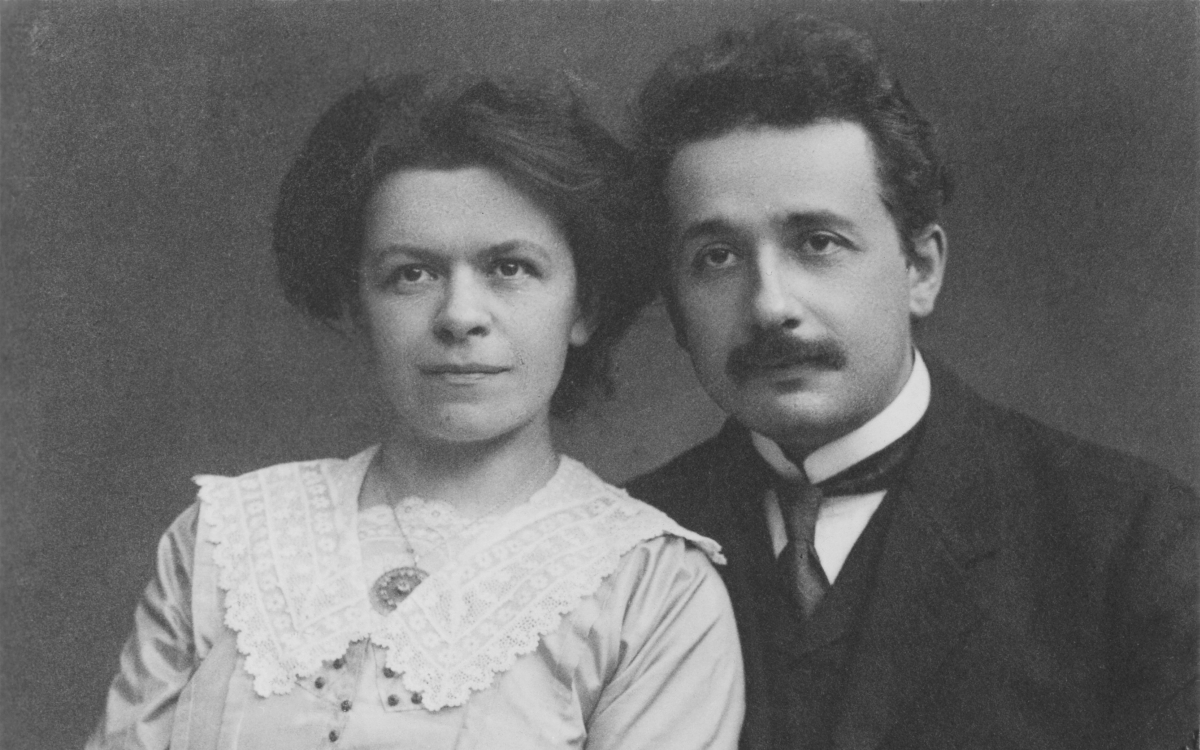
Mileva Marić Einstein was born on December 19, 1875, in Titel. She was the eldest child of parents Miloš Marić and mother Marija. She had a younger sister, Zorka, and a brother, Miloš.
At birth, her hip was dislocated, but this handicap manifested itself in later years when she began to limp. She was an obedient child and later a very dedicated and talented student, especially in subjects like mathematics and physics.
She finished elementary school in Ruma, in 1886 she enrolled in a girls’ grammar school in Novi Sad, but since girls were not allowed higher education in the Austro-Hungarian Empire at that time, she transferred to the Royal Small Real Gymnasium in Sremska Mitrovica.
She would also study in Šabac, Zagreb, and in 1894 she continued her education in Zurich because it was one of the few European cities that admitted women to universities. Two years later, she enrolled in medical studies but switched to the State Polytechnic School to study mathematics and physics.
Mileva was only the fifth woman to be admitted to this school.
That’s when she met seventeen-year-old Albert Einstein, who was her colleague. After the first two years of successful studies, Mileva dropped out and went to Heidelberg where she attended lectures on theoretical physics with Nobel laureate Philipp Lenard, where she studied the photoelectric effect for which Albert would later receive the Nobel Prize.
Even today, there is much debate about whether and how much she contributed to Einstein’s work.
Also, at the same lectures, she became acquainted with four-dimensional geometry, which is the mathematical basis of the theory of relativity that would make Albert famous.
There are also claims that the letters that Mileva and Albert exchanged, which in addition to tender statements also contained mathematical calculations, were censored to diminish Mileva’s significance.
However, there are also those who believe that there is not enough evidence that Mileva helped Albert, so this question has not been fully clarified even today.
During her stay in Heidelberg, she corresponded with Albert all the time and returned to study in Zurich in 1899. The relationship with Albert became more serious, but her results in studies became somewhat weaker.
Although she did not pass the final exams the following year, she remained in Zurich as a laboratory assistant.

She and Albert plan to get married, but they both know that he needs a good job to support a family. They are both doing everything they can to achieve this.
She fails to pass the exams again, and she also withdraws her doctoral dissertation with Professor Heinrich Weber. The reason may also be that he did not want to accept Albert as his assistant, and she did not want to offend either the professor or Albert.
After a vacation with Albert on Lake Como in 1901, she found out that she was pregnant. She briefly returned to Novi Sad to visit her parents, but gave birth to a daughter, Liesrl, there. According to some sources, the girl died a year after birth, according to others, due to illness, she was given up for adoption in Serbia.
She moved with Albert to Bern, where they got married in January 1903. A year later, their son Hans Albert was born. In the meantime, Albert began to correspond with his cousin Elsa, with whom he had been in love as a boy. This leads to a deterioration of the relationship with Mileva.
They go on vacation to stabilize their marriage, and in 1910, Mileva gave birth to their second son, Eduard.
In 1914, Albert received an invitation to become a full professor at the University of Berlin. Mileva initially refused to follow Albert because Elsa lived in Berlin. However, they moved, and Albert demanded a special way of behavior from Mileva, such as only being allowed to answer him when he addressed her.
Before the outbreak of the First World War, Mileva returned to Zurich with the children. In 1916, Albert asked her for a divorce. Mileva fell ill because of this, so her sister Zorka briefly took care of the children.
Two years later, Mileva agreed to a divorce, but agreed with Albert to give her part of the Nobel Prize money that was rumored to be awarded to him, which Albert did after receiving the prize in 1922. In the same year, Mileva’s father died, and her sister Zorka was declared incapacitated after two strokes.
Mileva used this to secure housing, but a large part of the money went to the treatment of her younger son Eduard, who fell ill with schizophrenia in 1930.
Due to the spread of Nazism, Albert and Elsa fled to the USA. Her mother died in 1935, her sister three years later. In the same year, her eldest son Hans Albert emigrated to the USA with his family, while Mileva remained in Zurich with Eduard.
His condition got worse, and Mileva felt unwell after one of his violent attacks. She died on August 4, 1948, and was buried in the Nordheim cemetery in Zurich.
A monument was erected near her house in Zurich in 2005. Her bust is located in front of the secondary school she attended in Sremska Mitrovica as well as on the university campus in Novi Sad.
The secondary technical school in Titel bears her name, and the University of Novi Sad has been awarding the “Mileva Marić” award to the best mathematics students since 1994.
MORE TOPICS:
APPEALS GRANTED, TRIALS MUST RESTART: Ministry cancels the decisions on farm deactivations!
INJUSTICE REVEALED: Former KLA member admitts to witness intimidation in the Hague!
VUČIĆ “MUST TALK” TO PUTIN: State Department comments on possible sanctions! (VIDEO)
THEY IGNORED WARNINGS: Chinese contractors alerted the Serbian Railways about unsafe stations!
Source: Danas, Photo: Wikimedia Creative Commons