





In the heart of eastern Serbia, on the beautiful Magura Hill above the archaeological complex of Romuliana, lies hidden one of the most mysterious places in Europe – the tumulus, a place where mysterious rituals of apotheosis, the ritual elevation of emperors among the gods, were performed. Although difficult to access today and almost forgotten, this mysterious hill preserves secrets that are not only part of history, but represent a key point for understanding Roman religious and political systems. The tumulus on Magura Hill is not just an unusual archaeological site, but one of the last places in Europe where apotheosis was performed – the rite of elevating an emperor among the gods.
The mysterious history of Magura and the tumuli
Magura Hill was a sacred hill, a place where important religious and political rituals were performed. In the past, the monuments on this hill were reached through an imposing tetrapylon – a monumental structure 13 meters high, which represented a crossroads. One of these paths led to the monuments at the top of the hill, while the other led to the main gate of Romuliana. At 130 meters from this crossroads, research revealed the walls of an unknown building, which was later buried for protection, but very little is known about it because the research was interrupted and data on this site was not sufficiently documented.
However, the most prominent monument on Magura is certainly the mausoleum located at the highest point of the hill, 230 meters from the tetrapylon. Although the mausoleum is in ruins today, it is believed that its parts were used in the construction of late Roman Romuliana. It is assumed that Galerius’s mother, Romula, was buried in this mausoleum around the year 305. This building was about 12 meters high and represented one of the most important places in this part of the Roman Empire.

Tumulus – a place of divine elevation
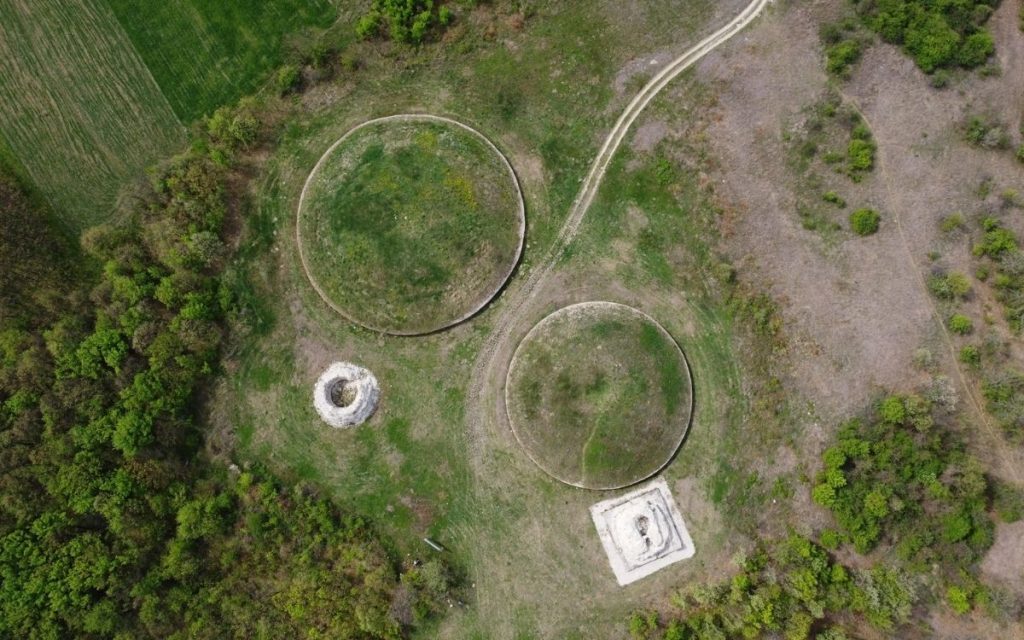
One of the most fascinating and enigmatic parts of Magura Hill is the tumulus – an area shaped by a stone ring with a diameter of 30 meters and a height of up to two meters, inside which a wooden pyre was found. This tumulus was not just a ritual space, but represented a place where rites of apotheosis were performed, which at that time marked the elevation of imperial figures among the gods. A wax figure was burned at this location – the actual body of the emperor was not burned.
The apotheosis on Magura Hill was dedicated to Romula, the mother of Emperor Galerius, and that was the moment when she was elevated among the gods. Given the symbolic significance of this act, the tumulus on Magura becomes a site of priceless importance in the history of the Roman Empire, as it represented the last such elevation in Europe.
The second tumulus on Magura, found not far from the mausoleum of Emperor Galerius, had a stone base and was covered with a layer of earth 8.5 meters high. On this tumulus, which formed a cone about 10.5 meters high, a pyre consisting of three levels was placed. According to beliefs, it was at this spot that the conceptual creator of Romuliana, Emperor Maximian, was elevated and also became a deity.
The ritual of burning wax figures
One of the most unusual aspects of these rites was the way the ceremonies were performed. Instead of burning the actual bodies of the deceased, wax figures representing those persons were burned on the pyres. This act was not only ritualistic but had a deep religious meaning, as the elevation of the emperor toward the gods enabled the divine recognition of the ruler in the future. Wax was a symbol of death, but also of transformation, because in such a way the emperor could pass from a human to a divine state.
It is truly fascinating that Magura Hill has been a sacred place for different civilizations throughout history. On this same hill, where the Romans performed rites of apotheosis and elevated their emperors among the gods, there are also traces of Neolithic civilizations that considered this location sacred. This place obviously had a special significance through the centuries, as different cultures considered it a place carrying spiritual power and mystical energy. They likely saw a symbolic connection with nature, the energy of the earth, and the deities in this area, which resulted in them considering this hill a holy place.
This continuity in respecting the hill through various epochs – from Neolithic communities, through the Romans, and up to the present day – further confirms the deep cultural and spiritual significance of Magura. The hill has become a bridge between past and modern beliefs, and its legacy continues to fascinate everyone who wants to explore how ancient civilizations interpreted nature and sacred spaces.
The forgotten cultural treasure of Serbia
Magura Hill is one of the most mysterious places in Serbia primarily because of its history of rituals that today seem incomprehensible to people. It is interesting that most tourists in Serbia are not even aware of the existence of this site. Magura Hill is completely untouched and preserved in its original form. For now, without much attention from the media and tourists, this place waits to be discovered. A visit to Magura means more than an ordinary walk through history; it is an opportunity to experience one of the most mysterious moments of the Roman Empire, which has remained insufficiently researched to this day.
If you are a lover of history, mystery, and untouched nature, Magura Hill is the right place for exploration. This unique site not only represents a key part of the Roman cultural heritage but is also one of the last places in Europe where rites of apotheosis, the ritual elevation of imperial figures among the gods, were performed. A visit to this mysterious hill provides an opportunity to connect with ancient times and dive into deep history, which has survived centuries and waited to be discovered. Exploring this mystical place, you will experience an encounter with the past, which even today carries untold stories of power, faith, and imperial rituals.
MORE TOPICS:
Source: Kulturizam; Photo: Kulturizam