




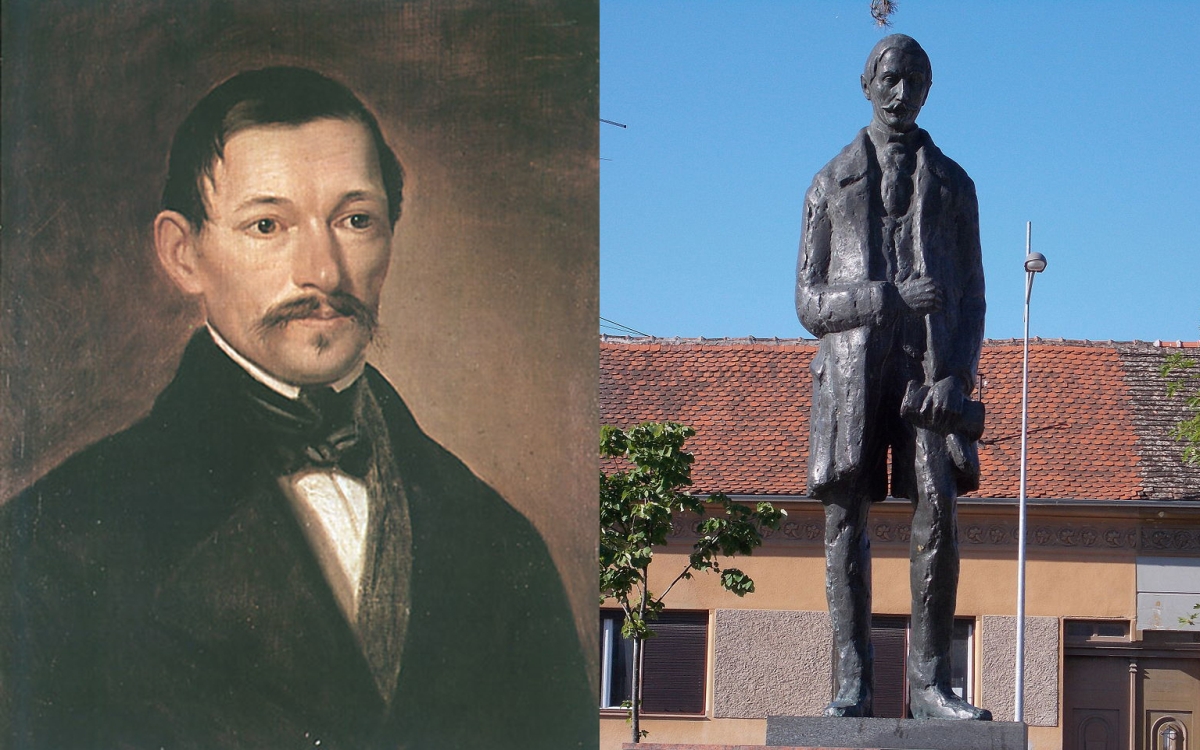
“You know everything – what the Russians, what other courts think, only what you yourself think, is difficult for you to know,” is Sterija’s thought which undoubtedly confirms his significance and universality more than two centuries after his birth.
“Jovan Sterija Popovic is an authentic greatness of ours, who even today, after a hundred years, does not necessarily need to be relatively measured to determine his values, and of whose kind in our early 19th century there are not even enough to count on the fingers of one hand,” wrote Milan Bogdanovic in his book of critiques back in 1927.
Jovan Sterija Popovic was born on January 13th in Vrsac, then the Austro-Hungarian Monarchy. He was born into a modest, merchant family. The part of his name by which he remains recognizable to this day, Sterija, is actually the name of his father, who was of Greek origin.
He finished elementary school in several cities – Vrsac, Timisoara, and Pest, and later studied law in Kezmarok. He was born as a very sickly child, and already in his early years, he suffered a stroke, due to which he had a paralyzed left arm throughout his life.
During his schooling in Pest, he became close with Djordje Stankovic, the man who would be one of the founders of Matica Srpska in 1826. He practiced law and private tutoring until he was invited to come to Kragujevac and teach at the Lyceum.
That was only the beginning of his career outside of creative work. From 1842, after the Lyceum, he became the head of the Ministry of Education.
During 1844, he passed a school law by which gymnastics was legalized for the first time in Serbia as a school subject in secondary schools.
However, his influence regarding the study and preservation of Serbia’s cultural heritage is particularly significant. After he proposed to the Council that a Decree on the Protection of Antiquities be passed, Serbia, through Sterija’s merit, passed the first legal act on the protection of cultural monuments.
During the years spent in the ministry, he was the main organizer of secondary school education and one of the founders of the Serbian Learned Society.
However, we see his influence in everyday life because of the initiatives he launched – for the founding of the Academy of Sciences, the National Library, and the National Museum, as well as the National Theatre.
He participated in organizing the first Belgrade theater, better known as the Theater at Djumruk or Djumrukana. The theater operated for only one year, and it opened in 1841 precisely with Sterija’s play “The Death of Stefan Decanski.”
Like many writers who have left a debt on these lands, Sterija was no exception regarding political persecution and conflicts with officials.
From 1848 and the conflict with Toma Vucic Perisic, he was driven out of Serbia and returned to Vrsac, where he died in 1856 in poverty, withdrawn and dissatisfied.
However, we remember Sterija most for his works which to this day remain on the highest scale of the highest quality works from these regions.
“It would not be easy within the scope of one short and occasional article to mark the full literary figure of Jovan Sterija Popovic. With his appearance, he makes an exception in our literary space in every respect,” notes Bogdanovic.
Although he is considered the founder of Serbian drama, he is much more important as a playwright, because it was only there that his literary talent was reflected with success.
To understand Sterija’s works fully, it is necessary to understand the context of the time and space in which those works were “born.”
“In the greatest number of his comedies, Sterija gives a picture of our social circumstances of that time. In the life of the Serbian population in our small towns across the Sava and Danube, where everything representing Serbian culture was concentrated then, there was a strange conflict between the primitiveness of our semi-peasant-semi-citizens, craftsmen and merchants, ‘kupeca’ as they were then called, and that sudden infiltration of profligate fashionability that came to us from very nearby Vienna and Pest,” explained Bogdanovic in his text.

Sterija’s eye, and also his pen, was among the first to notice the comicality of such a social moment.
One could say that courage was needed for the type of criticism Sterija engaged in, since the time in which he created, more precisely the environment, was quite sterile ground for the needs of criticism.
However, although Sterija knew this, he did not try to hide his intentions. An ideal example is the preface to “The Upstart” itself, which he wrote in 1830 but published only seven years later, when circumstances became a shade more favorable.
In the era of “linguistic chaos in our literature,” as Bogdanovic called it, Sterija did not hesitate to subject certain phenomena in our cultural life to satire as well.
“He had especially set his sights on the language spoken in our ‘fine circles,'” explained Bogdanovic.
He did not recognize Karadzic’s ideas about language and orthography, so in an era when they had almost complete victory, more precisely in 1854, he published a collection of his lyrical poems Davorije printed in Church Cyrillic.
Yet, consistent in contradictions, he very directly attacked and mocked in his comedies people and writers who write and speak the “Slavic” language, Bogdanovic recalled.
“A true playwright is one who transfers the comic from man and from life into situations, and does not create the comic of situations,” was written back in 1927, alluding to the overall significance and quality of the same.
While many remember him for his comedies, it should not be forgotten that in literature he also walked from one side of the spectrum to the other.
Some of his lyrical poems can be included in the darkest pessimistic lyrics that our literature knows.
In Sterija, the ironist and satirist appears quite early, one who does not only deal with the illusions of a distant historical past, but also knows how to notice the comical sides of contemporary life at that time.
It should not be forgotten that Sterija’s works carry within them timeless ideas, and that although the basic frameworks might have changed, the essential message of his works can still be seen today.
“In essence, many of Sterija’s criticisms are an expression of his conservative spirit,” said Bogdanovic “but likewise his very sober and healthy logic was a powerful corrector in that conservatism of his. And when his comedies are read and watched today, one truly feels that Sterija almost always rightly attacked those people or phenomena from his time about which he wrote.”
As part of marking 150 years since the birth and 100 years since the death of Jovan Sterija Popovic, the festival “Sterijino pozorje” was founded in Novi Sad in 1956.
Even today, this festival, in which theaters from the country and abroad participate with works by Yugoslav writers, while in the beginning it was a festival only of Sterija’s works, is considered the most significant theater manifestation in Serbia.
From Sterija’s first comedy “The Liar and the Arch-Liar,” then through “The Miser,” “The Upstart” (according to which Mihovil Logar composed an opera in 1956) and “The Evil Woman,” “Marriage and Wedding,” “Kir Janja,” “The Patriots,” as well as “Belgrade Then and Now,” one reaches a wide spectrum of different literary genres in which Sterija tried his hand.
To go into the details of his creativity, much more than just one article is needed.
He undoubtedly left a great mark behind him, both in terms of literature and in the sphere of culture as a whole.
MORE TOPICS:
Source: Danas; Photo: Wikimedia Creative Commons