




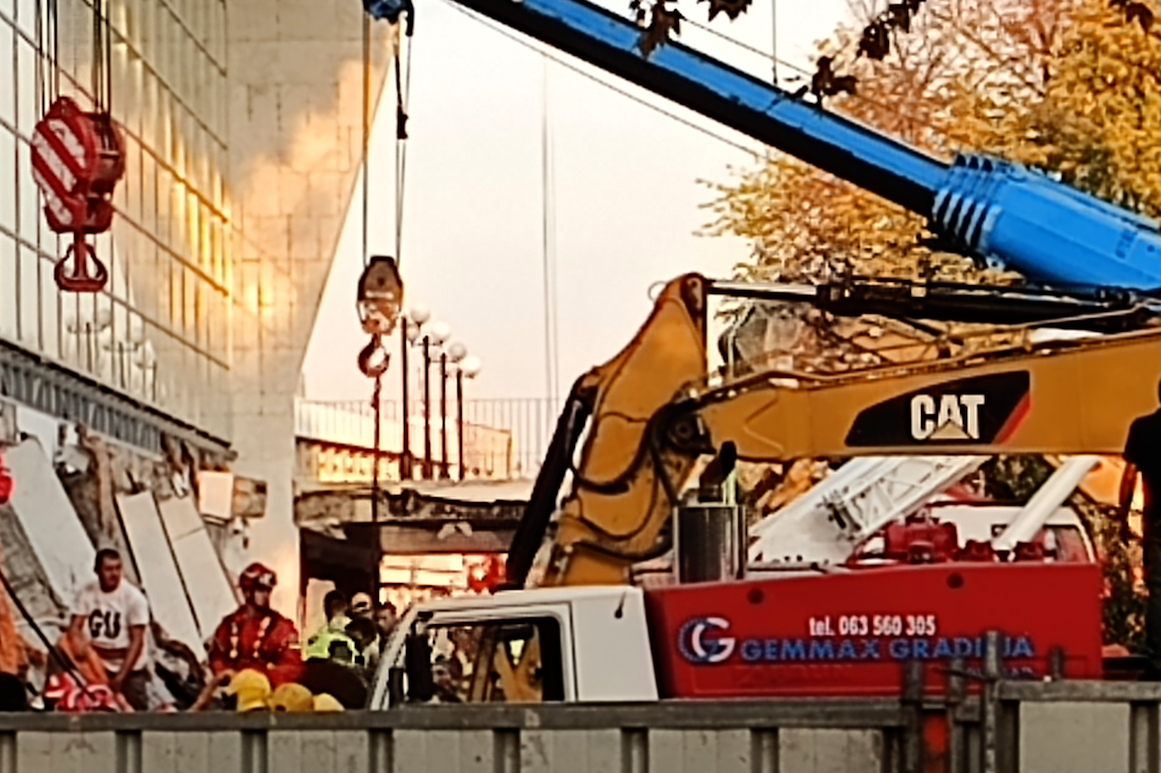
Dobrica Petrić and his 19 colleagues were on the scene when the canopy at the Novi Sad Railway Station collapsed exactly one year ago. Together with 80 members of the Emergency Situations Sector, they spent more than eight hours going under the ruins in an effort to help the injured and rescue people trapped beneath the collapsed structure.
Our interlocutor recalled everything that happened that day in Novi Sad. He thought the day would be like any other. Then, in a group chat of the Organization, he saw the news about the collapse of the canopy. The first thing he thought was — he had to help people.
“The call of duty we do activates the mind in the direction of thinking about how to immediately get to the scene, how to help people. After reading the news, I called the people from the organization since our headquarters are in Novi Sad. We immediately received an activation call in our group,” he recalls.
“Three people under the canopy were showing signs of life”
As he says, the first member of the Organization arrived at the scene after 30 minutes. Soon, the others joined them.
“When we arrived at the site, we found other services already there — primarily members of the Ministry of Internal Affairs, firefighters, rescuers, their specialist teams. The Emergency Situations Sector was there, to which we directly report, and under their coordination, we acted. We were divided into three sectors and followed their instructions and guidelines,” recalls our interlocutor.
As he explains, their task was to assist the victims who were still alive.
“Our senses sharpened. At that moment, there were three people under the canopy who were showing signs of life. We established communication with them and approached from several sides. At one point, our members went under the canopy to open a venous path for an injured person. The communication and aid continued until we were able to pull her out,” he recalls.
“We didn’t know what awaited us underneath”
He says that at that moment, communication was the most important factor to keep a person alive — to prevent them from falling into shock or losing consciousness. It was important, he says, to maintain constant communication until the moment of extraction.
“We rescued three people — one man and two women. After that, we proceeded to extract the deceased,” he recalls.
He says that in his volunteer work, he has experience rescuing people from the ruins after the earthquake in Turkey, but the event of November 1, 2024, cannot be compared.
Serbian rescuers provided assistance to their colleagues in Turkey after the devastating earthquake.
“This was a completely different situation because it happened in our city, in our country, and it completely overwhelms you with strange emotions… It can’t be compared to anything because you don’t know what awaits you underneath — whether it’s someone you know, whether you’ll be able to help…” recalls our interlocutor.
He says that on that November 1, he witnessed a sight he will never forget. With heaviness in his voice, he said: “It’s always the hardest when you see a child who shows no signs of life, and that will never be erased from memory. Just that moment when a father with two children was in an embrace — I think that’s the most horrifying thing I’ve ever seen…”
MORE TOPICS:
“ROADS OF SERBIA” DENY THEMSELVES: The roads to Novi Sad will not be closed!
Source: Blic Foto: ATA images