




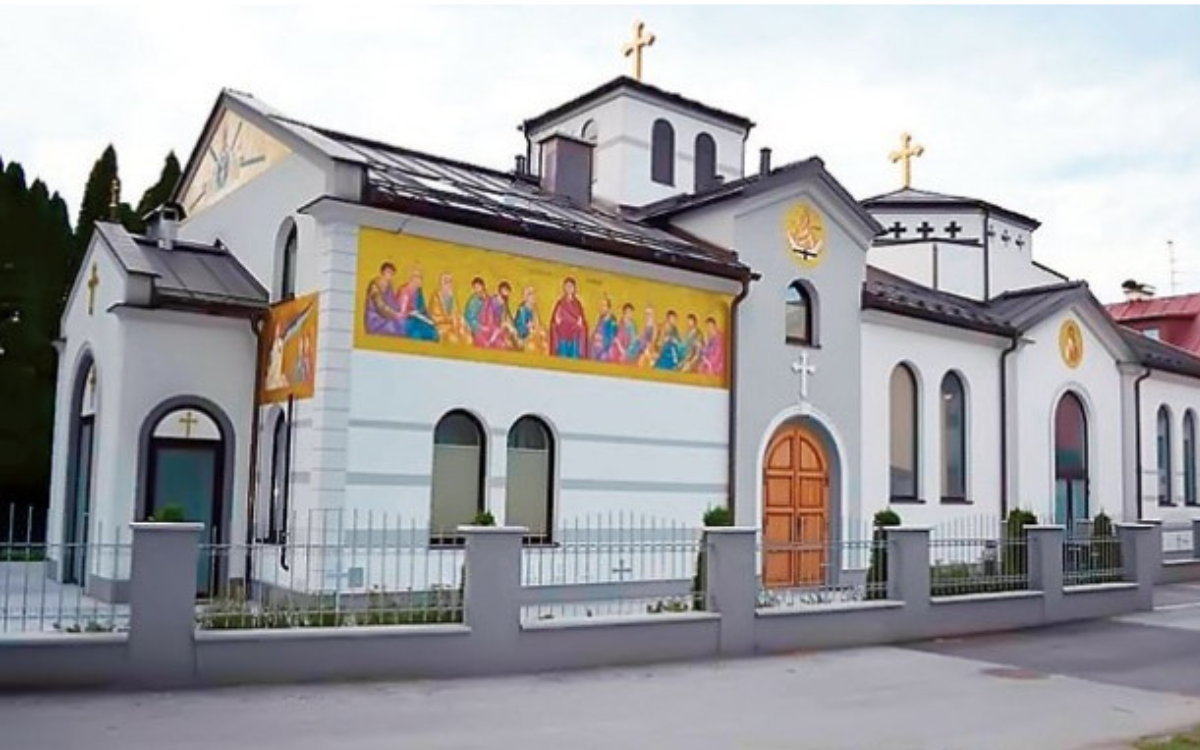
The Church of the Protection of the Most Holy Mother of God in Salzburg is a religious and cultural center for Serbs in that part of Austria, and Archpriest Stavrophor Dragan Erić says that the church has become too small for the large number of believers who come there and that an initiative has been launched to build a larger temple.
The head of the Church of the Protection of the Most Holy Mother of God in Salzburg and archpriest for Western Austria in the Austrian Diocese, Dragan Erić, says that yesterday, on the feast of the Exaltation of the Cross, a great number of believers gathered and the church was overflowing.
“This church has 170 square meters of space, it is always full, and very often people stand outside and cannot enter the temple. We have many young people, many children, and many activities. We have a choir, a children’s choir, a supplementary school of the Serbian language, and of course a lot of potential that could be developed, but unfortunately we currently do not have enough space,” Father Erić told Tanjug.
He emphasized that for this reason, with the blessing of Metropolitan Irinej, the Austrian Diocese has launched an initiative for the construction of a spiritual and cultural center in Salzburg.
“It should be a place where we will have everything for our folklore as well, which we currently do not have apart from this church we have, thank God, but which unfortunately is no longer sufficient, too small for the whole community and for all the activities that are necessary,” said Father Erić.
The plan is for the new temple to be built in the settlement of Gugenthal and dedicated to Saint Sava.
Between 300,000 and 500,000 Serbs
When asked how many Serbs live in Austria, he said there is no precise figure, but estimates range from 300,000 to 500,000.
“As far as Salzburg itself is concerned, according to some estimates, in the province of Salzburg—but that already includes other areas that are not part of this parish, such as Saalfelden, the provinces of Pongau, Pinzgau, and Lungau—the estimate is about 10,000 Serbs in the entire province of Salzburg, perhaps even more,” said Erić.
He added that this is a large and significant number of our people living in that area, and there are many young people studying at the Mozarteum.
Father Erić says that Salzburg is a border city and that many Serbs also come from Germany, since this church is closer to them than Munich or some other more distant place where there is a Serbian Orthodox church and temple.
He added that the Church of the Protection of the Most Holy Mother of God has two parishes, served by himself and Father Nikola Pantić.
“This is the only place of worship for Serbs who live in Salzburg and its surroundings. This church was built from 2006 to 2011 and is now a well-arranged and good temple, but unfortunately too small for such a large number of our believers and people,” he said.
Supplementary Serbian language school
At the Church of the Protection of the Most Holy Mother of God, a supplementary Serbian language school for children is organized, and teacher Monika Radulović says that classes are held within the framework of the Prosvjeta Serbian language school project from Vienna, led by Srđan Mijalković.
“Serbian language classes are held here in the church in Salzburg every Saturday. We currently have about 30 students aged seven to 12. We also hold a storytelling group for children aged four to seven, where we introduce them to the Serbian language. A school for older students is also planned,” Radulović told Tanjug.
She emphasized that one of the main priorities of the Serbian language school project is the preservation of Serbian identity, the Serbian language, and the Cyrillic alphabet.
When asked how well our children know the Serbian language, she said that they know it quite well or learn it very quickly.
“You would all be surprised if you attended one Serbian language class and saw how well the children know the Serbian language. Of course, when they first come to school, it happens that they do not know Serbian at all, but after just one year of attending our school, they learn to write and speak, and they are happy when they go to Serbia on vacation, where they can speak with their family in their mother tongue,” she said.
In Salzburg, a humanitarian concert “Evening of Metohija” was also held on Saturday in support of Serbs in Kosovo and Metohija.
As stated on the church’s website, the church life of Orthodox Serbs in Salzburg began in May 1946 in prisoner-of-war camps in St. Johann in Pongau, in the province of Salzburg, and in Innsbruck in the province of Tyrol.
After the war, the faithful were political or military emigrants, and services were held in the mentioned camps.
From 1968, economic emigrants—gastarbeiters—began to arrive, and in 1974 the Church Municipality for the provinces of Salzburg, Tyrol, and Vorarlberg was founded, administratively separating from the Russian Orthodox Church Outside of Russia.
Today, services are held in five places: Salzburg, Innsbruck, Reutte, Zell am See, and Hallein.
MORE TOPICS:
US-ISRAEL CONFLICT LOOMS: Trump Unveils Gaza Peace Plan, Netanyahu Vows to Continue War
FINNISH BASKETBALL WONDER ARRIVES IN BELGRADE: Mika Muurinen Takes Partizan Jersey (PHOTO)
Source:Politika, Foto: SPC