




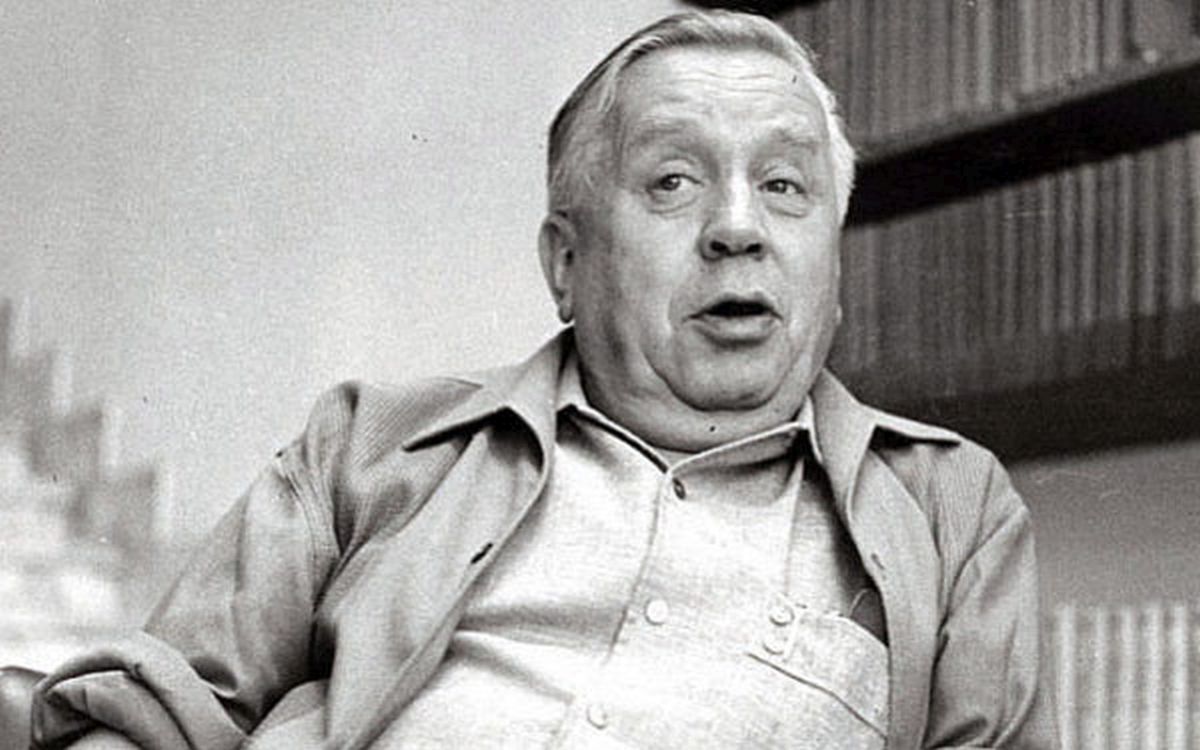
It was March 26, 1984. Branko Ćopić left his apartment, somewhere near “Beograđanka,” the tallest palace in Belgrade, and headed to the “Moskva” Hotel. In the upstairs restaurant, he ordered coffee and gazed at the Sava River for a long time.
He treated the waiters, probably for the first time, and with a generous sum…
What’s the occasion? – the waiters asked.
I have, believe me, a big reason – Branko replied.
He walked down to the bridge. Turned his back to the Central Committee building, climbed over the railing, and plummeted onto the concrete. The next day, a brief report in the newspapers. Nervous breakdown… No questions about why… Why was Branko Ćopić the first writer publicly attacked after the war by the “son of the people and nationalities,” the most authoritative man in the country, Josip Broz Tito, declaring his naive truth a lie? No questions about why Ćopić was the only writer with a special file in the City Committee of the Communist League of Belgrade and in the secret police (UDBA), a file that remained open until the early 1970s, writes Večernje novosti.
This suicide still looms like a dark shadow over his rich body of work. He took many questions to his grave. Both his own and ours.
The trial of Branko Ćopić, as Ratko Peković titled his book about him, began right at the start. Yugoslavia was recovering from a bloody war and the first consequences of the destructive Informbiro Resolution, having severed ties with Moscow. The country was slowly recovering, but with recovery came the slow growth of numerous privileges for those who had taken power in the name of the people.
In that distant summer of 1950, the weather was sweltering, as it often still is in Belgrade. Duško Kostić, the chief editor of “Književne novine,” had just finalized the August issue and was heading to his hometown of Ivangrad, not suspecting that Branko Ćopić’s latest satirical piece, “Heretical Story,” would shake the very top of the new state. At the bus station, he was met by comrades from the Committee and informed that he must return to Belgrade immediately and be in the editorial office at 7 p.m. the next evening. And nothing more. He barely made it on time.

In that distant summer of 1950, the weather was sweltering, as it often still is in Belgrade. Duško Kostić, the chief editor of “Književne novine,” had just finalized the August issue and was heading to his hometown of Ivangrad, not suspecting that Branko Ćopić’s latest satirical piece, “Heretical Story,” would shake the very top of the new state. At the bus station, he was met by comrades from the Committee and informed that he must return to Belgrade immediately and be in the editorial office at 7 p.m. the next evening. And nothing more. He barely made it on time.
When he arrived, Ćopić was there. They had brought him to the office. He also didn’t know who had summoned them or why.
Around nine o’clock, two comrades in leather coats entered and stuffed them into a red “Buick” with tinted windows. What a symbol—their communist red color and a car that symbolized capitalism! Goli Otok, they thought. Someone must have informed on them if they had carelessly spoken well of Stalin somewhere.
But instead of the secret police, they found themselves in front of Đilas.
So that’s how it is, Ćopić! Your satire and “Heretical Story”! Food for the petty bourgeoisie, pandering to the small bourgeoisie and the townsfolk… And your literature, all peasants, Jovandekas, and other peasant folk, but where is the Party? It doesn’t exist in your work… – Đilas criticized, warned, but in a soft, informal tone, not harshly or sternly, almost in a comradely way.
You found out that the Party was preparing an action against privileges, so to appear brave, you fired the first shot. Like that soldier in the war who, without waiting for an order, fires first and thus reveals the position… – and so on in that tone.
FIND OUT MORE IN ENGLISH:
The Betrayal of Writers Hurt Him
Branko slumped, nodded, and meekly muttered:
Oh, how wisely you speak, Comrade Đilas. How well you noticed all that. And my stupid Bosnian head cannot discern it all… How well you see it… – Branko bowed and maneuvered.
Now consider this matter closed – Đilas told Ćopić.
They left, stunned. In the hallway, Duško whispered:
We got off cheap!
Many years later, in Herceg Novi, after all of Đilas’s sufferings and imprisonments, sometime after the Brioni Plenum, the former party ideologist and the former chief editor of “Književne novine” would meet for the first time since that August episode.
No one in my life ever screwed me over like Branko did that night in my office over “Heretical Story” – were the first words Đilas said to Kostić as they shook hands.
But it didn’t end there, as Đilas had promised.
First, he and Moša Pijade dedicated two full pages in “Borba” to defend against the “plague” called Branko Ćopić. Imagine, he dared to write a story about a minister and his assistant vacationing in a luxury villa in Dubrovnik with their families, sisters-in-law, and additional staff, and even mentioned a general and a labor hero. But that wasn’t enough. The condemnation was joined by prominent figures of the time, Dušan Popović, as well as renowned writers and critics – Skender Kulenović, Mihailo Lalić, Velibor Gligorić, Oto Bihalji-Merin, and Milorad Panić Surep.
But even that wasn’t enough. At the AFŽ Congress in Zagreb, no less than the greatest son of our peoples and nationalities, Josip Broz himself, spoke up. Not innocently, not naively.

Tito saw in Ćopić’s “Heretical Story” an allusion to “our highest leadership.” He explicitly stated that he personally would not allow such satire, but that the writer would not be arrested.
Ironically, in the front rows sat an old woman from Lika, Soja, Sofija, Branko’s mother. Legend says that the brave old woman approached the Marshal and told him that her Branko was not a traitor. Of course, there is no mention of this in party archival documents.
The cheerful man from Krajina was deeply hurt and terribly frightened by it all. He kept repeating: Why use heavy artillery on a sparrow!
But Branko wouldn’t be Branko if he didn’t turn even such situations into mischief. He cut out the text of Tito’s speech from Zagreb, in which he said he wouldn’t be arrested, and pasted it on his apartment door. As if to remind forgetful comrades, especially those in leather coats, of what their leader had said if they came to arrest him.
He lived a double life between wit and depression, between the glory of being the most-read and most-translated writer and the pressure of the state apparatus trying to break his enduring human values. In the 1970s, in the preface to “The Garden of the Saffron Color,” he gave us a warning we didn’t understand at the time. Only when war and bloodshed erupted did his message become clear.
MORE TOPICS:
SERBIAN EXPERT TEAM: Data indicates that NATO deliberately committed genocide in Yugoslavia in 1999!
Source: Kurir, Foto: Oslobodjenje.ba