




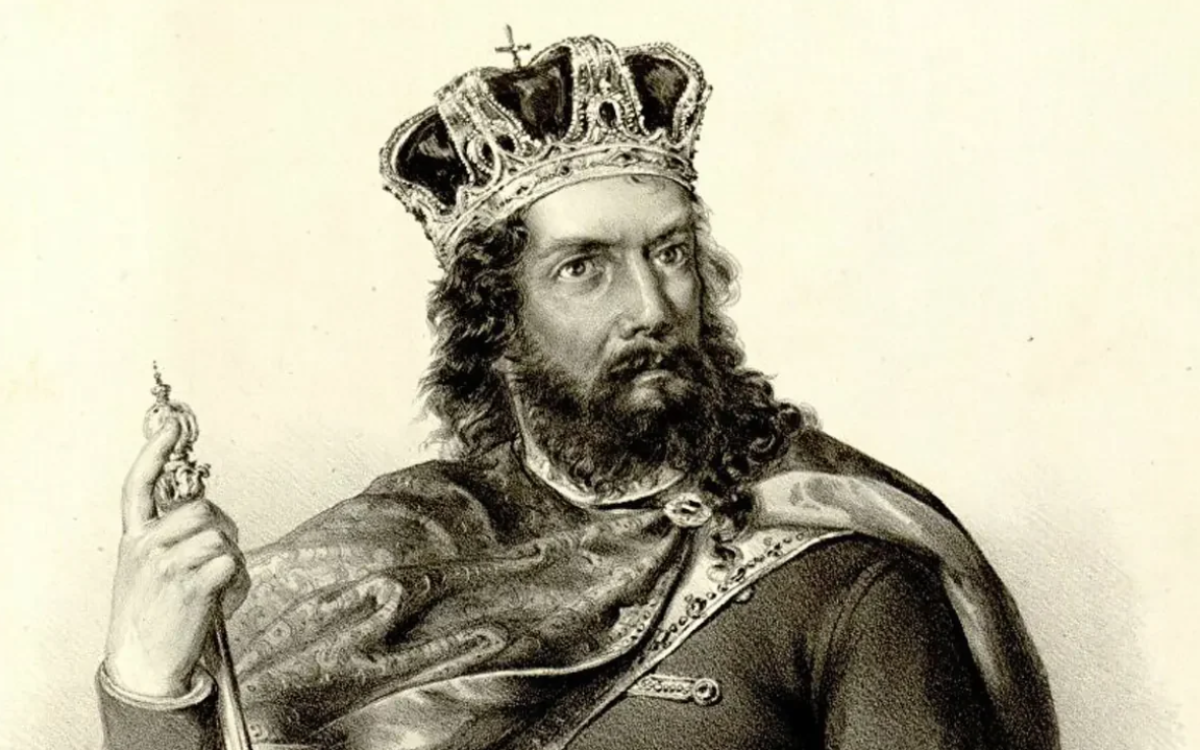
The beginning of župan Stefan’s reign is characterized by major changes in the relations between states in the Balkans and beyond.
During the time of the Hungarian king Emeric (1196-1204), his brother, the future king Andrew (1205-1235), conquered Hum from king Vukan in 1198. This was a step that certainly represented an introduction to the conquests of Serbian lands. To defend himself, Vukan sought support in the west, primarily from Pope Innocent III (1198-1216), with whom, according to some sources, he was related through his wife.
Vukan expected that these ties with the pope, then the possibility that Rome would impose its Catholicism on all of Serbia through him, and his announcement to the pope about the presence of Bogomils in Bosnia and the plan for their extermination, would put him in the spotlight as their exponent in the Balkans.
However, the pope called on Emeric to settle the situation in Bosnia, neglecting Vukan. At that time, the Bulgarian Tsar Kaloyan (1197-1207) had already accepted Catholicism. Thus, župan Stefan could expect an attack from all three sides: from Vukan, Emeric, and Kaloyan. To avert potential dangers, he also sought a royal crown from the pope, which would mean a form of legitimacy and protection from Catholic kings and their attacks. In return, he would subject the country to Rome in ecclesiastical terms.
The pope welcomed this request and appointed his cardinal John for Stefan’s solemn coronation. This would mean the final establishment of Catholicism throughout the Balkans. As this did not coincide with the interests of Vukan and Emeric, Emeric, encouraged by Vukan, prevented Stefan’s coronation.

In the context of these events and the weakening of Byzantium, Stefan drove away his wife Evdokia in 1200 or 1201. Some sources say she was “unfaithful.” Stefan had children with her: Radoslav and Komnenia, and perhaps Vladislav and Predislav.
The outcome followed as early as the beginning of 1200, shortly after the death of Stefan Nemanja, monk Simeon, in Hilandar on February 13, 1200. Vukan, with Emeric’s help, managed to overthrow župan Stefan and occupy Serbia in 1202. Pope Innocent III congratulated Emeric in a letter that same year for the occupation of the lands of the Serbian grand župan, and in early 1203, he addressed Vukan as the grand župan of Serbia.
The pope did not entrust Vukan and his Bar archbishop with the organization of the Catholic Church in Serbian lands this time either, but entrusted Emeric’s archbishop of the city of Kalocsa in Hungary with this task.
This is the reason for Vukan’s short rule over Serbia, because such a papal policy, certainly wrongly directed, spiced with Hungarian aspirations, created increased revolt among the Serbian people. Already oriented towards Orthodoxy, they opposed Vukan and his plans.
When Tsar Kaloyan penetrated Serbia in mid-1203 and captured Niš and Braničevo from the Hungarians, Stefan took advantage of these circumstances, managed to expel Vukan and regain the župan’s throne. Since Emeric was in conflict with his brother Andrew, he could not provide Vukan with appropriate assistance, and he withdrew to his estates in Zeta.

Thus, Vukan did not receive Innocent’s royal crown, which he had agreed to give him in 1202, accepting Vukan’s reasons. This would have elevated Vukan’s županship to the rank of a kingdom.
Reconciliation between the brothers occurred only with the arrival of Archimandrite Sava, who brought with him the relics of their father Simeon the Myrrh-flowing to Serbia in 1207. After that year, Vukan’s name no longer appears in the sources. His eldest son Đorđe held the title of king from 1208 to 1242. The middle son Stefan is known as the founder of the Morača monastery. The youngest son Dmitar became the monk David. The grandson of župan Dmitar was Prince Vratko, a general of Dušan the Mighty. Mladen, the progenitor of the Branković family, was probably also Vukan’s descendant.
In the spring of 1202, the Fourth Crusade was being prepared in Venice. The outcome of the campaign was the capture of Constantinople and the formation of the Latin Empire (from 1204 to 1261). With this major change in relations in the Balkans, Serbia found itself under attack from the Bulgarian Tsar Boril (1207-1218), the Latin Emperor Henry of Flanders (1206-1216), the Epirus ruler Michael I Angelos (1205-1214) who dreamed of restoring Byzantium, and the Hungarian King Andrew.
To avert all these dangers, župan Stefan sought allies in Venice and the pope. The fruit of these negotiations was Stefan’s marriage to Anna, the granddaughter of Doge Enrico Dandolo (according to some sources, this was Stefan’s third marriage), which was concluded most likely around 1207-1208. Stefan’s son Uroš was born from this marriage. This marriage brought about a greater turn of Serbia towards the papacy. Thus, Stefan sought a royal crown from Pope Honorius III (1216-1227), promising to subject his state to Rome in ecclesiastical jurisdictional terms. The pope accepted Stefan’s proposals, sent him legates with a royal crown, and he was solemnly crowned in 1217.
According to the enumeration of the crown lands (Serbia, Duklja, Travunia, Dalmatia, and Zahumlje), it is evident that he took over Vukan’s possessions after his death. The pope appointed the Serbian Bar Archdiocese as the ecclesiastical center of all these wide areas because he realized Innocent’s mistake in entrusting ecclesiastical organization and jurisdiction to the Hungarian city of Kalocsa.

Archimandrite Sava of Studenica, certainly dissatisfied with this pro-Western policy of his brother King Stefan, left Serbia and went to Mount Athos. The strength of the opposition to Catholicism in Serbia and the dissatisfaction due to the disagreement between the brothers, which led to Archimandrite Sava’s departure from Serbia, forced King Stefan to re-approach Byzantium and his dissatisfied brother. Archimandrite Sava went to Nicaea and, taking advantage of his brother’s initiatives with Emperor Theodore I Laskaris (1204-1222) and the Patriarch of Constantinople Manuel Sarantenos Charitopulos (1215-1222), whose seat after the capture of Constantinople by the Latins was in Nicaea, managed to obtain independence for the Serbian Church, but this time no longer from Rome.
The former Archimandrite Sava was solemnly ordained as the first autocephalous archbishop in Nicaea in 1219. On his return to Serbia, Archbishop Sava stayed in Thessaloniki, in the Philokalou monastery, where, while arranging legal books, he compiled the famous “Krmčija” or “Nomokanon,” the basic legal monument of the Serbian Orthodox Church.
With Sava’s arrival in Serbia, the organization of the Serbian independent church began. In addition to the two existing eparchies, Raška and Prizren, which are mentioned as early as the charter of Emperor Basil II from 1019, new episcopacies were founded: Zeta, Hum, Hvostan, Toplica, Budimlje, Dabar, and Morava. The center of the new archdiocese became the Žiča monastery, the endowment of King Stefan. The new Orthodox archbishop, under the influence of his brother the king, did not seek the abolition of the Catholic Bar Archdiocese.
King Stefan the First-Crowned died in September 1228. Archbishop Sava tonsured him as a monk before his death and gave him the name Simeon. On that occasion, royal power was transferred to his son Radoslav. He was buried in the Studenica monastery and became “Saint King of Studenica.”
When Stefan Nemanjić received the royal crown from the pope, the Hungarian King Andrew II was on a crusade, from which he returned at the end of 1218. Dissatisfied with the change in Serbia, he immediately began preparations for war against Serbia. King Stefan sent his brother Archbishop Sava on a diplomatic mission to King Andrew II.

The result was the king’s dissuasion from attacking Serbia, which Sava’s biographers call his miracle (something similar had happened earlier with Strez). The only danger to Serbia could still come from Epirus, where Theodore I Angelos (1214-1230), in his bold plans to restore Byzantium, also had in mind the conquest of Serbia.
The danger was successfully averted by the marriage between Stefan’s son Radoslav and Anna, the daughter of Theodore I Angelos. According to some recent research, this political marriage took place in 1219 or 1220.
Tradition holds that King Stefan was crowned not only by the pope but also by his brother Archbishop Sava upon his arrival in Serbia. The pope’s coronation of Stefan is indisputable, with the crowning on Ascension Day 1220 according to the Orthodox rite, as confirmed by the biographers Domentian and Theodosius, hence the epithet First-Crowned.
MORE TOPICS:
THE GREATEST SERBIAN DIPLOMAT: Here’s Why Jovan Ristić Is Known as the Thomas Jefferson of Serbia!
Source: Dinastija Nemanjić, Photo: Wikimedia Creative Commons