




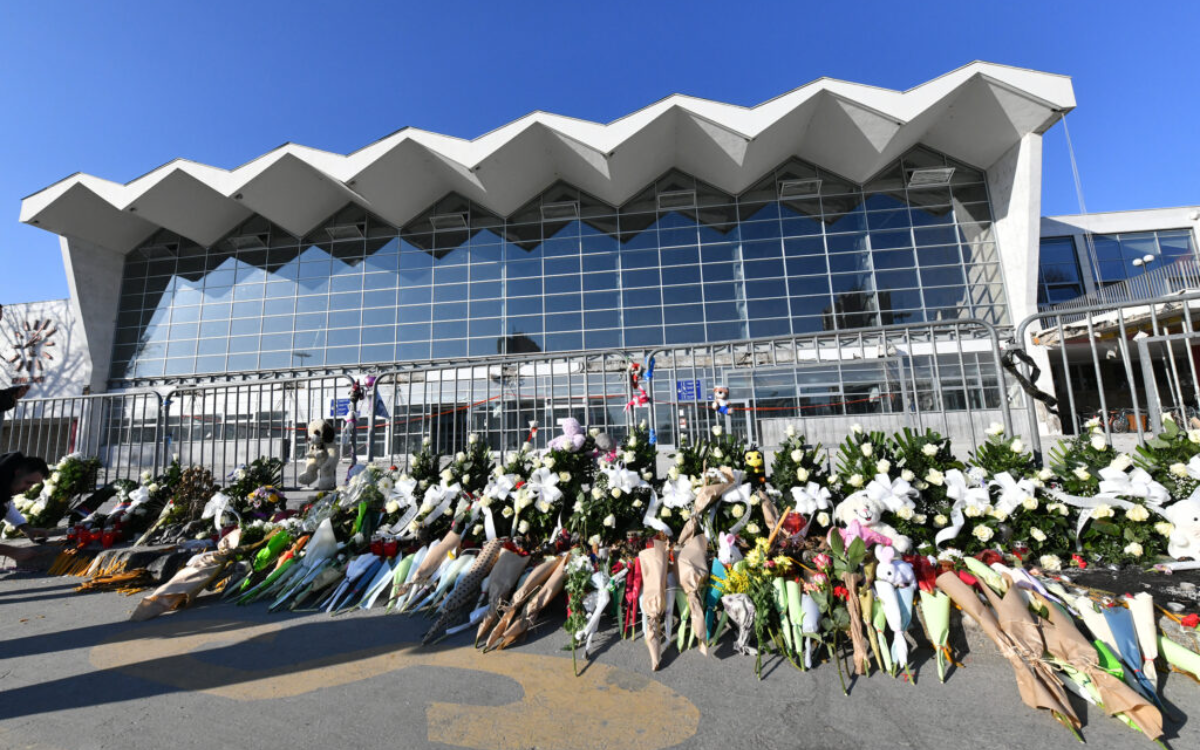
On that day, under tons of concrete debris, the following people lost their lives: Sara Firić (6), Valentina Firić (10), and Đorđe Firić (53) from Kovilj; Milica Adamović (6), Sanja Ćirić Arbutina (35), and Mileva Karanović (76), all from Kać. Also killed were Nemanja Komar (17) from Stepanovićevo, Miloš Milosavljević (21) from Knićanin, Stefan Hrka (27) from Belgrade, Anđela Ruman (20) from Stara Pazova, Goranka Raca (58) from Novi Sad, Đuro Švonja (77) from Stepanovićevo, Vukašin Raković (69) from Bukovac, and Vasko Sazdovski (46), a citizen of North Macedonia. Anja Radonjić (24) from Paraćin died from severe injuries in the hospital on November 17, while Vukašin Crnčević (18) from Zmajevo, a high school student from Novi Sad, died on March 21 of this year.
Teodora Martinko survived the accident with serious injuries.
Immediately after the collapse, the company Serbian Railways Infrastructure announced that the canopy had not been reconstructed, which was later confirmed by then-Prime Minister Miloš Vučević, who visited the site with Interior Minister Ivica Dačić and Novi Sad Mayor Milan Đurić.
“It’s unbelievable that the canopy hasn’t been renewed for 60 years. Even when the entire station was reconstructed, the canopy wasn’t. Someone will have to explain why,” said President Aleksandar Vučić that same evening in a public address broadcast by Radio Television of Serbia.
On the evening of November 1, activists from the student organization STAV (Students Against Authoritarian Rule) held a candlelight vigil for the victims at Liberty Square.
From the following day, citizens and opposition activists began organizing gatherings demanding accountability from officials.
Minister of Construction, Transport, and Infrastructure Goran Vesić resigned on November 5, stating that he was doing so “for moral reasons” because the tragedy occurred within his ministry.
“I cannot accept blame for the death of 14 people because neither I nor my associates bear any responsibility for what happened,” Vesić said the previous day at a press conference, announcing his resignation.
On November 20, Minister of Trade Tomislav Momirović, Vesić’s predecessor in the construction ministry under whose mandate the reconstruction of the Novi Sad railway station — including the canopy — took place, also resigned.
Goran Vesić and 11 others, including Jelena Tanasković, acting director of “Serbian Railways Infrastructure” who had resigned days earlier, were arrested on November 21 in connection with the canopy collapse.
Further arrests were carried out on August 1 of this year under orders from the Office of the Prosecutor for Organized Crime, whose investigation included 15 people, among them Tomislav Momirović.
Among those arrested were Momirović and his former assistant Anita Dimoski, as well as Nebojša Šurlan, who served as acting general director of the public company Serbian Railways Infrastructure a.d. Belgrade from May 2020 to March 2024.
Currently, three legal proceedings are still in the investigative phase, with no indictments yet confirmed and no trials initiated.
In addition to that investigation, which also examines possible corruption in the modernization of the railway line to the Hungarian border, two other investigations into the canopy collapse are underway — one in Novi Sad and another in Belgrade.
The Higher Public Prosecutor’s Office in Novi Sad, by decision of the Higher Court in Novi Sad on March 12, had its investigation returned for completion.
On June 18, the prosecutor’s office accused the Higher Court of obstruction, and after completing the additions, announced on September 16 that it had filed a new indictment against the same suspects for the same crimes.
The Higher Public Prosecutor’s Office (HPPO) in Belgrade also filed an indictment against three suspects already under investigation in Novi Sad, but for crimes “with elements of corruption.”
Experts, including members of the Parliamentary Inquiry Committee, stated that the Belgrade case appeared to be an attempt to obstruct the Novi Sad investigation.
In recent weeks, several senior government officials have repeated claims that the collapse of the canopy was caused by a terrorist act, even though the Higher Public Prosecutor’s Office in Novi Sad announced on July 14 that, in cooperation with the Criminal Police Directorate’s Anti-Terrorism and Extremism Unit and the National Forensic Center of the Ministry of Interior, it had conducted additional on-site inspections.
“Analysis and forensic testing of more than twenty collected samples, conducted by the Technical Department of the National Forensic Center of the Ministry of Interior, found no traces of explosive materials, thereby confirming that the collapse of the railway station canopy was not the result of terrorism,” the prosecutor’s office said in July.
MORE TOPICS:
“ROADS OF SERBIA” DENY THEMSELVES: The roads to Novi Sad will not be closed!
Source: N1, Foto: Vladislav Mitić/Nova.rs