




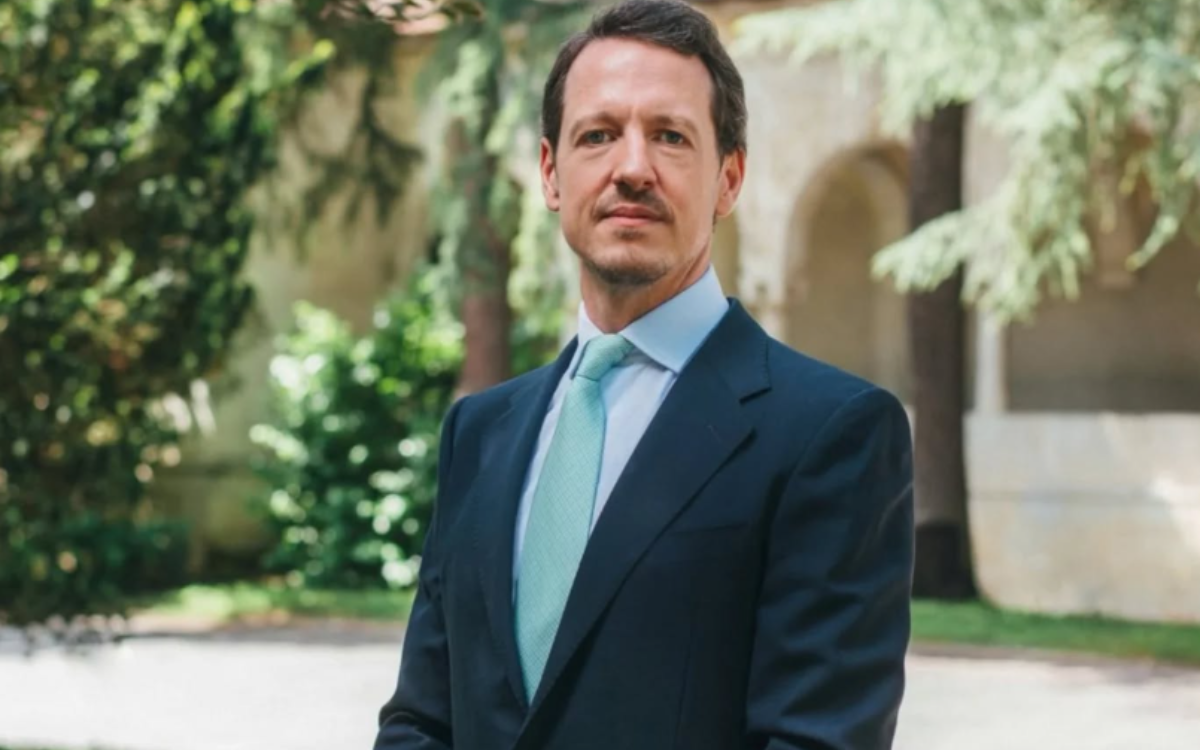
The Movement for the Restoration of the Kingdom of Serbia has called for the removal of President Aleksandar Vučić, proposing the return of the monarchy with Prince Filip as king.
A country with a throne that has come and gone — and that could once again become a kingdom. After eighty years as a republic, and part of that period as part of the former Yugoslavia, Serbia could once again become a parliamentary monarchy. At least that is what the Movement for the Restoration of the Kingdom of Serbia is calling for, with Prince Filip Karađorđević, nephew and godson of Queen Sofia, as the perfect candidate for a new king.
This is not an isolated movement, but what is new is that he is precisely the candidate proposed by this political option, which for years has advocated the re-establishment of the monarchy in the country. According to their arguments, presented in a statement, “only a monarchist restoration can guarantee national unity and stop the current division and polarization.” In the same text, they also call for the removal of the current president, Aleksandar Vučić. If this initiative were to be realized — and, as we will see, it is not without support — it would mean the return of the monarchy to Serbia after eighty years without a throne, after Josip Broz Tito and the communists took power in 1945 and formally abolished the monarchy in November of the same year, overthrowing Peter II and establishing a socialist republic.
This would also mark the return of the Karađorđević family to the throne, which it held after the coup d’état from 1903 until its overthrow, through the figures of Peter I, Alexander I, and Peter II — the last king of Yugoslavia and grandfather of Prince Filip — whom some lawmakers now mention as a figure for that possible return of the monarchy. As we said, this would not be an unexpected move nor a change that would catch Serbian politicians unprepared. Alexander II, the son of the last monarch, who was born outside the country due to his parents’ exile, was unable to return permanently until 2001, after the fall of Milošević’s rule. That same year, he regained citizenship and all properties that had belonged to the royal family and were confiscated in 1947. Since his return, however, Serbian authorities have included Alexander in numerous official events, and political party support for the return of the monarchy has gradually grown. Today, according to available data, the majority of parliamentary parties would accept a possible restoration of the institution, with various groups openly expressing support for the Crown and the Karađorđević family as the legitimate holder of the throne.
However, if the figure of Alexander Karađorđević is important, no less important is that of his middle son, Filip, whom the Movement for the Restoration of the Kingdom of Serbia proposes as the ideal candidate for the throne. And this despite the fact that he was not born as the most likely heir, but as third in the line of succession, behind his older brother Peter, who renounced his rights to the throne in 2022.
NEPHEW OF QUEEN SOFIA WHOM THEY WANT AS KING
His youth and the fact that he has lived in Serbia for 20 years, as well as that he is married to a woman born in Belgrade, make him a perfect candidate for the throne; moreover, his public role in recent years has gained prominence, as various authorities and institutions have invited him to numerous events. He was born in 1982 in the United States, but soon afterward moved to London, where he completed his education, including higher education focused on economics. He works in a financial institution in the British capital, while dividing his time between the United Kingdom and the Royal Palace in Belgrade, where he lives with his family after that return from exile.
He became the heir in 2022, when his older brother renounced his rights in order to settle in Seville, where he has lived for years and where he married just a few months ago. He did so in an intimate ceremony in the Andalusian city, transferring his prerogatives to his middle brother, whom he considered more suitable for a possible throne, as he is far more integrated into Serbian society and politics than he himself is.
And it is enough to look at who his godparents at baptism were or who served as witnesses at his wedding to see the connections he has with other European royal houses. By blood relation, he is doubly related to King Felipe VI, since his father, Alexander of Yugoslavia, is a second cousin of Queen Sofia — the same relation that connects King Juan Carlos to his mother, Maria da Gloria of Orléans-Braganza. But emotional ties are even stronger, as seen, for example, in the fact that Queen Sofia was one of his godmothers at baptism, together with her brother, King Constantine, and Princess Anne of Orléans. The queen mother did not hesitate to attend his wedding in 2017 in Belgrade either, at which Princess Victoria of Sweden served as a witness.
A clear indication that, although dethroned, the Royal House of Serbia, the former Yugoslavia, is still regarded as one of the most respected and that, in the event of a return to the throne, support in Europe would not be lacking.
MORE TOPICS:
Source: Vanitatis Foto: Printscreen Instagram