




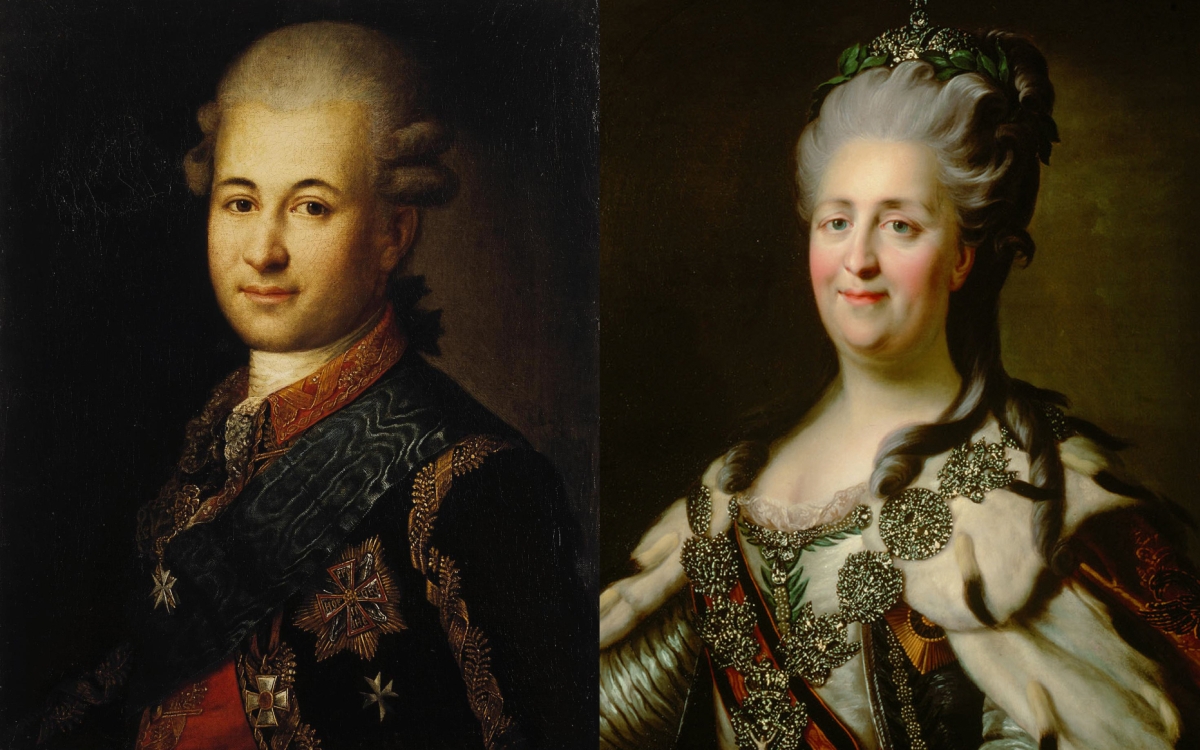
Catherine the Great was forced to renounce her love and remove Simeon Zorić from the court. What was the reason for this? Most likely, the vice—gambling—that followed him until the end of his life.
Simeon Zorić was one of the most unusual men to serve at the court of Catherine II. He was a nobleman who loved adventure, and although wealth was not his priority, he lived in abundance thanks to his patroness—Catherine the Great.
He had two completely opposite traits in his character; Catherine called him “a good man who does bad things.”
Brave Serb – Simeon Zorić
At the beginning of the 18th century, a large number of Serbs settled in Russia, and many families with Serbian surnames emerged at that time. They were ethnically Serbian, ideologically supportive of the Russian Empire’s aspirations, and loyal to it. Simeon Zorić came from this background. He was born in 1745, and after the death of his parents, was raised by his uncle, Major Zorić, whose surname he took. In 1754, Simeon trained at the Cadet Corps in Saint Petersburg.
During the Prussian War, he was captured, and immediately after being released, he was promoted to lieutenant. Soldiers described him as a brave and noble man who never surrendered in battle. It is worth noting that he was only 16 years old at the time.
FIND OUT MORE IN ENGLISH:
Resourceful Commander
The young lieutenant also proved his command skills during the Turkish War and was promoted to major. He was known as a brave and resourceful warrior. During battles with the Turks in 1770, realizing that his forces were weakening, Zorić reportedly shouted: “I am the Captain-Pasha.” The Turks believed he was a general. Although it wasn’t true, this deception saved their lives. The Turkish sultan even tried to persuade Zorić to join their side, but he refused.
Zorić and Catherine II
The turning point in Zorić’s life came in the summer of 1775. Potemkin was looking for a new adjutant, and Zorić was the perfect candidate. Catherine had heard of his feats, and his attractive appearance pleased her. The relationship between Grigory Potemkin and Catherine had cooled. With Zorić’s arrival beside the Empress, foreign diplomats began referring to him as a “powerful favorite” destined to play an important role in Russian history.
Both Potemkin and Catherine appreciated Zorić for not seeking power. He had enough fame and wealth given to him by his patrons—he needed nothing more. He loved fishing and the company of beautiful women, and disliked intrigue and scheming, although he enjoyed adventure. It is said he loved Catherine the Great, but he never offered her advice nor tried to lead the state. His greatest flaw was his love of gambling.
Catherine constantly waited for him; he spent hours gambling, and she often paid his debts. This was likely the reason she parted ways with Zorić, though Potemkin, being his rival, also played a role. Despite no longer living at court, Zorić retained Catherine’s favor, and she granted him a large sum of money.
After her death, Paul I (Catherine the Great’s son) reinstated Zorić into military service, but he soon gambled away all his money. He had to leave the military and moved to Shklov, where he founded a school that later burned down in a fire. Simeon Zorić died in 1799.
Simeon Zorić was a talented and brave commander, but he could not overcome his vice. Still, he lived life on his own terms, managed to handle various wartime situations, and emerged victorious from most of them.
MORE TOPICS:
COLUMN, KOVAČEVIĆ: On the police, batons, revolution and its children…
ALL MEMBERS OF OUR TEAM WON MEDALS: Six medals for Serbia at the Balkan Mathematical Olympiad!
Source: Sputnik; Foto: Wikimedia Creative Commons