




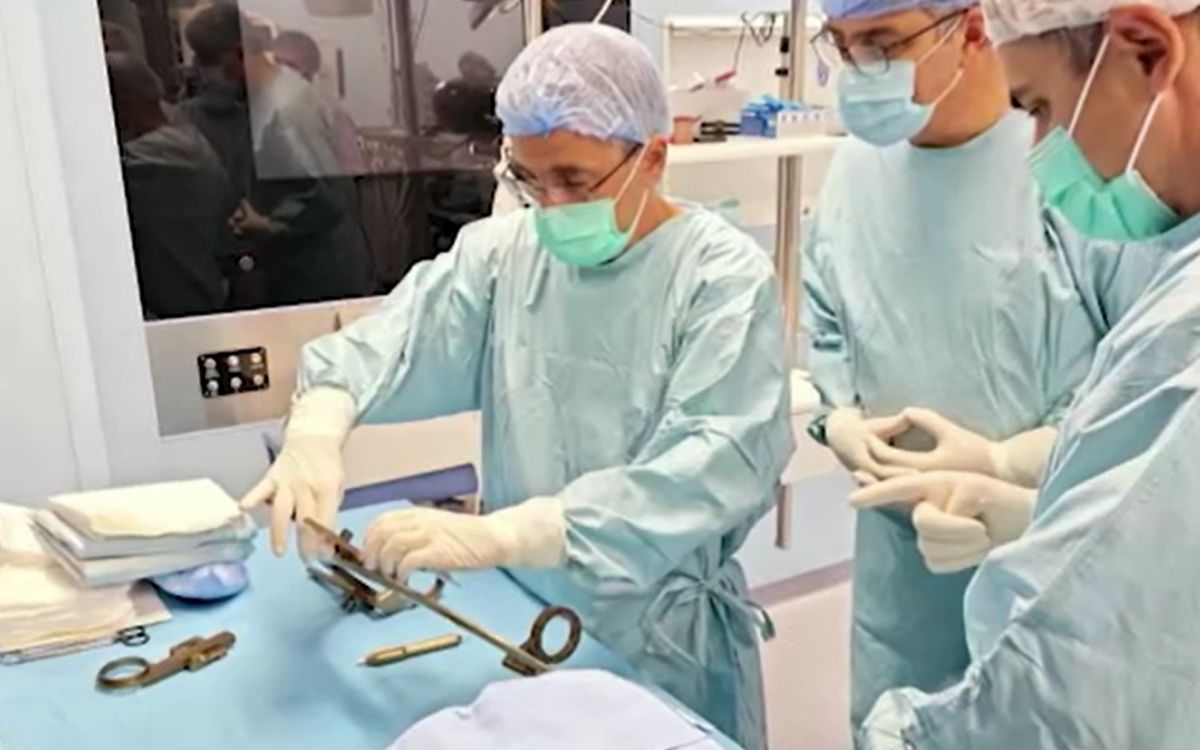
A procedure for implanting special electrodes into the brain was performed for the first time at the Clinic for Neurosurgery of the University Clinical Center of Serbia. The Stereo EEG procedure allows doctors to directly record brain activity, locate the epilepsy focus and its spread, and then plan the operation, leading to complete cure.
The forty-one-year-old female patient who had the electrodes implanted last Tuesday is doing well. The activity recorded by the instruments is being monitored, and in the coming days, doctors will decide when she is expected to have the operation that should resolve the epilepsy problem.
Professor Dr. Vladimir Baščarević from the Clinic for Neurosurgery of the University Clinical Center of Serbia, explains that this method allows for the precise localization of the epileptogenic zone, i.e., the focus from which the epilepsy starts, which enables surgical treatment to be carried out with great precision.
“We prepared for a long time to achieve this. It is the peak we aspired to, to include this type of operation in our operative program. Epilepsy surgery has been performed at the neurosurgery clinic for 15 years now, but this was the part that was missing for us,” adds Professor Baščarević.
The electrodes are about 0.7 millimeters in diameter and about 10 centimeters long. In order to place them, the most modern equipment that the clinic possesses must be in place, the professor notes. This involves navigation systems for the stereotactic frame.
“We implanted eight electrodes in the right hemisphere, in the temporal lobe, and one in the left. We did this with the help of our colleagues from Sofia, Bulgaria, Professor Krasimir Minkin and Kalaveyan Gabrovski. So, Assistant Ivan Bogdanović and I, and the two of them, successfully performed it,” Dr. Baščarević points out.
The entire procedure lasted more than eight hours, but the planning of the procedure for placing the electrodes in three planes was done a day earlier, which also lasted almost five hours.
“Then, in the morning, the stereotactic frame is placed on the patient, a new scanner is performed, and that complete CT is implanted into the navigation machine, the Stealth station system. Then we enter the operating room, and with the help of the stereotactic frame, one electrode after another is implanted on a precisely determined path into a specific part of the brain, with absolute precision, so that not a single blood vessel is damaged. The brain is permeated by a network of blood vessels, arteries, and veins, and every one of them must be missed,” the professor emphasizes.
The EEG electrodes will be removed tomorrow, and after that, in the next month or two, the patient needs to recover so that the resection of what was recorded by the deep stereotactic EEG electrodes can be performed.
Thanks to this diagnostic method, at least 10 to 15 patients with epilepsy who are candidates for surgical treatment will be able to be operated on annually, Professor Dr. Vladimir Baščarević points out.
Great success for Serbian neurology and neurosurgery
Prof. Dr. Aleksandar Ristić emphasizes that without false modesty, it can be said that the Neurosurgery Clinic of the UCC of Serbia is on par with major epileptological centers.
“This team undertaking did not start yesterday or the day before. The program, which Professor Sokić started, has been very active for 15 years, and so far over three hundred patients have been operated on. But after a certain time and the experience we gained in the first phase, we have now reached the second phase, and there is great cooperation with centers around the world. It is established, it has been going on for years. There are people who have gone for that experience, gaining knowledge directly from major centers,” adds Dr. Ristić.
At the American clinic in Cleveland, where Prof. Ristić spent two years on subspecialization, this program was started in 2009 and 2010. Now, 15 years later, it is available here, which is a great success for Serbian medicine and especially for Serbian neurology and neurosurgery, the professor emphasizes.
“This is a team effort. It requires a well-coordinated team. And besides neurologists and neurosurgeons, it is also composed of neuroradiologists, neuropsychologists, neurophysiologists, nuclear medicine specialists, and we must not forget a very important segment of this work, which are the EEG technicians who are actually in direct contact with the patient; they continuously monitor the patient, they intervene with the seizures the patient has. All people are fully trained in terms of staff and possess the knowledge. So, we have the expertise, and we have the knowledge,” the professor points out.
Stereo EEG is the method that most precisely determines where the epilepsy is located. The electrodes enter the deepest parts of the brain, where the epilepsy begins. In complicated cases, operative treatment was not possible, but now that has also been achieved and has made it possible for patients to no longer go abroad for such procedures.
The female patient who underwent this diagnostic method has been suffering from very pharmacoresistant epilepsy for 11 years, which severely functionally disables her.
“She is fighting strongly against it, and she is active, she is employed, she has a family, but the seizures are very stubborn. This treatment is an excellent way of treatment, and we think that in this specific case, it will have a full outcome. We have now done absolutely everything we wanted, and we believe we did an excellent job with this patient,” emphasizes Prof. Dr. Aleksandar Ristić.
MORE TOPICS:
SERBIA LEFT WITHOUT A LEGENDARY DIRECTOR: Zdravko Šotra passed away at the age of 93!
DUE TO OVERCROWDED PRISONS: Belgium considers sending prisoners to Serbia or Albania!
KOVAČEVIĆ COLUMN: How Halid was connecting Miljacka and Romanija while others were separating them
Source: RTS; Photo: Printscreen RTS