




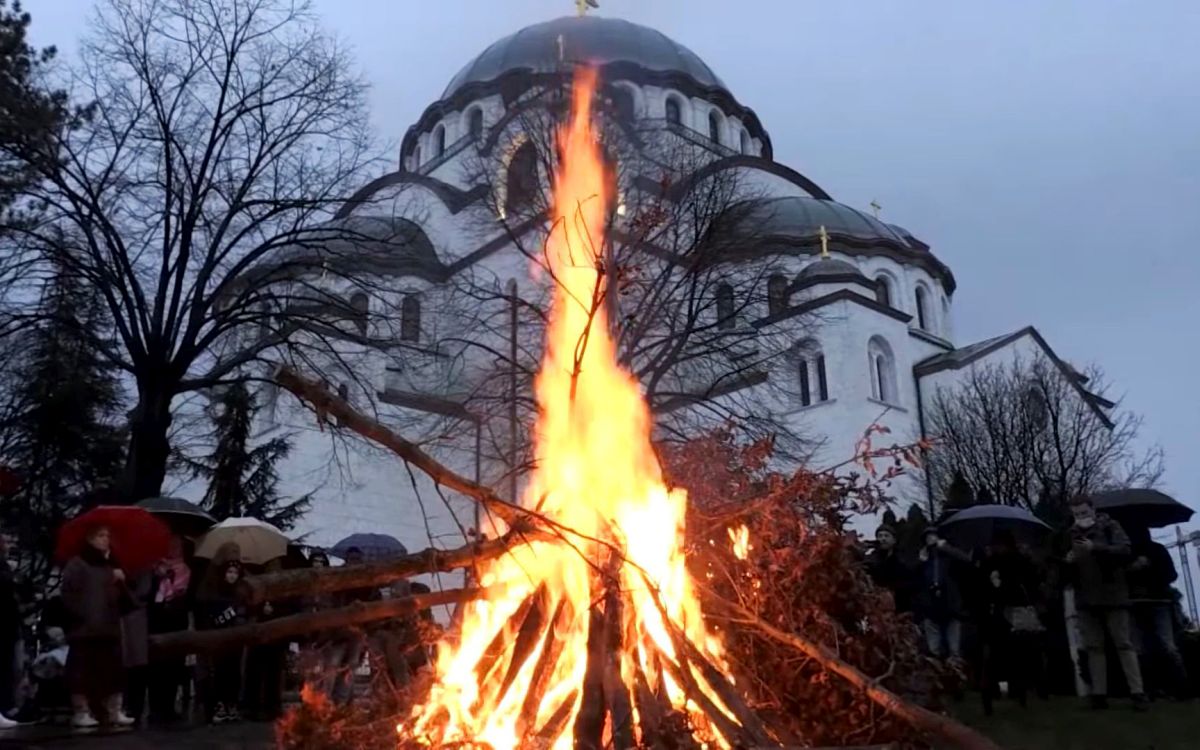
Orthodox believers in Serbia mark Christmas Eve with the traditional bringing in and burning of the “badnjak” (oak branch), liturgies in temples, and family gatherings at the Lenten table before the most joyful Christian holiday of Christmas – the holiday celebrating the birth of Jesus Christ.
Preparations for this holiday begin 40 days before January 7th, with the Christmas Fast, which represents the purification of spirit and body.
Christmas Eve begins early and lasts until late. In the morning, before sunrise, the head of the household goes to the forest for the badnjak, which is brought into the house only with the first darkness. Along with the wood, grain is offered so that the coming year will be fertile. The bringing in of straw is also mandatory, and in this way, a sacrifice is offered to the spirit of Christ, who was born on straw.
Serbs have marked Christmas since time immemorial, and with the badnjak, or Christmas tree, happiness, health, and progress are brought into the house.
The badnjak originates from the miraculous night in Bethlehem when shepherds cut and brought branches to light a fire next to the Newborn and his Mother. The straw that is brought into the house with a cornelian cherry twig also reminds us of that night when the Son of God was born and when he was laid in a manger on straw.
The people inherited these customs from their ancestors and continue to maintain them. Thus, tonight the badnjak is placed on the hearth, sprinkled with grain, honey, and wine, along with a series of ritual actions intended to ensure the health and progress of the entire house and family.
In urban conditions, in a safe manner, only a few leaves are singed.
On Christmas Eve, one does not sleep, but keeps watch and awaits the solemn moment of the Birth of Christ. Christmas Eve is a night of peace and expectant joy.
According to the customary calendar, nothing is taken out of the house today.
Whoever has quarreled with someone during the year should be reconciled on Christmas Eve, so that Christ’s birthday can be spent in peace and love. Thus, it is also a reminder that forgiveness is a gift from God and one of the most difficult Christian virtues.
Christmas is a holiday for the whole family, and therefore it is expected that they be together during the festive days, and it is accompanied by a large list of folk customs, such as the breaking of the festive bread (pogača).
Custom dictates that the household members give gifts to the first guest on Christmas, the “položajnik,” and host them as best they can, because he symbolizes the divinity.
MORE TOPICS:
IN THE WORDS OF A YOUNG GIRL: Here is what Christmas Eve looked like in Serbia in 1909!
Source: RTS; Photo: Printscreen YouTube / NOVA S