




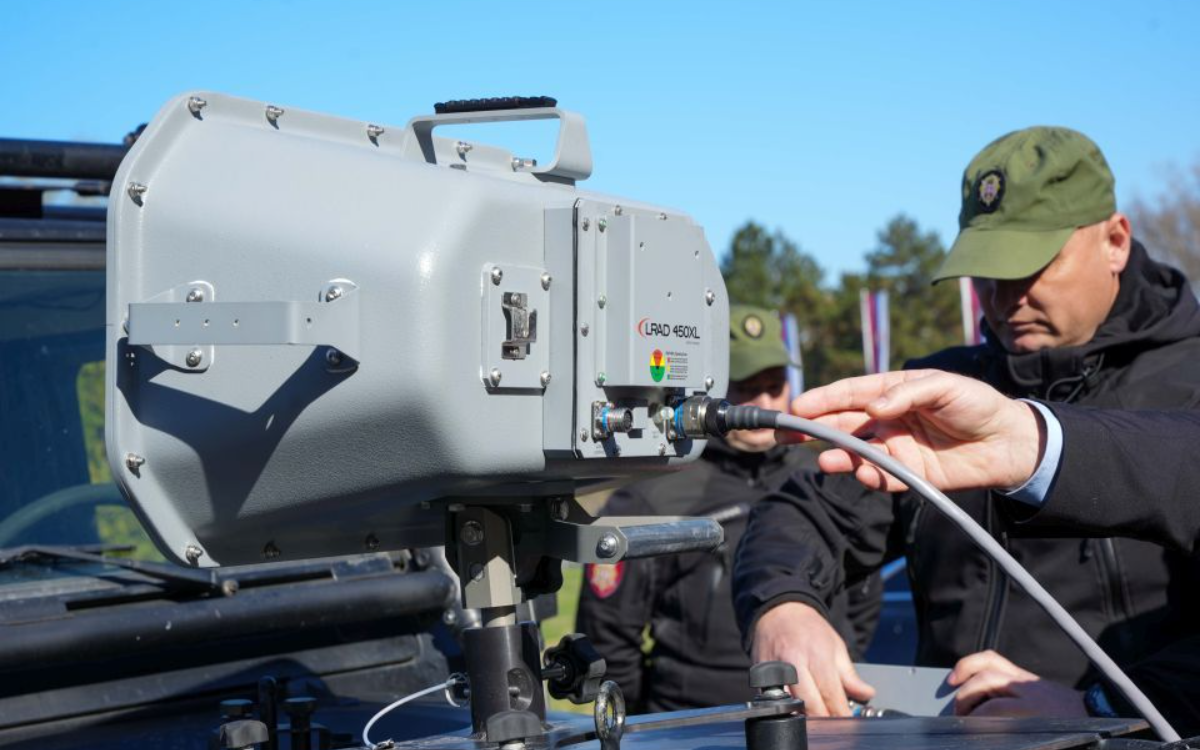
Serbian intelligence officers tested sound cannons on dogs in cooperation with the notorious Russian security service, according to government documents reviewed by Politico.
Serbian documents confirm that the administration of President Aleksandar Vučić carried out experiments with powerful loudspeakers, colloquially known as sound cannons, two weeks after an anti-government protest in Belgrade was disrupted by what demonstrators described as a disabling sound blast, Politico writes.
The joint testing of sound weapons on animals points to the depth of security cooperation between Russia — the European Union’s most aggressive adversary — and Serbia, an EU membership candidate whose accession process is stalled, as the government faces serious challenges, the article says.
Long Range Acoustic Devices (LRADs) are marketed as tools for communication over long distances, but when used at close range they can pose a risk of hearing damage. They have also been reported to cause headaches, dizziness, and nausea. The government has denied using sound cannons during the protests.
Serbia is in the grip of the largest protest movement in decades. For more than a year, tens of thousands of people — and at times hundreds of thousands of citizens — have taken to the streets across the country, organizing regular, mass protests that reflect growing anger toward the authorities, Politico reports.
On March 15, 2025, during one of the largest protests, a sudden, deafening noise tore through Belgrade’s main thoroughfare, forcing waves of people to duck and seek cover.
Footage recorded from multiple angles shows the disturbance spreading through the densely packed crowd, followed by people fleeing in panic. Demonstrators who arrived at Belgrade emergency centers reported nausea, vomiting, headaches, and dizziness. They said they heard a sound resembling a “group of motorcyclists” or a “locomotive” approaching them.
READ MORE:
After initially dismissing claims that the authorities had used a sound cannon, Vučić said that “within 48 hours a full investigation will be conducted, and then all those responsible for such brutal fabrications and lies will be held accountable before the competent authorities.”
Interior Minister Ivica Dačić also denied any abuse, insisting that Serbia “did not use any illegal means, including the so-called sound cannon.”
A month after the protest, the Security Information Agency (BIA) published a report which, Politico writes, it had commissioned from Russia’s Federal Security Service (FSB), stating that high-decibel devices “were not used during the protest” and that there was no mass “psychological, moral, and physical impact on people.”
Serbia’s Ministry of the Interior did not respond to Politico’s request for comment.
Testing on animals
Animal testing was carried out as part of the post-protest investigation, according to documents obtained by Politico, prepared by the BIA and a government ministry.
The aim was to determine whether the symptoms reported by demonstrators were consistent with the effects of sound cannons, which Serbian officials had previously acknowledged the police possess.
Approximately two weeks after the protest, Serbian and Russian intelligence experts gathered a group of dogs at a BIA testing range to assess the “effect of emitters on biological objects.” Dogs were chosen as test subjects because of “their high sensitivity to acoustic effects.”
The animals were exposed to two LRAD models — LRAD 100X MAG-HS and LRAD 450XL — manufactured by the California-based company Genasys, from “distances of 200, 150, 100, 50, and 25 meters,” according to the documents.
Technical specifications of the models used indicate that they can emit sound levels of up to 150 decibels, equivalent to the sound of a jet aircraft during takeoff.
The documents also suggest that the tests may have been conducted without the necessary permits for animal experimentation.
“The Ministry of Agriculture, Forestry and Water Management… has no knowledge of whether tests of the effects of LRAD 100H and LRAD 450XL, as well as other tests of the effects of other devices on dogs, were conducted,” the documents state.
“This ministry has never received a request for consent to conduct animal testing, and therefore did not issue a decision approving the testing in question, nor any other similar testing,” they add.
Danilo Ćurčić, a Serbian human rights lawyer, said the dogs were “subjected to experiments or abuse,” as defined by the Animal Welfare Act.
He said Serbian law requires that animal experiments be reported in advance and approved by competent bodies — including review by an ethics committee — and explicitly prohibits testing on animals for the purpose of “testing weapons and military equipment.”
Radomir Lazović, an opposition politician, described the tests as “part of Aleksandar Vučić’s campaign to cover up the use of sound cannons against his own people during the March protests.”
“Thousands of people last year felt the mass effects of this sound weapon on their own skin,” he said.
In its report on the experiments on dogs, the FSB insisted: “During the emission of basic and test signals, the biological objects (dogs) did not experience discomfort (changes in behavior) at the tested distances. The dogs were examined three days after the testing and showed no changes in their health condition.”
MORE TOPICS:
HILANDAR TURNED WHITE: Snow delighted Serbian monks after almost a decade! (PHOTO)
Source: N1, Foto: MUP