




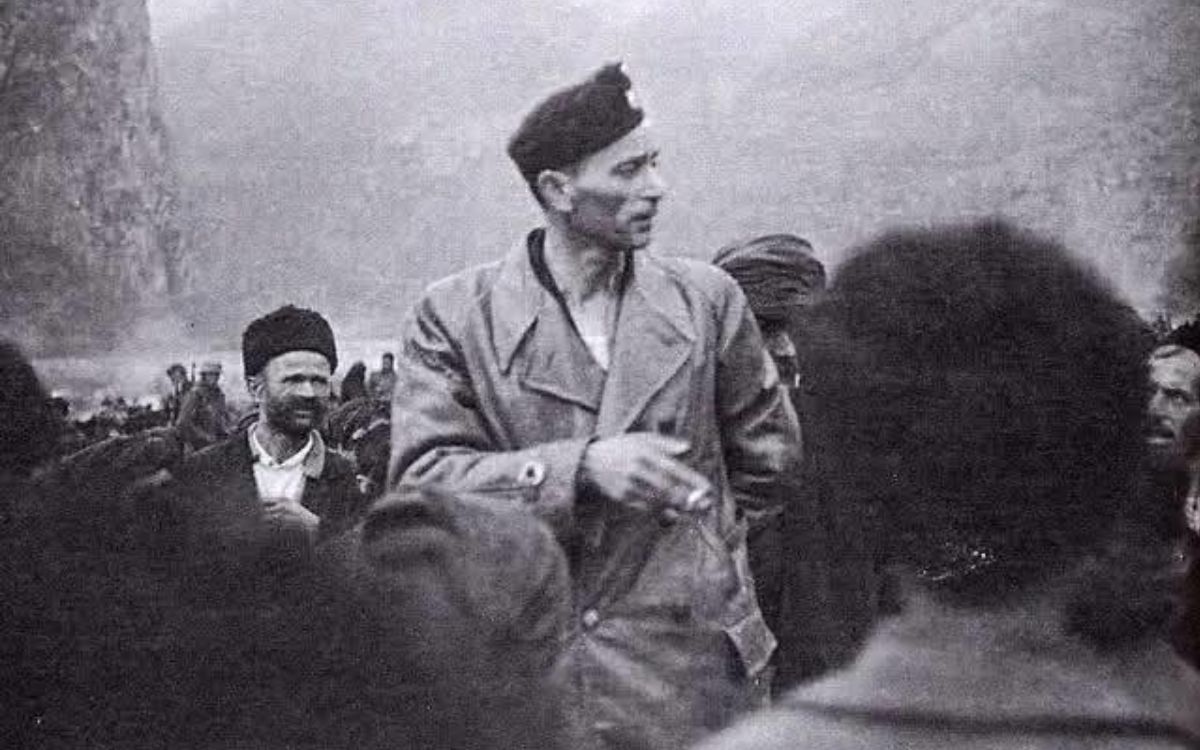
Jure Francetić was the commander of the Black Legion, an Ustaša unit that massacred and killed thousands of Serbs. Wherever he went, Francetić left bloody traces of crimes against Serbs.
– When it comes to his death, some would say that Francetić was unlucky. Others will say that there is a God – it is stated on the Facebook page “Interesting History and Geography,” which recalled Francetić, his deeds that left horrific consequences, and the way he died.
The plane he was flying in malfunctioned above Slunj. Francetić had to land not far from the village of Močila. The malfunction was allegedly sabotaged by the Italians.
Francetić ordered the assembled peasants, Serbs, to find some transportation for him and the pilot. However, the peasants recognized Francetić, who was widely known for his atrocities.
– They tried to capture him, but Francetić began firing from a submachine gun. One of the peasants, Petar Trbojević, fired an old hunting rifle and hit Francetić’s submachine gun in the part that holds the magazine. The weapon was disabled and the peasants captured Francetić with their bare hands. While he was resisting, one of the peasants struck him on the head with the blunt end of an axe. In a Partisan report, it is stated that this was done by Mile Trbojević. Francetić’s skull cracked – it is stated on this page.
Soon the Partisans arrived and transported him to Slunj, to the hospital where he was operated on. The Partisans wanted to exchange him for 100 prisoners from Jasenovac. Ante Pavelić would probably have agreed to release more Jasenovac sufferers, because Francetić held the rank of Ustaša general and was extremely well known and popular in the NDH:
– Francetić did not survive. After five days during which he was in a coma, he briefly regained consciousness. He called out for Pavelić, and then on the caps of the Partisans guarding him he saw five-pointed stars. He died on December 27, 1942, not understanding how he had ended up among enemies.
FIND OUT MORE:
The Ustaše hid the news of Francetić’s death for three months and declared eight days of mourning. Only on March 30, 1943, did the NDH announce the news of Francetić’s death.
The Partisans transported Francetić’s body by truck in an unknown direction, and to this day it is not known where he was buried. Croatian right-wing groups have been trying for decades to find his grave, which would probably become a gathering place for Ustaše.
Let us recall that Juraj Jure Francetić (1912–1942), one of the most notorious Ustaša commanders during World War II, is remembered as the commander of the Black Legion, a unit responsible for mass crimes against Serbs, Jews, and members of the National Liberation Movement in Bosnia and Herzegovina.
Born on July 3, 1912, in the vicinity of Otočac, Francetić began studying law in Zagreb after completing high school, where he joined the Ustaša movement. Due to political activity against the Kingdom of Yugoslavia, he was soon expelled and then emigrated to Italy, where he took the Ustaša oath in 1933. The following year he spent in emigration in Italy, Austria, and Hungary, including stays in Ustaša camps and terrorist groups.
After the assassination of King Alexander in 1934, he was interned, and he returned to Yugoslavia at the end of 1937. New arrests and internments followed, and in early 1941 he fled to Germany, avoiding a new detention.
After the proclamation of the Independent State of Croatia in April 1941, Francetić rapidly advanced in the Ustaša hierarchy. He became a colonel of the Ustaša Militia and commander of the Black Legion, a formation that operated primarily in eastern Bosnia.
Although without serious military education, he was given broad authority. Under his command, mass deportations, arrests, and killings were carried out, as well as the persecution and destruction of the Jewish population, in line with the racial and repressive policies of the NDH.
The Black Legion was officially presented as a force for the “defense of the border” on the Drina, but its actions were marked by brutal repression of the civilian population. The crimes caused concern even among German military authorities, who demanded Francetić’s removal.
Despite this, Poglavnik Ante Pavelić promoted him to commander of all Ustaša units in Bosnia and Herzegovina.
During 1942, the Ustaša authorities, partly due to political pressure and relations with the local population, removed Francetić from duty.
That same year, in December, his plane made a forced landing in territory controlled by the Partisans near Slunj. Francetić was seriously wounded on that occasion and soon died, on December 27, 1942.
Decades later, Francetić’s name has periodically caused political and social controversy.
Attempts at his rehabilitation, including the erection of memorials and the naming of streets after him during the 1990s and early 2000s, met with strong protests in Croatia and abroad. Most of these memorials were later removed, and streets were renamed, as local authorities sought to distance themselves from the legacy of the Ustaša regime.
Today, Francetić remains a historical figure whose name is associated with one of the darkest periods in the history of the region and with a policy of systematic violence and persecution during World War II.
MORE TOPICS:
Source: Kurir; Foto: Printscreen Facebook