




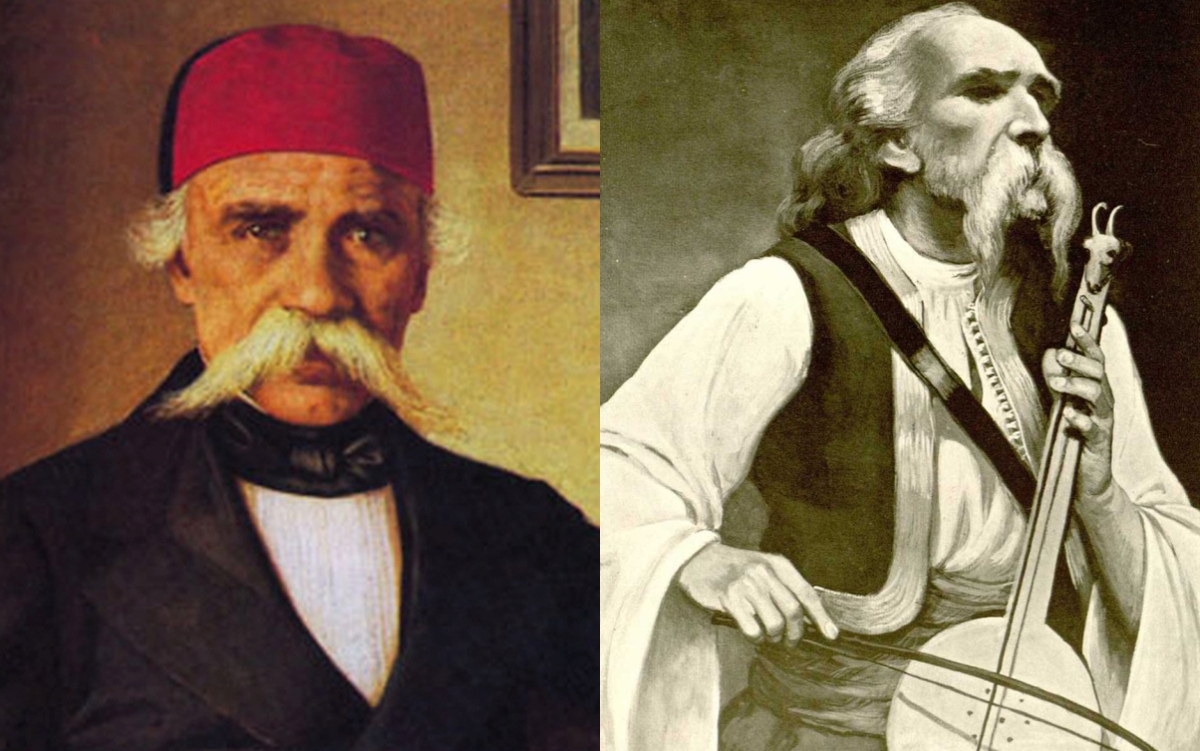
Until the second half of the 18th century and the beginning of the Romantic era in European culture, Serbian folk literature, art, and tradition remained in the shadows, practically unknown to most intellectuals on the Old Continent. However, thanks to German creators such as Jacob Grimm and Johann Wolfgang von Goethe, the Serbian people finally began to attract the attention of the West.
For a long time, the Balkans were not considered an important topic in Western intellectual circles, and very little was known about Slavic nations under Ottoman rule.
Only with the rise of Romanticism, a literary and artistic movement emerging from the new ideals shaping the spirit of the time in Europe in the late 18th century, did Serbian folk literature and culture gain significance.
Romanticist ideas celebrated the national state, language, culture, history, and struggles for national liberation. Romanticism, as an artistic movement, embraced ancient, ‘primitive’ poetry that arose as a natural expression of the human spirit.
Thanks to these ideals and to great German intellectuals such as Jacob Grimm and Johann Wolfgang von Goethe, the Serbian people finally began to capture Western interest, prompting the question: “Who are the Serbs, and what is their culture?”
Serbian oral epic poetry provided Europeans with insight into the lives of Serbs, their customs and history, what they fought for, and how they understood honor, love, and freedom.


The educational mission of Vuk Stefanović Karadžić, who recorded poetry as he heard it from folk singers and guslars, allowed Jacob Grimm to develop an affinity for Serbian culture, which he enthusiastically studied and introduced to the West.
It was through Grimm, who learned Serbian in the process, that Serbian folk songs reached Johann Wolfgang von Goethe, one of the greatest and most respected artists of his time.
Goethe was so impressed by Serbian folk poetry that he compared its beauty to the biblical Song of Songs. The German artist particularly admired “Hasanaginica,” which he translated into German along with other Serbian folk songs.

Beyond German Romantics, Serbian folk poetry also gained prominence through the works of Alexander Pushkin, Therese Albertine Luise von Jakob-Robinson (Talvj), Johann Gottfried Herder, Claude Fauriel, and Adam Mickiewicz.
Epic poems emerged as a result of collective folk creativity, passed down from generation to generation, glorifying important events, great battles, and heroic deeds. They were also called “men’s songs” because their main themes often revolved around bravery, heroism, and a glorious past.
The dominant verse was the epic decasyllable, and the narratives were dynamic, without unnecessary lyrical details. Epic songs were traditionally sung to the accompaniment of the gusle, and folk singers often added their personal touch to the original structure without altering its essence.
Considering that these poems were passed down orally, guslars were the most important guardians and interpreters of this cultural heritage.
Thanks to singers such as Filip Višnjić, Tešan Podrugović, and Starac Milija, Serbs today learn through artistic expression about national heroes such as Prince Lazar, Kraljević Marko, Miloš Obilić, Emperor Dušan, and other historical or semi-mythical figures.
The verbal creativity of the Serbian people led to the development of not only epic folk songs but also lyric folk songs, stories, fairy tales, riddles, ballads, and legends. Despite the fact that Serbs were without a state for centuries, their rich cultural heritage survived, escaping oblivion in a remarkable way and introducing Serbia into the ranks of great European cultures.
MORE TOPICS:
THE NEW YORK TIMES ON SERBIAN MEDIA: After protests in Novi Sad, RTS “changed Its tune”!
Source: Serbian Times / Mediji, Foto: Wikimedia Creative Commons