




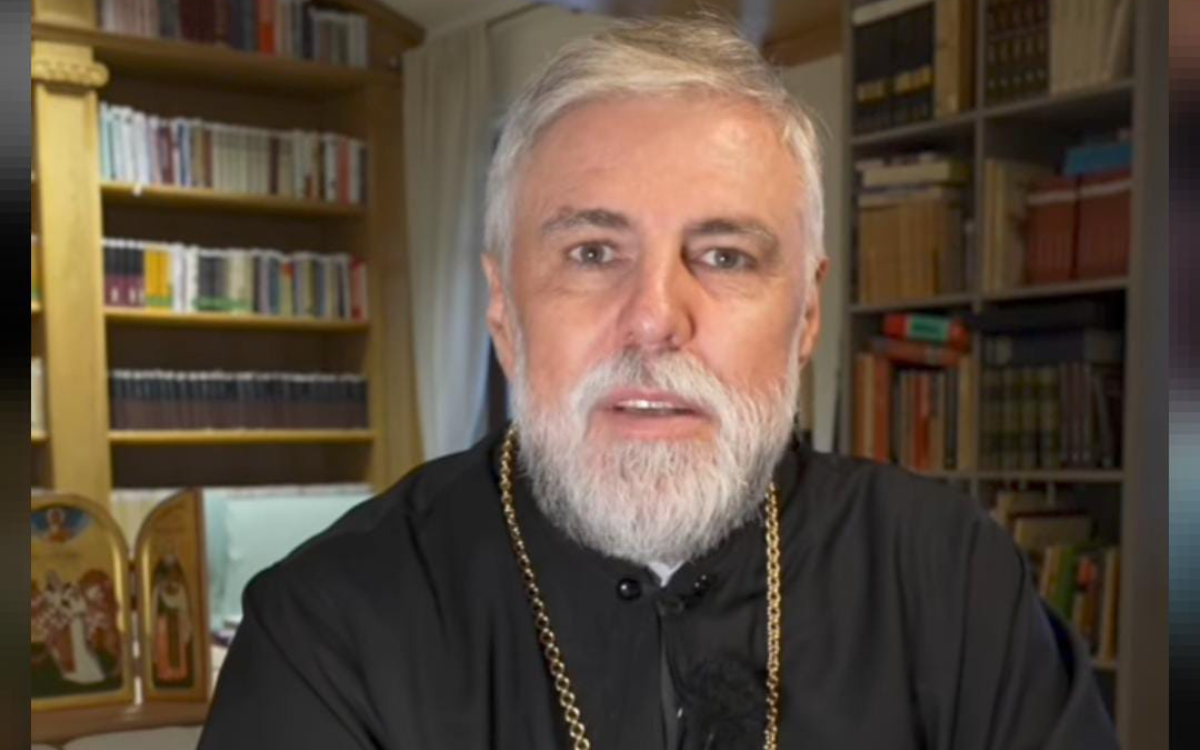
We need one another, and we are needed by others, Bishop Grigorije Durić emphasizes for N1. It is necessary, he notes, to understand that all people are potentially good and by no means to look up to those who have committed evil. This is the precondition for his deep conviction that “lambs always, in the end, defeat wolves.”
Bishop Grigorije Durić has published the book “We Need One Another,” in which he brought together 30 sermons (symbolically, for 30 years of service in the Church), reminding us what it means to be a “neighbor.”
“I always gladly recall some old, ancient wisdom of the Egyptian monks who said, ‘You have seen your neighbor, you have seen your God.’ Therefore, if we see the good face of our neighbor, then we will see God in that face as well. The path to God is through the neighbor,” said the bishop.
The final sermon, titled “The Mirror in Which We Look at Ourselves,” was delivered while students were staying in Munich, on their way to Brussels.
“As a young monk, I taught religious education in a school. Then I realized that children are always a mirror of their parents. Here, a real miracle is happening, that these children are a wonderful mirror in which everything is revealed, both what is good in us as parents (spiritual or biological) and what is not. If we want to do something, we must direct all our intellectual, physical, and psychological strength toward helping these children, being with them, and looking at ourselves in them, seeing our virtues and our weaknesses,” he said.
Was he reproached for hosting the students?
Asked whether he was reproached for hosting the students, he says that no one called him directly, but that he heard there were objections.
“Some even reproached us for receiving them into the house at all, which is truly frightening to me. A person would receive even a stranger, if he is a traveler, hungry, thirsty, and tired, let alone one’s own children. Children who are fighting for freedom, for justice, for truth, who have made an enormous sacrifice,” the N1 interlocutor said.
He is convinced that the students are fighting for a good, healthy, normal Serbia and for their future in it.
In the book “We Need One Another,” on the other hand, there is much discussion of the past and the mistakes that were made. The bishop speaks about “remembering without bearing grudges.”
“Bearing grudges is, according to Saint Anastasius of Sinai, the gravest sin. Worse or heavier than murder itself, adultery, or theft, because bearing grudges is actually letting hatred into the heart. That does not mean that a person should not remember, but one should not bear grudges. At terrible places of remembrance (the sufferings of the Serbian people), I warn that there must never be bearing of grudges, because, as the wise Hannah Arendt said, the only thing she would not forgive the fascists for is making her become like them. My thesis is clear—lambs always, in the end, defeat wolves, but that end must be lived to see, and one must have hope that good will triumph over evil,” he said.
The precondition for this, he emphasizes, is to understand that all people are potentially good, and that we must by no means look up to those who have committed evil.
“All people are brothers; we are all capable of making mistakes, but also of correcting ourselves. One of the most wondrous moments was when a young Franciscan priest approached me whose father and brother were killed by the Army of BiH in the area of Bradina. I was then in Bradina speaking about the suffering of the Serbs and said that it is better when a person is a descendant of those who were killed than of those who killed. As terrible as that is. He approached me and told me that his faith in the Gospel had returned,” he said.
The world has a different view of things, but the bishop emphasizes that “the final judgment will be given by God.”
“God will judge the world, and that judgment will be terrible, not because God is terrible, but because we will then experience various surprises. The only possibility of not experiencing a dreadful surprise is to follow what God tells us, which is to walk the path of love and forgiveness,” said Bishop Grigorije.
READ MORE:
On depression
In the book, the bishop also addresses the question of what life looks like outside one’s own country, as well as the topic of depression.
“The world is depressed; depression is an all-encompassing, pandemic illness that prevails. In my deep conviction, the solution is the hand of another. When a person falls into that black hole, they cannot get out alone. Then they need the hand of another—strong, courageous, and sincere. I wrote that sermon at a terrible moment when my long-time friend committed suicide. I spoke at the funeral in front of his family and people who knew him. And I admitted that countless times he wanted to tell me something, and I somehow turned my head away from it. ‘How are you?’ we ask too formally and do not listen at all to the other person who wants to reveal their pain. And physical pains are much easier than mental ones. With words we can change ourselves, and the world around us, and help one another,” he said.
The bishop says there is enormous abuse of words that sow hatred, wound, and do not allow people to emerge from depression.
Terrible words, he says, he reads in calls for violence against students, “hit them, break them.”
“In a sermon before the students, I told them that whoever strikes at them, we should feel as if they are striking at us. Even more, we should remember Christ’s words that whoever strikes at the small and unprotected has risen up against Christ,” he said.
He believes that the protective feeling toward young people is growing among many in Serbia.
“I read those sick things—hit them, break them—but that is all a reflection of powerlessness. A person sometimes becomes frightened and then thinks that this is power, but it is not. In the Church we say that ‘the power of God is manifested in weakness.’ And that is precisely what our children are doing—and then those who appear powerful become confused, and turmoil arises in their ranks,” he added.
There will be elections, to walk the path of justice and truth
Asked about attacks on his friends, such as Dejan Bodiroga, the bishop says that such attacks are ridiculous.
“That is his independent, autonomous decision. It is a decision not only of his or mine, but of countless good people who are not afraid of blackmail, threats, and pressure,” he said.
He hopes this will be a year of normalization in our country.
“There will be, I hope, elections; at the elections people will decide (I hope) freely. One only needs to endure and to bear everything with dignity, not to speak ugly words, not to think ill of anyone, not to insult or humiliate anyone, but simply to go one’s own path of justice and truth,” he concluded.
MORE TOPICS:
FOR THE SECOND TIME AFTER 70 YEARS: Orthodox Christians near Zadar swam for the Holy Cross! (VIDEO)
TRAGEDY IN BELGRADE: Brother of famous footballer Nemanja Vidić found dead!
Source: N1; Foto: Printscreen Instagram @vladika.grigorije