




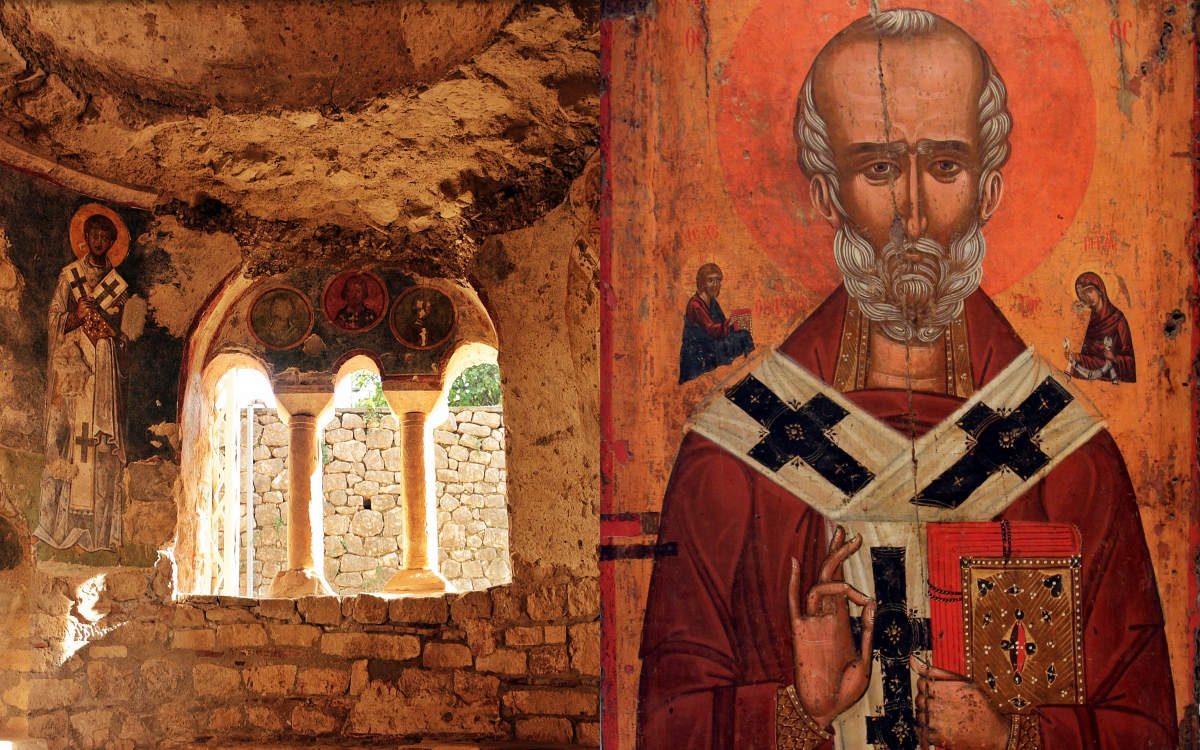
Srpska pravoslavna crkva i njeni vernici danas, 19. decembra, slave Svetog Nikolu – zaštitnika putnika, The Serbian Orthodox Church and its faithful celebrate Saint Nicholas today, December 19th – the patron saint of travelers, seafarers, and children!
According to a saying, half of Serbia celebrates Saint Nicholas, while the other half goes visiting. Besides being one of the greatest Serbian slavas, Saint Nicholas is also the patron saint of many churches and monasteries of the Serbian Orthodox Church. Over 600 churches of the SPC are dedicated to this great saint.
Saint Nicholas is celebrated on a fixed date – December 6th according to the new calendar, or December 19th according to the old calendar, on the day the saint passed away in 343 AD. As Saint Nicholas’ slava falls during the Great Lenten fast, believers prepare exclusively fish and other lean food.
Relics in Bari, Patron Saint of Amsterdam
It is also celebrated on May 22nd, in memory of the day when his relics were transferred in 1096 from Myra in Lycia to the then Orthodox Bari, in Italy, and placed in the church of Saint John the Baptist, which soon became a pilgrimage site. Three years later, the citizens of Bari built a magnificent church for the saint.
Saint Nicholas, Archbishop of Myra, is also celebrated throughout the Christian world. It is celebrated as a children’s holiday in Western European countries, as this is when children receive gifts if they have been good. He is the patron saint of the city of Amsterdam.
Saint Nicholas is recorded in the history of Christianity as one of the most ardent advocates of the Christian Church and a great opponent of heretical teachings in the early centuries of Christian preaching.
Highly revered in Serbian Orthodoxy, Saint Nicholas was the patron saint of Serbian kings, and the oldest churches were dedicated to him. Prince Miloš Obrenović also celebrated Saint Nicholas according to all folk customs as his slava.
In the Studenica Monastery, the church of Saint Nicholas (13th century) was built by Stefan Nemanja, and King Uroš I Nemanjić and Queen Jelena Anžujska built a church of Saint Nicholas next to their endowment in the Gradac Monastery, which is still almost intact today.
Saint Nicholas was considered a saint during his lifetime and was invoked for help. According to belief, he can heal any ailment. Many miracles have occurred due to his myrrh-streaming relics. The sick who prayed to him, according to beliefs, managed to regain their sight, walk, and the deaf regained their hearing. On this day, wheat should be planted to grow by Christmas.

Preached in a Roman Prison
Born in the Asia Minor city of Patara, a port on the Mediterranean coast of present-day Turkey, Saint Nicholas lived in the 4th century, long before the schism between the Orthodox and Catholic Churches in 1054. His parents, the wealthy Greeks Theophanes and Nona, had him during the reign of the Roman emperor Valerian (253-260 AD), a greedy man who, out of a passion for gold, organized a military campaign against the Persian Empire.
At baptism, he was given the name Nicholas, which means conqueror of the people. He was taught the spiritual life by his uncle Nicholas, the bishop of Patara, with whom he later became a monk in the New Zion monastery. After the death of his parents, Nicholas sold his entire estate and distributed the money to the poor. For some time he was a priest in his hometown, distinguished by his mercy, and many believed that he would succeed his uncle as bishop. However, being humble, he withdrew into solitude, ready to wait for death in that way.
Christians believe that the voice of the Lord then appeared to him and told him: “Nicholas, go to the people for a feat if you want to be crowned by me.” Then he left his solitary life and went to the people. He was chosen as archbishop of the city of Myra in Lycia (the then Roman Empire, the area of present-day Turkey).
During the reign of emperors Diocletian and Maximian, at the time of the persecution and martyrdom of Christians, he was imprisoned, but even there he did not stop preaching and spreading Christianity. He attended the First Ecumenical Council in Nicaea, but because he struck the Alexandrian priest Arius, accused of heresy, he was removed from the council and forbidden from further attendance.
Christian tradition mentions that they allowed him to attend the council again only when the voice of the Lord Jesus Christ and the Most Holy Theotokos appeared to them in a dream through the chosen hierarchs, saying that great injustice had been done to Saint Nicholas, who had defended the true faith.

People considered him a saint even during his lifetime. They invoked him for help in illness, misfortune, or weakness. Christians believe that he answered everyone and helped everyone, and that light shone from his face. In old age, he fell ill and died on December 6, 343. Saint Nicholas is also commemorated on that day, which is December 19th according to the new calendar.
He was buried in the cathedral church of the metropolitan see of Myra, and at the end of the 11th century his relics were transferred to Bari, to the monastery of Saint John the Baptist. In addition to commemorating the day of Saint Nicholas’ death on December 19th or 6th, the date also commemorated in honor of Saint Nicholas is May 22nd or 9th, in memory of the transfer of his relics to Bari.
On Orthodox icons, he is depicted as a tall man in a recognizable red cloak, with a bishop’s miter on his head and a staff in his hand, giving gifts to children from a sack.

IMPACT ON POPULAR CULTURE
The feast of Saint Nicholas today has great significance worldwide, as his image is associated with the origin of the image of Santa Claus, and he is called Santa Claus and Santa Nicholas. In the Alpine countries and regions, the day of Saint Nicholas is associated with Krampus, a custom whose origin dates back to German-Slavic tradition.
Saint Nicholas first appeared in the image of Santa Claus on December 23, 1823 after the publication of the anonymous poem “A Visit from St. Nicholas” (now better known as “The Night Before Christmas”) in the town of Troy in the state of New York. The poem was later attributed to Clement Clarke Moore. Many of Santa Claus’s modern attributes were established in this poem, such as riding in a sleigh that lands on rooftops, entering through the chimney, and a full bag of toys.
As the years passed, Santa Claus evolved in popular culture into a large, plump figure. One of the first artists to define the modern look of Santa Claus was Thomas Nast, an American cartoonist of the 19th century. In 1863, a picture of Santa Claus painted by Nast appeared in Harper’s Weekly.
MORE TOPICS:
JAĆIMOVIĆ UNWAVERING: I will drive students to the protests even if they seize my buses again!
DUE TO FORCED LABOR IN THE ZRENJANIN FACTORY: America ordered the retention of goods from Linglong!
Source: Media, Photo: Wikimedia Creative Commons