



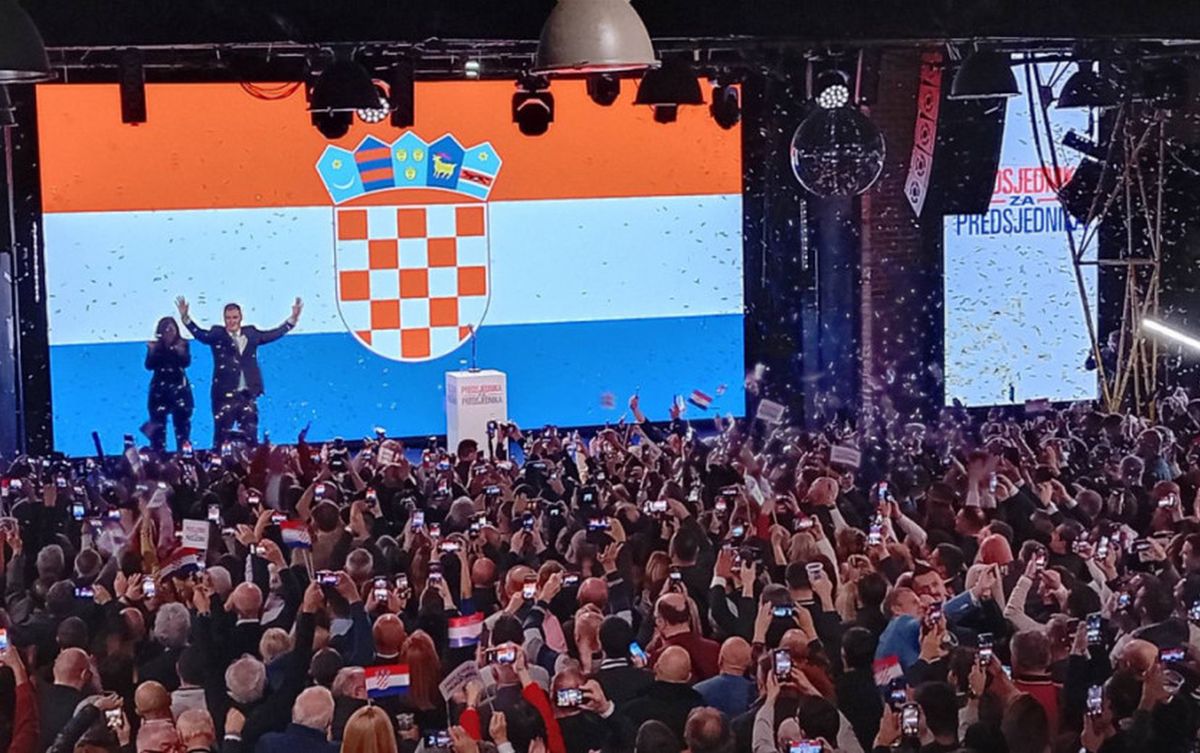
Based on 99.48% of counted polling stations, Zoran Milanović has been re-elected as the President of Croatia with a historic result of 74.66% of the vote.
His opponent in the second round of the presidential elections, Dragan Primorac (HDZ), received 25.34% of the votes cast, according to the State Election Commission (DIP).
Voter turnout was 44.15%.
Milanović thanked voters for their support in the second round of the presidential elections.
“Thank you,” wrote Milanović on Facebook.
He will remain in the office of president for the next five years.
“We visited several polling stations today and confirmed that there were no significant crowds, and citizens exercised their right to vote relatively quickly, within a few minutes. There were minor electoral irregularities, as mentioned by the State Election Commission and the NGO Gong, which monitors the election process and election day,” reported a Euronews Serbia correspondent from Zagreb.
In the first round of the elections, eight candidates participated. Milanović entered the second round with 49.1% of the vote, while Primorac secured 19.35%.
The second round of the Croatian presidential elections concluded the “super-election” year, during which three election cycles were held in Croatia.
In addition to the presidential elections, parliamentary elections were held in April, followed by European Parliament elections in May. This year, Croatia is also set to hold local elections.
The presidential elections were the eighth since Croatia gained independence.
Powers of the President of Croatia
The powers of the President of Croatia include calling elections for the Croatian Parliament and convening its first session, calling referendums in accordance with the Constitution, and appointing a Prime Minister-designate based on parliamentary majority support after consultations.
The President grants pardons and awards honors and decorations as prescribed by law, on the proposal of the government and with the countersignature of the Prime Minister.
The President decides on the establishment of diplomatic missions and consular offices abroad, receives credentials and letters of recall from foreign diplomatic heads.
The Croatian President is also the Commander-in-Chief of the Croatian Armed Forces, appointing and dismissing military commanders in accordance with the law, based on decisions made by the Croatian Parliament. The President declares war and concludes peace in line with the Constitution and the law and cooperates with the government in guiding the work of security services. During wartime, the President can issue regulations with the force of law within the scope of powers granted by the Croatian Parliament.
PROČITAJTE VIŠE:
From Tuđman, through Mesić, to Milanović
Franjo Tuđman was the first president of independent Croatia, serving two terms from 1992 to 1999.
He was succeeded by Stjepan Mesić, who served as President of the Republic from 2000 to 2010.
Ivo Josipović was President of Croatia from 2010 to 2015. He was succeeded by Kolinda Grabar-Kitarović, who served as president from 2015 to 2020.
Zoran Milanović assumed office after defeating Grabar-Kitarović in the second round of the presidential elections in 2020.
READ MORE:
“NOVAK WASN’T ALLOWED TO SEE AN ORTHODOX PRIEST”: Details emerge about Novak’s ordeal in Australia!
Source: Euronews, Photo: Euronews/Dušan Ilić