




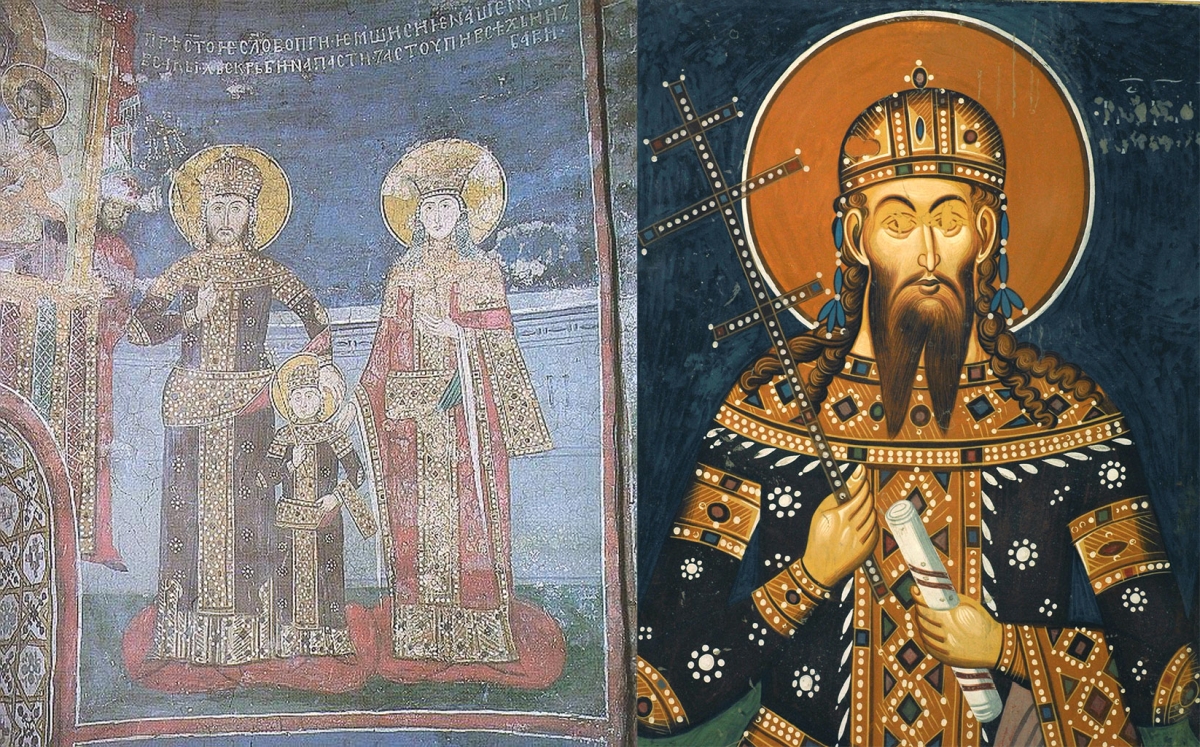
Stefan Uroš V Nemanjić, better known as Uroš the Weak, was the son and heir of Emperor Dušan the Mighty. He ruled from 1355 to 1371 and remains remembered in Serbian history as the last ruler of the Nemanjić dynasty. During his time, central authority weakened and regional lords became independent. After the death of Emperor Uroš, the Serbian state ceased to exist.
The reign of Uroš, the son of Emperor Dušan, was in almost every respect the opposite of his father’s rule. Fate and history sometimes play merciless games.
Inheriting a great father and from him a great state, Emperor Uroš the Weak was not equal to his time and also lacked decisiveness, which prevented him from realizing his father’s plans. It can be stated that almost the entire reign of Emperor Uroš was marked by internal divisions, conflicts among the nobility, and the total disintegration of the Empire, which he as emperor could not prevent.
The death of Caesar Preljub, governor of Thessaly, in the spring of 1356, was used by Despot Nikephoros II Orsini, son-in-law of Emperor John VI Kantakouzenos, to conquer Thessaly and the southern part of Epirus. On that occasion, Nikephoros II expelled the Serbian despot Simeon and Caesarina Jerina (the widow of the military commander and Caesar Preljub) with their children. The Palaiologos brothers, John and Alexios, conquered the border town of Christopolis with its surroundings shortly before Dušan’s death. Matthew Kantakouzenos, son of Emperor John VI Kantakouzenos, attempted to conquer Serres, but was prevented because Uroš’s assistance arrived in time. Simeon, with a small army, took Kastoria and proclaimed himself emperor. He did not want to be Uroš’s co-ruler; Uroš was even forced to defend himself against his uncle. John Komnenos Asen, brother of Empress Jelena, to whom Dušan had entrusted the governorship of the area around Kanina and Valona, became independent, recognizing Simeon as his suzerain. A clash occurred between Simeon and Uroš near Skadar. Simeon was repelled, thereby losing the possibility of realizing his aspirations to the entire Serbian state. Taking advantage of the death of Despot Nikephoros II near Achelous in 1358, Simeon seized his territories, Thessaly and Epirus, founded his own state, and took the name Palaiologos through his mother.

In November 1354, John VI Kantakouzenos was forced to hand over power to Emperor John V Palaiologos, and his son Matthew, in conflict with the Serbs, was also captured and handed over to Emperor John V in 1357.
In northern Serbia, Louis I continued his campaigns. He was supported by Pope Innocent VI, who urged him to reach an agreement with Venice and jointly attack Serbia. However, when Louis I, with an army assembled in Zagreb, marched against Venice instead of Serbia, the pope was deeply disappointed. Louis I seized Adriatic territories from Venice and, by the Peace of Zadar in February 1358, obtained Dalmatia with Dubrovnik. Thus Serbia lost its coastal regions. Louis I then attacked Serbia as well and advanced as far as Rudnik. After his withdrawal, the Braničevo regions nevertheless remained in Hungarian possession and were again governed by the Rostislavići as Hungarian vassals.
Thus, already by 1359, the Serbian Empire had significantly diminished. In the north, Braničevo and Kučevo were lost; in the south, Epirus and Thessaly and the Serres region of Empress Jelena.
The wife of Emperor Uroš, Anna, daughter of the Wallachian prince Alexander, whom Uroš married in 1360, was the reason for indirect contacts between the papacy and Serbia. Pope Urban V (1362–1370) addressed Anna’s mother with a request that she influence her daughter, the wife of Emperor Uroš, to convert Emperor Uroš and his Serbia to Catholicism. This pope took the Turkish threat seriously and on Good Friday in 1363 proclaimed a call for a crusade. However, the soon death of the French king John the Good (1350–1364), on whom the pope particularly counted, led to the abandonment of that idea. Pope Gregory XI (1370–1378) was preoccupied with the final end of the so-called “Avignon captivity” of the popes and the return to Rome in 1377, so the Balkans were of lesser importance to him. Nevertheless, he made contact with Dubrovnik and Bosnia during the time of Tvrtko I, while in Serbia he did not directly address anyone.
The Hum prince Vojislav Vojinović was among the first regional lords to become independent. He ruled a wide area from Rudnik to the sea. He drew Emperor Uroš into an unnecessary war with Dubrovnik. According to the confirmation of Dubrovnik’s privileges by Emperor Uroš, it is evident that Zeta under the Balšić family also separated. Đurađ Balšić in 1360 governed a narrow strip between Lake Skadar and the sea. Prince Vojislav, in order to round out his territories, ceded to the noble Musa in 1363 the Župa and town of Brvenik in exchange for the Župa and town of Zvečan (the name Musić has no connection with an Islamic name; it is a vocalization of an older vocalic l: Mlsić as Vlk, hence Musić and Buk). After the death of Prince Vojislav in 1363, his ambitions were continued by his nephew Nikola Altomanović.
Despot Oliver, one of the most powerful nobles in Dušan’s time and the founder of the Lesnovo Monastery (not very prominent in Uroš’s time), had sons Krajko and Rusin. They managed to reclaim Lesnovo but could not rise beyond that.
Despot Dejan, as Dušan’s relative, was given governance over the large župas of Žegligovo and Preševo. There he built his endowment, the Arhiljevica Monastery. In those areas, his sons Jovan and Konstantin established a strong feudal state after the Battle of Maritsa, but as Turkish vassals.
In Uroš’s time, more significant than Dejan and the Dejanović family was Vlatko Poskočić with the župas of Vranje and Ingošte. In his endowment in Psača, the fresco contains portraits of Emperor Uroš and King Vukašin, although he acted more as Vukašin’s vassal.
After the death of Prince Vojislav Vojinović, his territory was divided between the widow Goislava and his nephew Nikola, the son of Vojislav’s brother Altoman.
Such was the overall situation in Uroš’s Serbia when he tried to find himself a co-ruler among the nobles. Despot Oliver and Despot Dejan had already died. The Grand Duke Nikola Stanjević had handed over his endowment Konče to Hilandar and withdrawn. Nikola Altomanović was župan over lands from Rudnik to the sea. The Raška noble Lazar Hrebeljanović and the Kosovo noble Vuk Branković were still in the phase of consolidating their territories. Đurađ Balšić held small possessions in Zeta. The Rostislavići did not recognize Hungarian authority and were also outside the composition of Uroš’s state. The brothers Vukašin and Uglješa, sons of Mrnjan, held territories around Prilep and Serres (in later tradition characterized as greedy and usurpers of power, while Vukašin’s son Marko grew into the greatest Serbian mythical hero). Vukašin and Uglješa conducted a very complex marriage diplomacy, which reflected their political strength. Vukašin’s son Marko married the daughter of Radoslav Hlapen, and Olivera’s daughter became the wife of Đurađ Balšić. Nothing is known about the other son, Andrijaš. Uglješa married Jelena (Jefimija), the daughter of Caesar Vojihna. Through these ties they grew into powerful and influential magnates, although they did not succeed in uniting all the territories intertwined by these marriages.

Taking all these circumstances into account, Emperor Uroš took Vukašin as his co-ruler and elevated him in mid-1365 with the title of king, and recognized his brother Uglješa with the title of despot. Uglješa received this title from Uroš’s mother, Empress Jelena, from whom he took over the Serres region.
The Raška nobility was not satisfied with this choice, because since Emperor Uroš had no male children, it logically followed that the Serbian throne could only pass to the co-ruler’s son Marko, which would end the tradition of the holy-born Nemanjić dynasty.
Župan Nikola Altomanović was the real heir to the possessions of his uncle, Prince Vojislav. Princess Goislava was more content with only the coastal part of that inheritance. Even Emperor Uroš on two occasions granted her the ruler’s tribute from Dubrovnik. She peacefully ceded Upper Zeta to the Balšić family. She was finally pushed aside by Župan Nikola in 1368. He demanded Ston and Pelješac from Dubrovnik. Faced with this danger, the people of Dubrovnik managed to win over the noble Sanko Miltenović, and Župan Nikola’s attempt did not succeed. He nevertheless seriously imposed himself on his rivals at the beginning of the next decade. Dissatisfied with his rise, King Vukašin with his son Marko and the Balšić brothers attacked him at Kocovo in 1369, during which Sanko Miltenović temporarily took Konavle from him.
Lazar Hrebeljanović withdrew from imperial court service already with the appointment of Vukašin as co-ruler king, remaining around Prilepac near Novo Brdo. After Nikola’s defeat in Kosovo in 1369, Lazar’s rise began.
The extensive kinship ties carefully planned by King Vukašin in mid-1371 did not practically fulfill their goal. All Serbian nobles, occupied with concerns about preserving or expanding their possessions, left the Mrnjavčević brothers to face the Turks alone. King Vukašin and Despot Uglješa bravely marched toward Adrianople, but were tactically surprised near Chernomen on the Maritsa River on 26 September 1371. Their army was defeated and both were killed on the same day. With this battle, the Turks gained decisive prestige in the eastern part of the Balkans. Emperor Uroš himself did not participate in that battle.
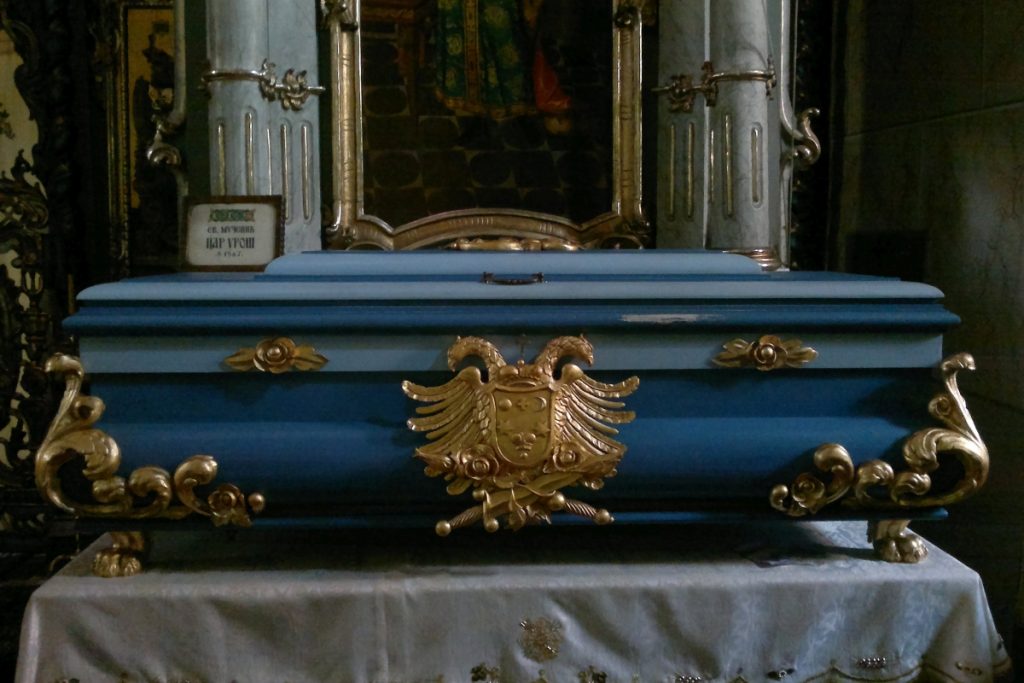
After the death of King Vukašin, the emperor granted his son Marko the co-rulership and royal title. Emperor Uroš himself did not long outlive the Mrnjavčević brothers. According to records, he received the Ston tribute from Dubrovnik on 3 November 1371, and died a month later, on 2 or 4 December 1371. Until 1705 he was buried in the Monastery of the Mother of God near Prizren, after which his relics were transferred to the Fruška Gora monastery of Jazak.
The possessions of Despot Uglješa were seized in November 1371 by the Despot of Thessaloniki, the future Byzantine Emperor Manuel II (1391–1425). However, in Byzantium too, the full tragedy of the defeat at the Battle of Maritsa was felt. Turkish vassalage had to be accepted by all the magnates of Macedonia, among them King and Serbian co-ruler Marko.
From the great state of Emperor Dušan, with the death of his son Emperor Uroš, only the central and western regions of Serbia and Zeta remained. This also marks the end of the holy-born Nemanjić dynasty and the inglorious end of the unification of Serbian medieval lands into a single state entity.
MORE TOPICS:
JAĆIMOVIĆ UNWAVERING: I will drive students to the protests even if they seize my buses again!
DUE TO FORCED LABOR IN THE ZRENJANIN FACTORY: America ordered the retention of goods from Linglong!
Source: Dinastija NemanjićFoto: Wikimedia Creative Commons