




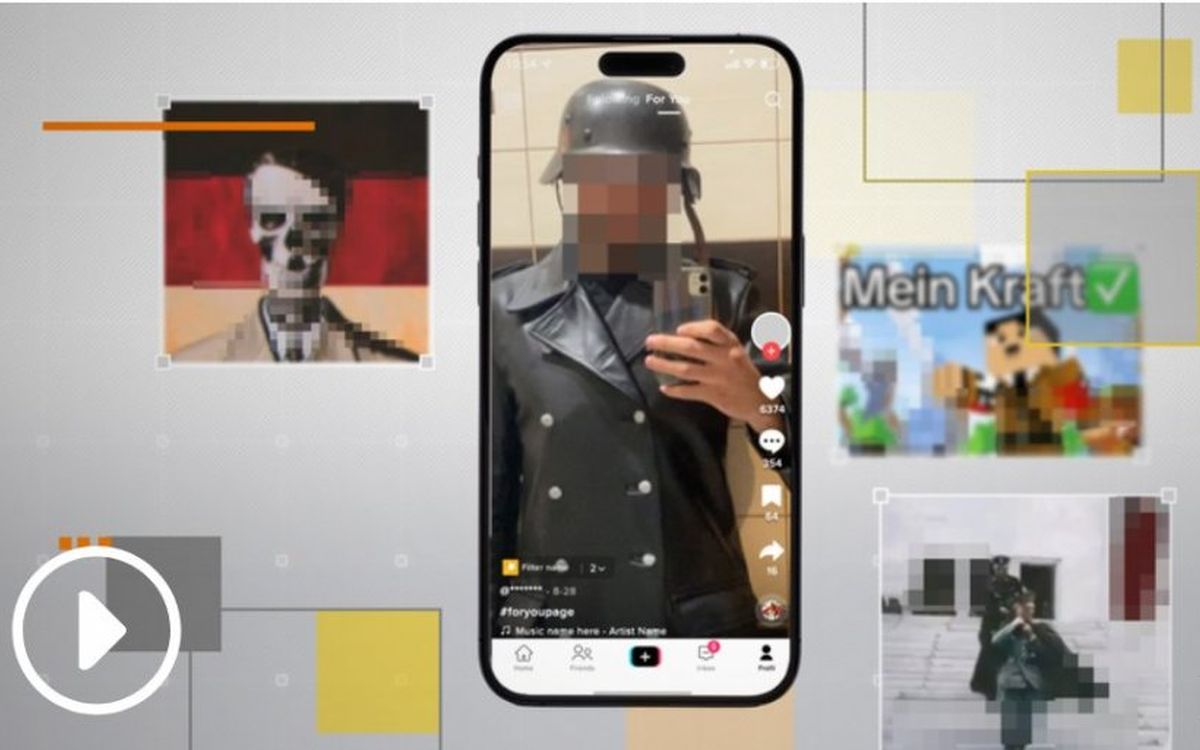
A dark challenge is gaining popularity on the social media platform TikTok, where students are mass photographing swastikas wherever they find them and posting them online. This socially dangerous game has become particularly evident during the so-called school day at the Book Fair.
“On Thursday, it was a day for schoolchildren, and we noticed that students no older than ten were flocking to the book ‘Culture in Nazi Germany’ by Michael H. Kater, which features a photograph of a Nazi uniform with a swastika on the sleeve. It is a significant work that explains how the Third Reich controlled culture and used it for propaganda purposes. We found it strange that this would interest elementary school students,” said Vladimir Petrović, a writer and editor at “Akademska knjiga.”
Students would approach the book in groups, take pictures of the cover, and run away. When one of them tried to remove the cover, staff stopped him and asked why he was doing it. He confessed to them about the TikTok challenge: take a picture of the “swastika” and post it online!
“Of course, we don’t believe these kids are neo-Nazis, but we are convinced they need more knowledge about World War II and all the horrors that Nazism and fascism produced. That is why we are publishing literature that nurtures a culture of remembrance. But that is not enough. The cultural and educational public needs to talk about this and point out the dire consequences of attempts to introduce Nazi symbolism into the public space through social media, making it seem normal over time, just as that ideology would become ‘normal.’ And then, presumably, a revision of history would follow,” explains Petrović.
He adds that videos of Hitler and, for example, cats standing with raised paws in a “Heil Hitler” salute, with German marching music playing in the background, are also popular on other platforms. He recalls that Auschwitz has already complained about the mockery of victims and the culture of remembrance, again through social media.
The latest challenge related to Nazi symbolism is not the first of its kind, as confirmed by the mother of a thirteen-year-old boy from Belgrade, who states that in her child’s school, one student started a “trend” of greeting each other with one hand simulating Hitler’s mustache and the other with a “Heil Hitler.” Because of this, a meeting was called with the class teacher, where it turned out that some of the children participating in this foolish game were descendants of victims from the camps or from the karst pits of the NDH!
Aleksandar Markov, a history professor and president of the Belgrade Gymnasiums Forum, believes that both elementary and high schools teach enough about World War II and its crimes—if someone wants to learn.
“This is about the disinterest of the ‘Z’ generation in events that are not temporally close to them, just as the events of the 19th century were not close to us. They cannot connect with people who suffered for our better future. Of course, this does not excuse them, nor their tendency to participate in various questionable challenges on social media without critical reflection,” Markov states.
He believes many are not even aware of what they are getting into but follow peer groups. This especially applies to younger, immature students. On the other hand, it is more difficult to suggest alternative behavior models to those who have already formed their attitudes after the age of 14.
“Not all of them will be neo-Nazis, although every society has a percentage of neofascists who can create more or less serious problems. Therefore, families, schools, and society as a whole need to work together. If the school notices such tendencies, it must react immediately, just like parents. Awareness and knowledge are power, but if necessary, stricter legal sanctions are also required. If we forget the horrors of war, we who were among the greatest victims, who will remember them then?” Markov asks.
PRATITE NAS I NA FEJSBUKU:
THE CINICISM OF ALGORITHMS
Our interlocutors emphasize that public platforms need better policies and that algorithms must recognize and remove Nazi symbolism. As it stands, we find ourselves in an absurd situation where algorithms remove artistic acts recognized as pornography while Nazis and fascists promote their ideology without hindrance.
Historian Milan Koljanin from the Memorial Staro Sajmište believes that the ignorance of students should be fought with better teaching materials and testimonies from survivors.
“Children are always attracted to the phenomenon of ‘forbidden fruit,’ but that’s exactly why we need to constantly explain what the swastika and the raised hand symbolize, how horribly people were killed, how many of our own people we lost, and that this is neither fun, nor modern, nor aligned with our values and traditions. This should be discussed more in class, and when it comes to teaching materials, we in institutions dealing with the culture of remembrance need to be more involved,” Koljanin emphasizes.
READ MORE:
Source: Novosti
Photo: Printscreen TikTok