



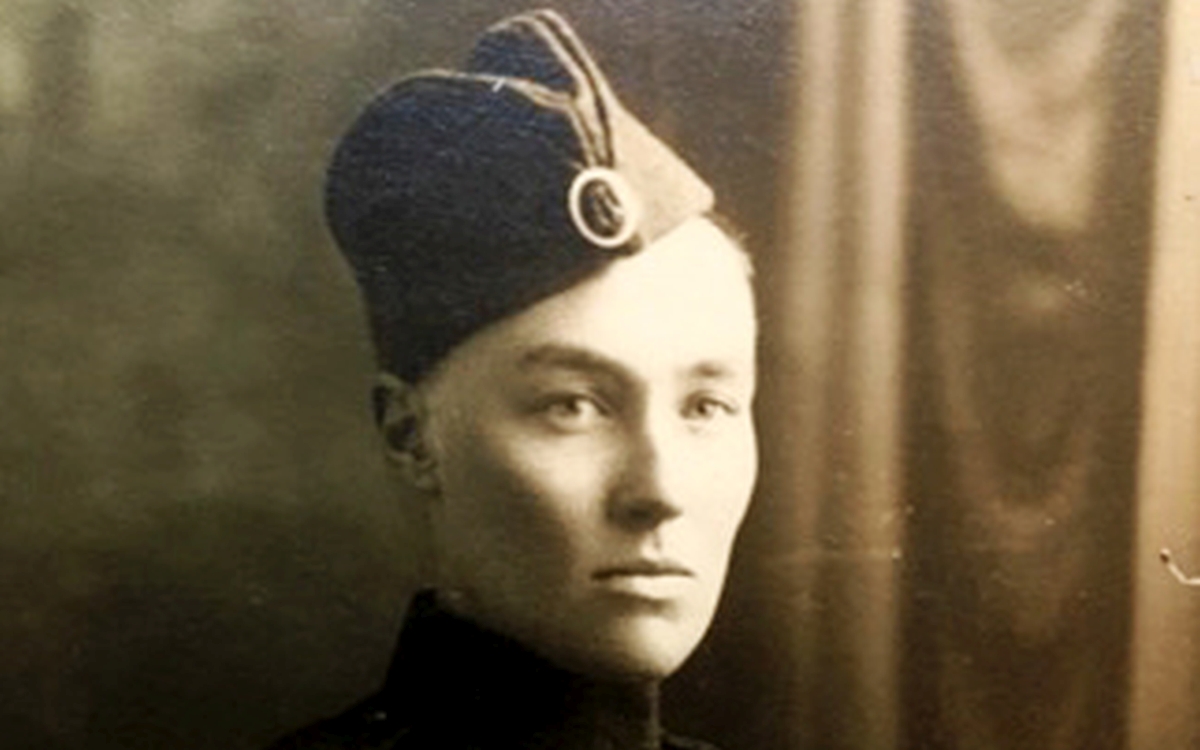
In mid-1915, British local newspapers reported that Leslie Joy (Jo) Whitehead, the daughter of a Canadian landowner, had landed in Great Britain – she wanted to volunteer in the First World War.
“It wasn’t unusual that the newspapers published an interview with the daughter of a wealthy cotton producer from Canada, but rather that in the interview she openly says she wants to go to the front,” says Nataša Stojsavljević, a doctoral student at the University of Leicester in Great Britain.
Women who fought on the front lines in the First World War were rare.
In her doctoral dissertation, Stojsavljević studies the role of women in the First World War through the experiences of the Scottish Women’s Hospitals for Foreign Service – women from Great Britain who participated in the war by treating and caring for the wounded and sick throughout Europe.
From 1915, the first Scottish Women’s Hospital in Serbia received its first patients and wounded in Kragujevac.
Dr. Louise Corbet, a doctor in this movement, first mentions Jo Whitehead in her diary, explains Stojsavljević.
“Corbet wrote in her diary about a certain V. It said it was a girl of only about twenty, a Canadian, who was disguised as a man and serving in the Serbian army,” says Stojsavljević.
That same girl, dressed as a man, ends up in the hands of the enemy during the occupation, and in captivity meets her future husband – Lieutenant of the Serbian Army Vukota Vojinović.
Who was Leslie Jo Whitehead?
Stojsavljević has been trying to answer this question for several years through her doctoral research.
So far, she has learned the following:
Leslie Joy (Jo) Whitehead was born on February 26, 1895, in Montmorency in the Quebec region of Canada.
She grew up in a family of wealthy cotton producers – as a twenty-year-old, she left her comfortable life and went to Europe.
Before coming to Serbia, she spent time in Great Britain and volunteered in military administration.
How she came to Serbia is unclear, but she soon found herself in Kruševac, where she voluntarily collaborated with the Scottish Women’s Mission – guarding medical equipment from robbers.
“Once it happened that the shops were robbed, and Jo alone managed to overpower three robbers,” Stojsavljević recounts an anecdote written in Corbet’s diary.
It is also unclear how she joined the Veterinary Corps of the Serbian Army, but Canadian newspapers, printed during the First World War years, published an article about Joy Whitehead, which states that she served as a lieutenant in the Veterinary Corps of the Serbian Army.

What role did she play in Serbia?
“She wasn’t a doctor, she wasn’t a nurse, she wasn’t even a driver in the Scottish Women’s Hospitals. Her role was very interesting,” says Stojsavljević.
Before joining the Veterinary Corps, Jo stood guard and took care of the safety of the nurses, but also something else.
“During the occupation, women were surrounded by enemy soldiers, and that also meant the threat of sexual violence,” says Stojsavljević.
In the diaries she studied, she came across entries in which the authors alluded to sexual harassment by occupying soldiers.
“Jo, dressed as a man, would overhear from soldiers which sisters they liked and would make sure that sister was never near them,” says Stojsavljević.
Stojsavljević says she found evidence of her participation in the actions of the Serbian army in a copy of a letter Jo wrote after the war.
In the letter, Jo addressed the president of the World War I Veterans Organization in Montreal.
“She wanted to know if she could become a member of the organization and therefore attached evidence of her service in Serbia – including a certificate showing that she served in the Ninth Regiment,” she says.
Stojsavljević does not know if Jo ever received a response.
That is not the only thing that has remained unclear to Stojsavljević.
FIND OUT MORE IN SERBIAN:
Men’s clothing and lifelong visits to the barber
The letter she sent to the veterans’ organization was signed – Leslie Joy Whitehead.
“She didn’t have a male name or anything like that,” says Stojsavljević.
However, Stojsavljević says that Jo, years after the war, when she had already returned to Canada, continued to go to the barber.
“The barber didn’t know that Jo was actually a woman,” says Stojsavljević.
How this is possible, Stojsavljević can only assume for now.
“I don’t think it was a secret in the Serbian army that Jo was a woman, but I think she played the role of a male soldier so well – in fact, she didn’t even have to act, it was part of her nature,” she says.
In the letter she sent to the veterans’ organization, she asked that her case not be made public, Stojsavljević emphasizes.
This is also repeated by her relatives, with whom Stojsavljević spoke in order to collect data for her academic work.
“This shows us that Jo was aware that the life she was living was not conventional.”
The importance of equality in war and after war
“Her relatives suggested that if she were alive today, we could talk about Jo as the first non-binary person in the army,” says Stojsavljević.
A non-binary person does not identify as exclusively male or exclusively female.
“Of course, when we talk about people from the past, it’s difficult to give them such attributes because they didn’t exist then,” says Stojsavljević.
However, she adds that it is important to know that people with such characteristics lived years before us as well.
“This is very important because it shows that they were among us even when we didn’t have a name for them,” she says.
The question Stojsavljević is now asking is – how many women actually fought in the First World War without anyone knowing they were women, and were they women in all cases at all?
“That’s a part of history we need to deal with,” she says.
Great Britain only allowed full participation of women on the battlefields in 2018, she emphasizes and reminds that, paradoxically, women were present on the fronts a whole century earlier.
“We know so little about everything that happened to those women,” says Stojsavljević.
She also emphasizes the importance of the discovery about sexual harassment during the war.
“Sexual harassment is something we are still fighting against, and the discovery of this woman who was a soldier and defended other women from harassment serves as an example,” she says.
Leslie Joy Whitehead was captured by Bulgarian soldiers in 1915.
Canadian newspapers at the time wrote that a “Canadian woman, known for her athletic abilities” was in the captivity of Bulgarian soldiers.
In captivity, she meets her future husband.
“I don’t even know how well she spoke Serbian, so it remains a mystery how she managed to communicate with her future husband, Lieutenant Vukota Vojinović,” says Stojsavljević.
The couple soon moved to Canada, where they had two children before divorcing a few years later.
Jo would later marry again and have two more children.
She died on June 5, 1964.
At Jo’s request, her great-grandchildren and relatives with whom Stojsavljević is in contact do not want to speak publicly about their great-grandmother’s experience in the Serbian army, but they have shared her photographs – “for the greater good they may serve.”
TEODORA SPEAKS OUT: Serbian woman from Vienna reveals how the winning Eurovision song was created!
Source: BBC; Photo: Wikimedia Creative Commons