




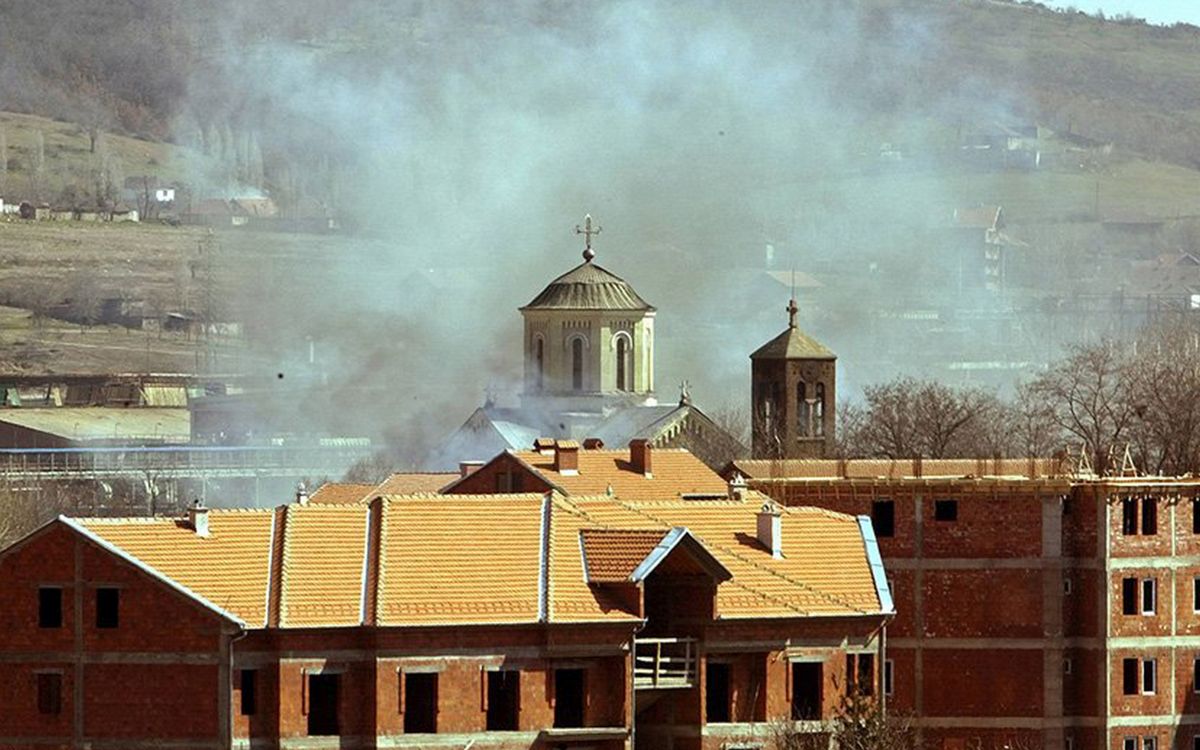
22 years ago, on March 17 and 18, 2004, a pogrom occurred against the Serbs of Kosovo and Metohija, in which 16 Serbs were killed, hundreds injured, 4,000 expelled, and more than 1,000 houses, churches, monasteries, and shrines were destroyed.
The ethnically motivated eruption of violence by Albanians against Kosovo and Metohija Serbs was caused, in addition to terrible hatred, by a media campaign that portrayed Albanian boys as allegedly forced into the Ibar River. The reporting of the Albanian media was tendentious and completely untrue.
During a kind of “Kristallnacht,” as one KFOR official put it, in March 2004, about 4,012 Serbs, their homes, property, shrines, and monuments were expelled from Kosovo and Metohija.
The consequence was permanent expulsion. A significant portion of the victims were recent returnees, mostly from 2003.
The March 2004 pogrom was actually the second major pogrom committed by local Albanians against the Serbs of Kosovo and Metohija in recent history, after the one following NATO’s aggression against Serbia, i.e., FRY in 1999. During June 1999, approximately a quarter of a million Serbs and other non-Albanians were expelled in the presence of international military forces.
During the violence in Kosovo and Metohija on March 17 and 18, 2004, at least 27 people were killed, including 16 Serbs, while 11 Albanians lost their lives in clashes with members of international security forces.
The day before the drowning of the boys in the Ibar River, on March 15, 2004, eighteen-year-old Jovica Ivić was wounded from a car in Čaglavica.
The next day, March 16, veteran associations of the so-called KLA organized demonstrations due to the detention of certain war commanders of Kosovo Albanians, suspected of war crimes. During the previous month, February, four were arrested. It is estimated that 18,000 people demonstrated.
On Tuesday, March 16, 2004, in the late night hours, Pristina media reported that three boys, Kosovo Albanians, aged 8, 11, and 12, died by drowning in the Ibar River, in the village of Čabra, near Zubin Potok. As was reported at the time, the boys were fleeing from Serbian attackers, which allegedly happened that day.
UN representative Niraj Singh, a police spokesperson, stated on that occasion that no evidence was found that Serbs were responsible for the drowning of Albanian boys. He clarified that the boy, the alleged witness, was under pressure from Albanian journalists who directed him what to say. Moreover, his version differed significantly from what others also present claimed.
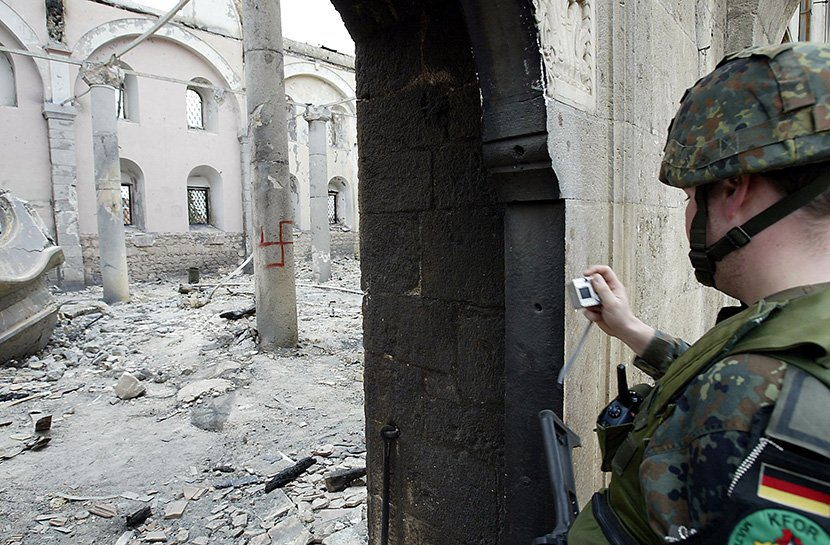
Over the next two days, an eruption of ethnically motivated violence occurred in Kosovo and Metohija. Mass gatherings, which may have been spontaneous at the beginning, were soon redirected against Serbs, their homes, shrines, and monuments.
Around noon on March 17, several thousand local Albanians, crossing the bridge over the Ibar River towards the northern part of Kosovska Mitrovica, attacked the Serbs there. Shooting began. Albanians with automatic weapons were visible in the city. Members of international security forces used tear gas and shock bombs.
In the afternoon, it was reported that seven people were killed, four Albanians and three Serbs, and more than 200 were injured in Kosovska Mitrovica. It was confirmed that Serbs were killed by sniper weapons from the southern part of the city. 11 French KFOR members were also injured.
Attacks on Serbs followed in a series of places across Kosovo and Metohija, in Lipljan, Obilić, Zubin Potok, Laplje Selo, Čaglavica. It is estimated that more than 50,000 Albanians participated in the pogroms on March 17.
Several thousand Albanians, according to some reports even 12,000, attacked Serbs in Čaglavica, a southern suburb of Pristina, sometime after 1 PM. Ten Serbs were wounded by sniper fire in that place. Serbian houses were set on fire. KFOR members from Sweden, Norway, and Finland, who held that sector, intervened against the attackers. They had 16 injured in the process.
During the afternoon, KFOR and UNMIK members evacuated Serbs from Čaglavica and other villages in that area.
In parallel, Serbs remaining in Pristina, in the “Ju Program” settlement, were attacked. Apartments were blocked, the ground floor was set on fire, Serbs were shot at, attacked with cold weapons. The so-called KLA was chanted, and open calls were made to kill Serbs. KFOR members, mostly an Irish formation, after several hours of intervention, evacuated the Serbs there. Hooligans then turned to the local Church of Christ the Savior, which they demolished and set on fire.
During the evening, attacks on churches and monasteries followed. In addition to numerous Serbian homes across Kosovo and Metohija, the Mother of God of Ljeviš in Prizren, as well as the Seminary and the Cathedral Church of St. George in that city, were set on fire. The Monastery of the Holy Archangels and the Church of the Holy Savior were destroyed. Both Serbian churches in Kosovo Polje were also set on fire.
In Lipljan, four Serbs were killed. Serbian houses were massively set on fire. Those who tried to take refuge in the local church were also attacked. In that town, KFOR members tried to evacuate Serbs.
The pogrom simultaneously lasted throughout Kosovo and Metohija. All Serbian houses in the village of Svinjare near Vučitrn were burned. In Peć, the UN office was attacked, as well as nearby houses of returnee Serbs in the Belo Polje settlement.
Posebno teška bila je situacija u Prizrenu. Lokalne srpske kuće i crkveni objekti napadnuti su, uključujući drevnu Bogosloviju Svetih Ćirila i Metodija, zadužbinu Sime Igumanova, koja je zapaljena. Jedna osoba je poginula u požaru. Brojni su pretučeni. U Prizrenu je uništeno, spaljeno, 56 srpskih kuća i pet crkava, među njima i Bogorodica Ljeviška, sa neprocenjivim kulturnim i istorijskim nasleđem. Demolirani su i zapaljeni svi objekti Srpske crkve u Prizrenu, Crkva Svetog Spasa, Crkva Svetog Georgija, hramovi posvećeni Svetom Kirijaku i Svetom Nikoli, kao i manastir Svetih Arhangela kod Prizrena. Lokalni KFOR, sastavljen od Nemaca, nije interThe situation in Prizren was particularly difficult. Local Serbian houses and church buildings were attacked, including the ancient Seminary of Saints Cyril and Methodius, the endowment of Sima Igumanov, which was set on fire. One person died in the fire. Many were beaten. In Prizren, 56 Serbian houses and five churches were destroyed, burned, including the Mother of God of Ljeviš, with invaluable cultural and historical heritage. All Serbian church buildings in Prizren were demolished and set on fire, the Church of the Holy Savior, the Church of St. George, temples dedicated to St. Cyriacus and St. Nicholas, as well as the Monastery of the Holy Archangels near Prizren. The local KFOR, composed of Germans, did not intervene.
In the evening hours, UNMIK spokesperson Derek Chappell stated that the violence in Kosovo was planned in advance. He emphasized again that the accusations that Albanian boys in the Ibar River in the village of Čabra died fleeing from Serbs, which was the excuse for the pogrom against Serbs, were unfounded.
The pogroms continued the next day, March 18. In the early afternoon, it was announced that the Commander-in-Chief of the Southern Wing of NATO, Admiral Gregory Johnson, had taken command of KFOR and approved the deployment of additional forces.
Ibrahim Rugova, then in the position of the so-called President of Kosovo, called on the international community to urgently make a decision on the independence of Kosovo.
Attacks, arson, and looting continued in Uroševac, Plemetina, Ugljari, Kosovska Mitrovica. It was reported that there were no more Serbs in Obilić, northwest of Pristina.
In the evening hours, the Church of St. Sava in Kosovska Mitrovica was set on fire. The Church of St. Nicholas in Pristina was set on fire. Albanian extremists threw bombs at police stations in Lipljan and Obilić.
The nuns of the Devič monastery were evacuated by Danish KFOR members after at least 1,000 armed Albanians surrounded the monastery, which was looted, destroyed, and set on fire.
Around 10 PM, the commander of NATO’s Southern Wing, Gregory Johnson, stated that the ongoing violence in Kosovo indicated the existence of an organized pattern.
The next day, Johnson assessed that the mass violence in Kosovo was “ethnic cleansing.”
In the evening of March 19, UNMIK representative Derek Chappell announced that 28 people had been killed and more than 600 injured in the conflict in Kosovo and Metohija over the previous two days.

On Monday, March 22, in the evening hours, Derek Chappell announced that 163 people had been arrested for arson, looting, murders, and other criminal acts during what he called “inter-ethnic” conflicts in Kosovo. It was said that, according to estimates, 51,000 people participated in 33 individual events.
According to Chappell, 28 people from both communities were killed, and 870 were injured. As he said, the attackers burned or blew up 30 Serbian churches, damaged 11 churches and monasteries, and destroyed 286 houses. 72 UN vehicles were also destroyed in the riots.
In total, during the pogrom against Serbs in Kosovo and Metohija on March 17 and 18, 2004, at least 27 people were killed, including 16 Serbs. Hundreds of Serbs were injured, as well as dozens of members of international forces who clashed with local Albanian extremists protecting the attacked, their homes, property, shrines, and monuments.
During the pogrom, as far as is known, 935 Serbian houses were destroyed and 35 religious buildings were set on fire, including 18 cultural monuments, among them the ancient church of the Mother of God of Ljeviš, from the beginning of the 14th century. The first liturgy in it was served only six years later.
The devastation and traces of fire have not been completely removed. In 2006, it was placed on the UNESCO list of protected monuments. The Mother of God of Ljeviš was the episcopal center of the Serbian church in the Middle Ages. It acquired a more lavish form during the time of King Milutin (1282-1321), although it was an archiepiscopal center of the Prizren bishop even earlier.
According to data from the Diocese of Raška-Prizren of the Serbian Orthodox Church, from April 2004, the total number of destroyed church buildings during the March 2004 pogrom is approximately one hundred. Numerous shrines, frescoes, icons, church relics were destroyed, causing an irreplaceable loss for the cultural heritage not only of Serbs but globally.
International prosecutors and judges in Kosovo and Metohija prosecuted seven cases of church destruction, and 67 people were convicted.
The pogrom of Albanian extremists against Serbs on March 17 and 18, 2004, in Kosovo and Metohija was condemned by the UN Security Council, the European Union, as well as bodies or officials of a number of countries.
MORE TOPICS:
Source: Telegraf, Photo: Profimedia