




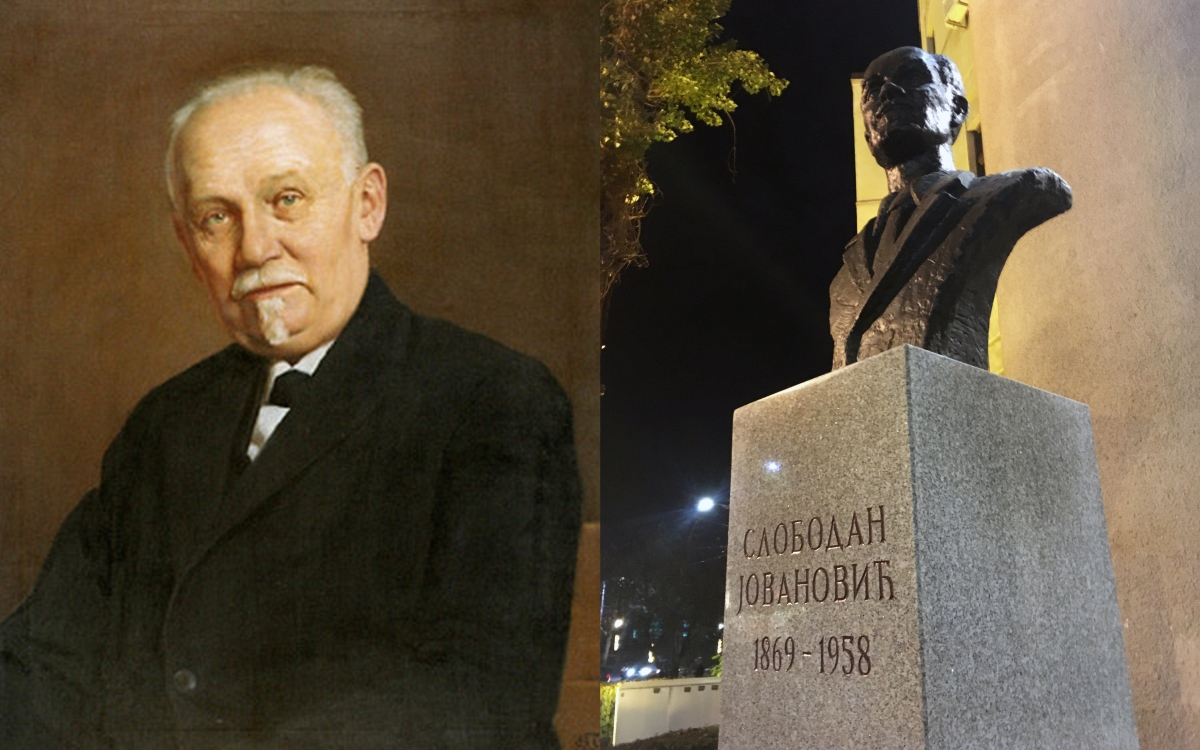
As President of the Serbian Royal Academy, Rector of the University of Belgrade, Dean of the Faculty of Law, editor of the Serbian Literary Herald, President and Vice President of the Ministerial Council of the Kingdom of Yugoslavia, founder and President of the Serbian Cultural Club, Slobodan Jovanović is certainly one of the most distinguished scholars and professors in the history of not only the University of Belgrade but also the whole of Serbia.
He wrote works in various scientific fields – theory of state and law, constitutional law, political philosophy, general history and Serbian history of the 19th and 20th centuries, sociology, study of literary work, literary and theater criticism.
His studies are written in the well-known Belgrade style. In the 1930s, he published his collected works in seventeen volumes.
Slobodan Jovanović was the son of Vladimir Jovanović, the last president of the Serbian Learned Society on the eve of the founding of the Serbian Royal Academy, professor of political economy, minister of finance, senator, and member of the National Assembly.
After his high school education acquired in Belgrade, Slobodan Jovanović continued his schooling abroad, in Munich, Zurich, Geneva, and Paris.
He was a clerk, and then the head of the Education Department and secretary of the Education Board, an advisory body of the Ministry of Foreign Affairs on national, educational, and ecclesiastical issues of the Serbian people in Old and South Serbia.
Slobodan Jovanović belonged to the circle of founders of the political and literary newspaper Red and the literary magazines Srpski pregled (Serbian Review) and Srpski književni glasnik (Serbian Literary Herald).
He was a professor at the Faculty of Law in Belgrade for more than forty years.

In the book on the state, which he published four times, he discussed the general concept of the state, the theory of the origin of the state, various philosophical theories about the state and society, the concept of state sovereignty, the relationship between state and law, the legal state, and the self-limitation of the state by the separation of powers and a bicameral parliamentary system.
Slobodan was the head of the War Press Bureau of the Supreme Command in the Balkan Wars and the First World War.
After the end of the war, he participated in the work of the Peace Conference in Paris in 1919 as the president of the Section for International Law of the Delegation of the Kingdom of Serbs, Croats and Slovenes.
He was the President of the Serbian Royal Academy from 1928 to 1931.
He was the founder and president of the Serbian Cultural Club in 1937. He considered that the Serbian Cultural Club should be a meeting and discussion place for all those interested in issues of Serbian spiritual and material culture.
After the coup d’état of March 27, 1941, he agreed to enter the multi-party government as the Second Vice President of the Ministerial Council (government).
After the April War, the government continued its work in England, where the seats of the governments of almost all occupied European states were located for longer or shorter periods from the beginning of the Second World War in 1939. Slobodan Jovanović participated in the work of four governments, twice as President and twice as Vice President.
At the political trial held in Belgrade in July 1946, Slobodan Jovanović was sentenced in absentia to twenty years of imprisonment with forced labor and the confiscation of all his property.
He died in London in 1958. His collected works were published again in Belgrade in the early nineties. He was rehabilitated in 2007. His remains were transferred to Belgrade in 2011.
MORE TOPICS:
Source: RTS; Photo: Wikimedia Creative Commons