




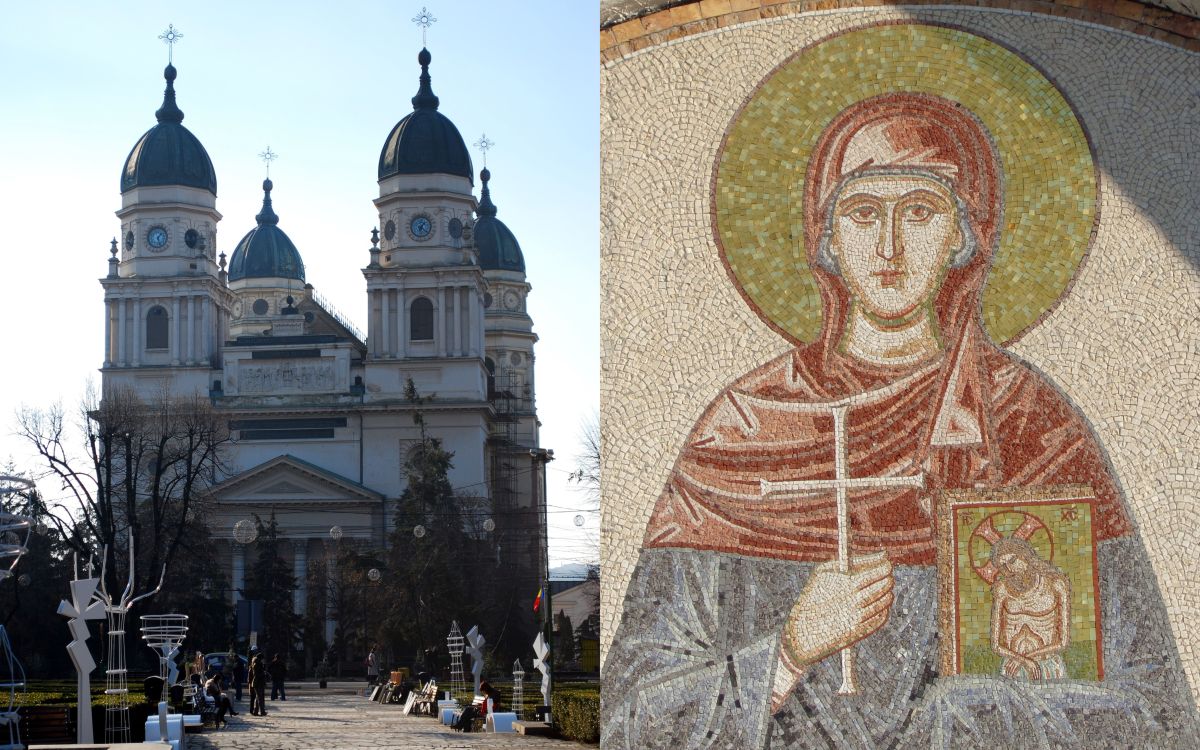
What the journey of Saint Petka’s relics looked like and who is credited with their preservation until today…
When Saint Petka passed away in the 11th century in the city where she was born, Epivatos, she was buried outside the cemetery.
According to tradition, that same night two people, a dignified and wealthy lady named Jeftimija and a poor day laborer named Georgije, had the same dream – that the body of the Holy Virgin was resting on the seashore. Each of them separately told the bishop about the dream. This is how the intact relics of Saint Petka were discovered and then enshrined in the Church of the Holy Apostles.
However, they did not stay there.
At the beginning of the 13th century, Crusaders from the West occupied and plundered Constantinople, and began transporting everything sacred to Christians to papal lands. Bulgarian Tsar Ivan II Asen offered a ransom to the Latins. In 1231, the relics of Saint Petka were brought to the capital city of Trnovo and laid in the Cathedral Church. But in 1393, the Turks conquered Trnovo. They expelled the elderly Patriarch Jeftimije, the first writer of the hagiography of Saint Petka, plundered the church, and threw the holy relics out of the reliquary adorned with gold and precious stones and stripped the gold-woven robe from them, writes Ljiljana Habjanović-Đurović for the newspaper Politika.
Soon, through the intercession of the lord of Vidin, Prince Strašimir, the relics were transferred to Vidin. But just three years later, the Turks arrived there too, executed the Christ-loving prince, and the treasures from the Vidin treasuries ended up in Serres as personal spoils of war for Sultan Bayezid. They remained there for two years.
In 1398, three prominent Serbian women—Princess Milica, Despotess Jefimija, and Milica’s daughter Olivera, who agreed to enter Bayezid’s harem for the salvation of her people and the Church—begged for the holy object from Sultan Bayezid. When he heard what the Princess was asking for, Bayezid laughed: “Why do you not ask for many and great valuables worthy of estates, but only dry bones!” he asked.
The Princess, as tradition says, humbly and nobly endured the insult and offered him all her earthly treasures and properties in exchange for the holy relics. Thus, Saint Petka arrived in Kruševac, in the court church of Lazarica. As Grigorije Camblah later wrote, “all Petka’s glory was taken from Bulgaria and bestowed upon the Serbian land.”
When the Princess’s son, Despot Stefan Lazarević, moved the capital from Kruševac to Belgrade, he took the Saint’s relics with him. He first enshrined them in the Dormition Church of the Belgrade Metropolitanate, and then in the new Church of Saint Petka, built near the miraculous spring under the Belgrade Fortress.
One hundred and twenty years later, the Turks, led by Suleiman the Magnificent, also captured Belgrade. In 1521, three holy objects were taken from the plundered city: the miraculous icon of the Most Holy Theotokos, the relics of Empress Theophano, and the relics of Saint Petka.
The relics were laid in the repository of the venerable relics at the Patriarchal Church of Saint George in Fanar. But Constantinople was no longer the new Jerusalem, but the capital of the Ottoman Empire.
In the 17th century, the Patriarchate of Constantinople fell into great debt due to the heavy duties imposed on it by the Turkish authorities. It was then that Voivode Vasile Lupu, the ruler of Moldavia, offered a huge contribution to cover the Patriarchate’s debts, and in return, to receive the relics of Saint Petka for his people. In 1641, the relics arrived in Iași (present-day Romania) and were laid in the magnificent Church of the Three Holy Hierarchs.
And then came the year 1888. One night, a great fire engulfed the church. The candlestick next to the saint’s resting place caught fire, and the fire spread from it. Everything burned – the shrouds, the baldachin, the draperies. The outer part of the reliquary, made of silver and gold, completely melted. But the inner part of the reliquary, made of wood, was only slightly scorched, and that was on the outside. And beneath the wooden lid lay the relics untouched by the fire. Even the wax seals on her robe did not melt.
After that, the relics were transferred to the Metropolitan Cathedral dedicated to the Presentation of the Lord, where they are still located today. It is the cathedral church of the Metropolitanate of Moldavia and Bukovina and the seat of the Metropolitan. It was built in the 19th century on the foundation of an old church from the 15th century. It has four towers and is visible from every part of the city.
MORE TOPICS:
REFINERY IN PANČEVO FACING CLOSURE: Millions of barrels of oil for Serbia stopped in Croatia!
Source: National Geographic; Photo: Wikimedia Creative Commons