




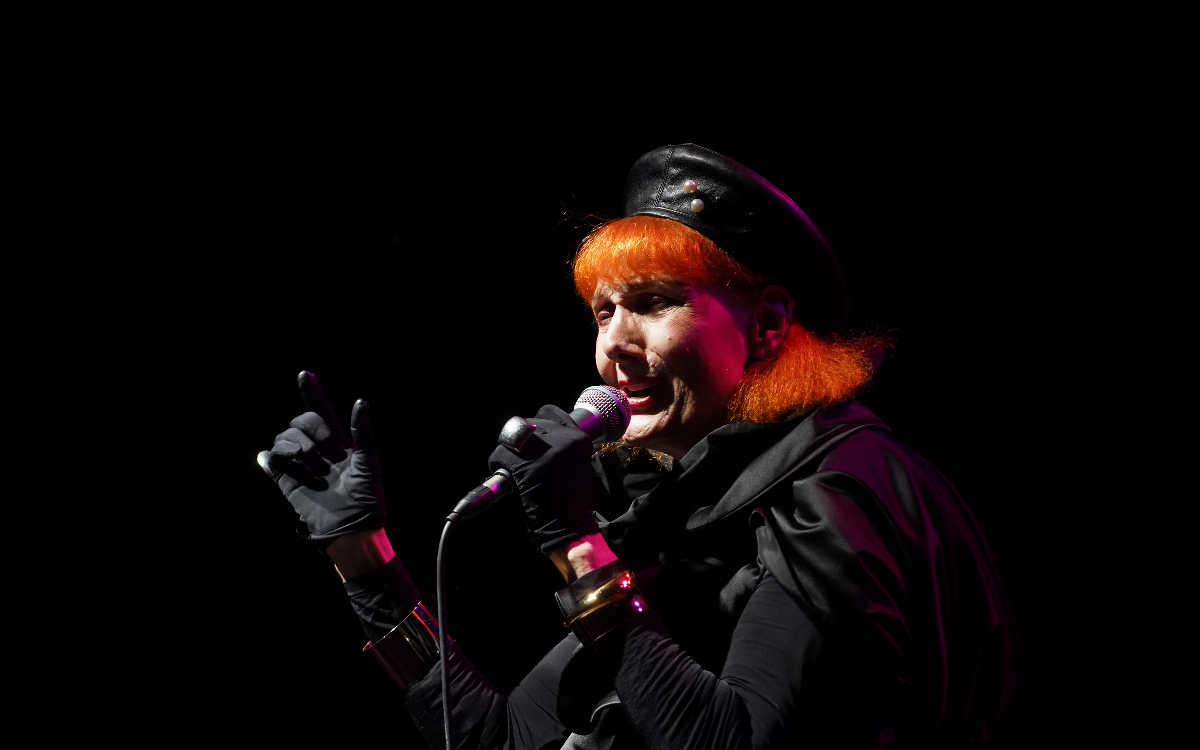
Josipa Lisac recently released a new song, “Zamisli,” which has already resonated throughout the region, and she has also scheduled a concert for November 27 at Sava Center, which she discussed in an interview for NIN.
What expectations and emotions accompany you ahead of this new encounter with the Belgrade audience?
I don’t have any special expectations, you know. Yes, we will meet again, and that is always wonderful to me. Our encounters have lasted for a long time, since the distant 1960s. There was, admittedly, that one inhumane period when we suddenly separated, and none of us knew why or how that happened. But we had to rise above that time, and when we finally met again, it felt as if we had never even parted. I wasn’t the only one who felt that way; many people I later spoke to felt the same. Through music, it is truly beautiful to live with people who understand you, who come because they want to experience something; maybe to hear you, to see you, but often to find something of their own within it. And I myself always find something new in those encounters.
Belgrade is also the city where, in 1967, at Dom omladine, you held your first concert. How do you think about it today?
I especially love Belgrade. I’ve always loved it and always will, because Belgrade knows how to recognize what is good. It’s a city with a soul, a city that truly knows how to experience music. Oh, that first concert of mine was… It was a different time, we were much younger. I was seventeen then. Around me, a hall full of young people, and the energy was incredible. Even today I have many young people around me; generations change, but people remain. Still, it’s hard to compare those two times. Today everything is different, even the air. Literally and symbolically. It’s no longer as clean as it was back in 1967. I remember, on the day of that concert, it was snowing. Yes, everything was cleaner, simpler, more sincere.
In what sense “cleaner”?
People today have created an entirely different world, mentally and physically. When I say it was cleaner then, I mean in every sense. You did what interested you, and everything else was mostly unknown to you. Today people are interested in everything, often too much and unnecessarily, while what they really should know—what they want, what they want to create in life—often gets lost in all of that. Millions of pieces of information, messages, sounds buzz around us, and then a person becomes confused, doesn’t know what to do, where to go, where to be. It’s the same in music. Everything is created, born, and passes, but I still think music was better then than it is today. Today everything is confused, not only in our region but worldwide. Everything has changed—East, West, everything has mixed. Even in the 1980s, when I was in America, suddenly the East was “discovered.” You remember Ayatollah Khomeini and everything that came with that, up to this very day. And even before that, there was that conflict between Israel and Palestine, that constant tension, unrest… something was always happening. But that is not just a political question.
What then?
It is actually a disturbance of order in the entire world society. People can no longer live peacefully and well. Moments of life are being taken from them—time for family, career, their professions and callings. Time today carries a kind of fear and that enormous, burning ego that bursts from all sides. Everyone measures themselves against others: who is better, who is stronger, who is worth more. And how can one even live, let alone create, in such a world? It’s a fact—a chaos, a confusion that is visible everywhere, even in music. Information comes from all sides: you must do this, take that, try this… some ready-made formulas are offered. But where is what is yours, what you create yourself? Where is your sincere creativity, your inner voice that drives you? Unfortunately, many lose themselves there. Frighteningly lose themselves.
Your greatest love, the famed artist Karlo Metikoš, once said: “She is so fragile, gentle, but when she steps on stage she turns into a beast.” How do you perceive those words today?
He has not been physically present for nearly thirty-five years, but in my soul and my heart he is always here. People say all sorts of things—that I write him letters, that I live with his urn… Oh no, those are nonsense. Death cannot take away what I felt for years. Can people only love each other when they touch and look at each other? People who love know that love does not end with physical departure. You have a heart, you have reason, and if you follow that, you know what is true. I decided to continue everything we created together on my own. I didn’t want to betray our idea, our story. I didn’t want to be Judas and abandon it. No, I decided to move forward, strongly, with a lot of energy, for as long as I can. Karlo still gives me strength for life and creation. I believe the soul lives and exists, and it is precisely that belief that enriches me and gives me the strength to go on. Music is my medicine and it truly heals. And regarding that “beast” Karlo—who was very witty—spoke of… yes, sometimes I really do turn into her (laughs). When I step on stage, it just happens. But there are also moments when I am smaller than a little mouse. Those are the quiet, invisible moments that no one sees and does not need to see. That is life, full of contrasts.
Two years ago marked half a century since the release of your first LP, “Diary of One Love” (whose authors are Karlo Metikoš and Ivica Krajač), the first conceptual album of the ex-Yu scene, which showed that domestic music could stand shoulder to shoulder with the world. How does that album shape your view of art and life today?
I am proud and happy—of that album and of Karlo. We met in 1971, the very next year our musical adventure began, and in ’73 “Diary” was released. And I can only say: I am grateful that I received that album and all those songs as a gift of life. Such enthusiasm, such passion… An ideal blend of concept, story, and songs. We were all in a rapture, from the lyricist to the musicians. It all looked world-class, both then and now. And the later albums were created with the same spirit, the same faith and will, but something unexpected always appears, something you cannot predict. That is creativity. I am also happy that back then, as a very young woman, I had the courage to refuse “Jugoton’s”—today’s Croatia Records—proposal to put all my earlier singles on my first LP. I said: no, that won’t do. I wanted something new, something that had a story and an idea. That was exactly “Diary…” Because of that determination, I seemed strange, rude, difficult to those people in charge… simply because I fought for something of my own. And I never thought “Diary of One Love” would have such significance and such a long life and journey as it has today.
One of your famous songs, “About One Youth,” contains the line: “Who knows, maybe some other world awaits me”… From this life distance, do you believe that this “other world” truly exists?
It certainly exists. Every day brings something new; nothing is the same as it was five, ten, or twenty years ago. Everything changes, and we must adapt, accept, and learn how to live within it. People always want things to be better, although sometimes they become worse. Sometimes it’s like this, sometimes like that. Still, we cannot take hope and faith away from a person. The inner peace and strength we carry help us create something beautiful and good, for ourselves and for others. That song speaks beautifully about exactly that—about hope, about life that constantly changes, and about that inner world each person must find for themselves. Young people always want to leave their mark, different from those left by older generations, and that’s how generations build upon and change each other. We must allow young people to experience and create their own world. Definitely. They are stepping into a world before them, where previous generations left traces they do not like. Now it is their time to step forward on their own and create something good, believing in what they feel is right. Of course, that is not easy—it never is.
In today’s time, when art increasingly succumbs to patterns and the “laws” of the market, you persist in authenticity. How much courage does it take to remain true to yourself, and has that consistency—your defiance—ever cost you more than you expected?
It has cost me a great deal (laughs), and it still costs me today. Every time I go before people, I am “under scrutiny.” I know not everyone likes me, but I also know I have intrigued many. Even those who don’t like me, in their own way, follow and appreciate what I do. I never thought of myself as brave, but I knew what I wanted and what I liked. I often said “no” when it was necessary, and that helped me stay true to my vision. For example, while many “fly” toward large arenas and massive concerts, I decided to go another way—more intimate, smaller spaces. For me, it is important to be with people who recognize and appreciate what I create, not to be part of mass appeal or to repeat what others do. And I will continue like that, because consistency with myself and my art is more important to me than the size of the audience.
These days you released a new single, “Zamisli,” a song that reaffirms your status as an unrivaled avant-garde figure of the regional music scene. In this often loud and chaotic time, “Zamisli” feels like a quiet but powerful message—a reminder of courage, dreams, and love. How did you experience it?
You put it beautifully. “Zamisli” carries very beautiful messages. I recall a time when we practically lived on air; we needed nothing. That song speaks of essential values, of the goodness that can overcome evil. Today it often seems that evil is stronger, because we are surrounded by that chaos in the whole world, and we constantly talk about it. But “Zamisli” reminds us that good always has strength. It is a song that restores hope and reminds us of courage, dreams, and love—to preserve what is essential in a person, even in such a world.
READ MORE:
In these global divisions, conflicts, and growing insecurity, does not the line “Imagine that good can defeat evil” carry a powerful, engaged message?
There is terribly much evil around us, in all segments of life. The question is always: is what is happening fair, does true good exist? Still, a person must believe in good, because in all of us both darkness and light live. I myself do not want to be arrogant, or harsh, or evil; I want to participate in the successes of the people around me. By nature, I am an altruist, and I believe we need to turn our attention toward good. The world is full of ugly words, untruths, attacks… they penetrate our lives and often mislead. That is why, when you bring good to someone—a kind word, support, a sign of attention—it can have a lasting impact on them.
How do you view what has been happening in Serbia since last November—student and civic protests, the struggle for a space of dialogue…?
It is the rebellion of youth. Young people want to walk their own path and create a better world, their world. Every young person feels the responsibility to build a quality life for themselves and others. When they see injustice or mistakes of the older generations, they want to change that. I believe in young people, because I know what I was like at their age—I always went against what I was told or advised. Young people simply want a better world, and there is nothing wrong with that. It is a natural impulse, courage, and hope for change.
The voice of an artist is often considered a beacon in society. You have not spoken out much when it comes to political issues?
No, I am not that politically active in the classical sense. For politics you must have a special talent, and I don’t think I have it (laughs). I feel things more spiritually; energy can be transmitted, felt, and through it one can act. What matters most to me is to express my feelings and messages through music. Perhaps I cannot directly change the world, but the energy I send through my songs reaches people who value it and to whom it means something. That energy is powerful and sometimes works more strongly than any politics or weapon, said Josipa Lisac for NIN.
MORE TOPICS:
BELGRADE UNIVERSITY ADVANCED ON THE SHANGHAI LIST: Highly ranked in 18 scientific fields!
AFTER NINE DAYS: Transporter Milomir Jaćimović ends hunger strike! (VIDEO)
Source: NIN; Foto: Antonio Ahel / ATAImages