




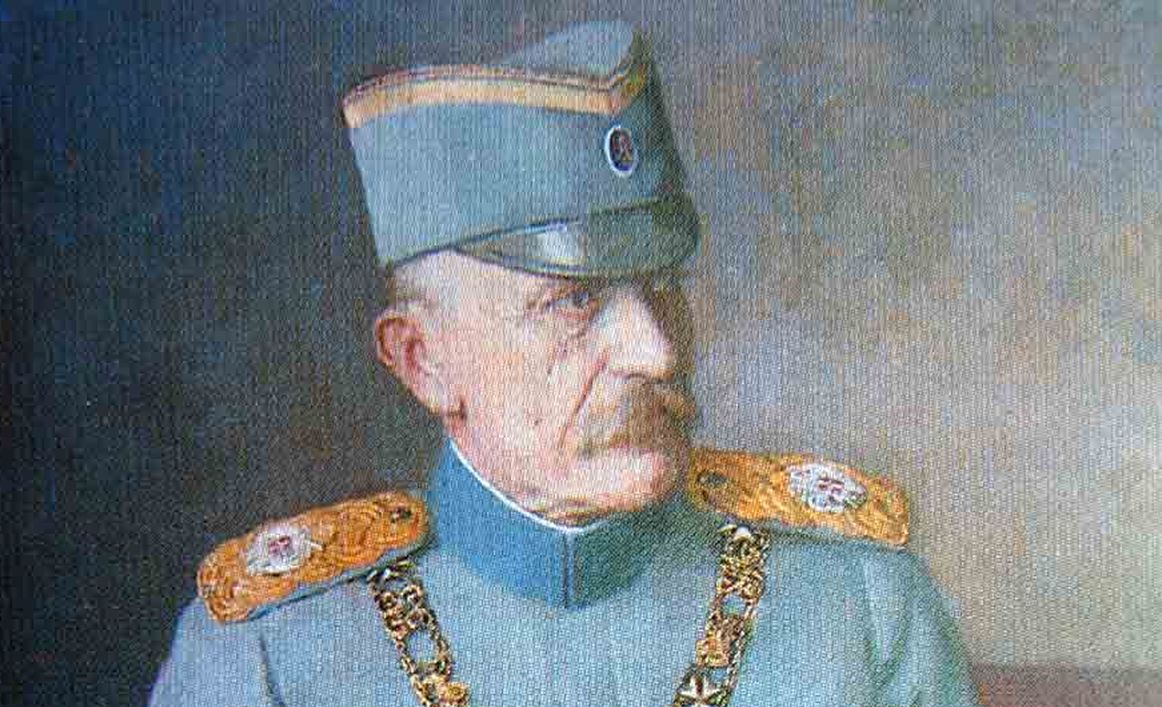
On July 20, 1855, Serbian Duke Živojin Mišić, holder of the highest Serbian and foreign war decorations, a man who entered history side by side with the greatest world military leaders, was born in the village of Struganik near Mionica.
Mišić is a military leader whose deeds are recorded in world history, a man who remained unyielding during 47 years in an officer’s uniform, never willing to bow before higher authorities for the sake of his career, even when rulers were concerned. What he thought, he spoke, as King Aleksandar Obrenović and King Aleksandar Karađorđević can attest.
He is a symbol of our victory in the Balkan Wars and the First World War, and even today he should represent a guiding light for the future of the Serbian people.
He is remembered, as Regent Aleksandar said: “When everyone lost their heads, only Duke Mišić knew how to stop the enemy.”
He participated in all six liberation wars that Serbia waged from 1876 – 1918!
His first officer duty was in Valjevo, in April 1876. In the Serbian-Turkish War, he commanded the Kolubara Battalion of the 2nd class of the Valjevo Brigade.
In the war of 1877 and 1878, Mišić was a company commander of the Valjevo combined battalion of the 7th regiment. After the wars, which ended with Serbia’s victory, he returned to the Academy to complete his education.
In the war with the Bulgarians in 1885, he entered as commander of the 1st company of the 1st battalion in the Valjevo 5th Infantry Regiment of the Drina Division, and was later appointed commander of that battalion.
After the Battle of Kumanovo, he was promoted to the rank of general on November 20, 1912.
He commanded the glorious First Serbian Army of the Army of the Kingdom of Serbia, particularly distinguished in the Battle of Kolubara in 1914, where the Austro-Hungarian army was utterly defeated. This magnificent Serbian victory became a subject of study in all military academies worldwide.
After this battle, he received the title of duke, and in gratitude for the liberation of Valjevo, he was declared an honorary citizen in 1915, where one of the central streets bears his name.
During the breakthrough of the Salonica Front, he commanded the Serbian army (as Chief of Staff of the Supreme Command, he also managed and prepared for the breakthrough of the Salonica Front). This marked the collapse of the Central Powers, and Mišić entered the annals of military history as an invincible military leader.

He is also remembered as a professor at the Military Academy; his works, such as Strategy, are studied at world military academies. He also edited the magazines “Srpska vojska” and “Ratnik.”
As aide-de-camp to King Aleksandar Obrenović in 1896, accompanying him to the first modern Olympic Games in Athens, he also visited Hilandar.
While commanding the Drina Division, headquartered in Valjevo, in 1902 and 1903, he also supported the activities of civic associations and was president of the re-established “Kolo Jahača Knez Mihailo” and the “Streljačka družina”.
In the summer of 1919, due to serious illness, he left the position of Chief of the General Staff of the Army of the Kingdom of Yugoslavia. Duke Živojin Mišić, a symbol of the Serbian people in the struggle for freedom, passed away on January 20, 1921, in a sanatorium in Vračar, without finishing writing his memoirs, which he began in 1920 in France.
His last words were:
“The general situation is good. The enemy is retreating on all lines.”
How we repaid our glorious Duke is reflected in the fact of the bandit demolition of the oldest barracks in Serbia on the centenary of the victory in the Great War, the barracks complex of the 17th Regiment of the Drina Division in Valjevo, which was named Vojvoda Živojin Mišić.
In this regard, due to the obviously invaluable historical value of the mentioned barracks, the local and state self-government has the obligation to revitalize all demolished facilities of the 17th Regiment barracks in Valjevo, and to establish a Memorial Center, a museum, where the glorious Serbian Duke Živojin Mišić would certainly take a central place.
And just as the Serbian army experienced Golgotha and then the Resurrection by defeating numerically superior enemies, so today should all that where Serbia and the Serbian people faltered in peace be Resurrected:
“Our ancestors will rise from their graves,
For the last battle! While steam rises
From spilled blood, we will go further
The shadow of the Great Emperor will lead us.
Until all our enemies fall in blood
And until we fall – last or first.”
Poet S.P.
MORE TOPICS:
SERBIAN DIASPORA GATHERS: Crown Prince Alexander’s Birthday Celebrated in New York!
Source: Mila Paramentić (Valjevo, 19. jul 2020.), Photo: Wikimedia Creative Commons